Archived records at The Smithsonian National Museum of the American Indian
https://americanindian.si.edu/sites/1/files/archivecenter/AC010_ncai.pdf
Biographical Note
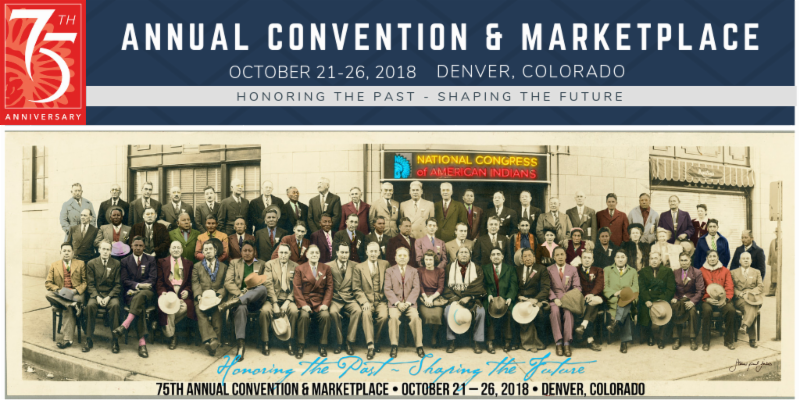
The National Congress of America Indians, which describes itself as the oldest and largest American Indian and Alaskan Native organization in the United States, was founded on November 16, 1944, in Denver, CO. NCAI was intended to serve as a link between individual tribal councils and the United States government, by defining and helping to crystallize Indian thought on the administration of Indian affairs. The Congress also aimed to educate the general public about Indians, preserve Indian cultural values, protect treaty rights with the United States, and promote Indian welfare.
At the first convention, delegates representing fifty tribes ratified the constitution and by-laws, drafted resolutions determining the direction of NCAI policy, and elected the organizations' first officers, with Oklahoma Supreme Court Justice Napoleon B. Johnson (Cherokee) as president. The officers, as well as eight elected council members, formed the Executive Council. The Council chose the Executive Director; Ruth Muskrat Bronson (Cherokee) was the organization's first director, from 1944-1948. "Persons of Indian blood" could join the organization either as individuals or as groups. In 1955, however, the constitution was revised to restrict group membership to recognized tribes, committees, or bands, and to make the Executive Council chosen by tribal representatives. These changes gave control of the organization to governing bodies of organized tribes, rather than individuals. A further amendment that year created a five-member Executive Committee, headed by the president, which had all the powers of the Executive Council between council meetings.
Conventions have been held annually in the fall since the formation of the NCAI in 1944. Since 1977, mid-year conferences have been held in May or June of each year, to allow more frequent and thorough discussion of issues. The resolutions passed at these conventions are the basis for all policy of the Executive Committee and Executive Director between meetings. The conventions are also used for informational sessions and meetings of standing and special committees of NCAI. One or two-day workshops may also be held on special topics or Congressional issues of particular concern.
NCAI created a tax-exempt arm in 1949 to accept charitable contributions and apply for grants, the NCAI Fund, which soon changed its name to ARROW, Inc. By 1957, however, ARROW had split off to become an independent organization, and NCAI started a new arm, again called the NCAI Fund. In the coming decades, the NCAI Fund would obtain grants from sources including the Bureau of Indian Affairs, Department of Veteran Affairs, Indian Health Service, Nuclear Regulatory Commission, Ford Foundation,
humanities councils and others, which they used for conferences, workshops, publications, and other projects.
In its early years, NCAI fought for the recognition of land claims of Alaska natives, the enfranchisement of Arizona and New Mexico Indians, the equitable settlement of tribal land claims, and the right of Indians to select their own attorneys. The NCAI lobbied vigorously for an Indian Claims Commission Bill, which became law in August 1946. NCAI's lobbying efforts on behalf of this act set the pattern for the organization's future role in legislative matters: keeping member tribes abreast of proposed legislation andascertaining their views, and maintaining a presence in Congress through lobbying and testimony. Beginning in 1954, the threat of termination pushed NCAI into a period of increased activity. Although some tribes were ready to terminate their relationship with the federal government, much of Indian Country felt threatened by the government's new stated policy. NCAI therefore organized an Emergency Conference of American Indians for February 1954 to protest this new termination policy. An agreement was forged at the conference between the NCAI and the Bureau of Indian Affairs to work together toward slowly liquidating the BIA. The termination period of the 1950s and 1960s, while challenging, saw NCAI increase in confidence and political acumen.
During the 1960s, a number of other activist Indian groups sprang up and began to dilute the singular influence which NCAI had commanded. Newer, more militant groups often considered themselves at odds with NCAI, which was increasingly perceived as conservative. As the number of Indian advocacy groups grew in the 1960s and 1970s, however, NCAI actively partnered with other organizations, particularly the National Tribal Chairmen's Association (NTCA) and Native American Rights Fund (NARF), on a variety of projects.
Piqua Sawnee Tribe
"Piqua Shawnee"