Showing posts with label Piqua Shawnee Alabama. Show all posts

Wednesday, September 26, 2018

Shawnee Indians - West Virginia

https://www.wvencyclopedia.org/articles/383
Williams, John Alexander "Shawnee." e-WV: The West Virginia Encyclopedia. 29 October 2010. Web. 26 September 2018.

The Shawnees were the southernmost of the Algonquian-speaking peoples of the eastern woodlands; hence their name, which derives from ‘‘southerner’’ in these languages. Originally centered in the mid-Ohio Valley, they descended, according to some archeologists, from the pre-historic Fort Ancient culture whose remains have been found in the Kanawha Valley, among other places. But they left this homeland during the 17th century, presumably in response to Iroquois attacks during the Beaver Wars, and were recorded by Europeans in such widely separated locations as Kentucky, Alabama, South Carolina, and Pennsylvania. A Shawnee companion of the French explorer, Robert Cavelier de la Salle, even traveled to Paris. The Shawnees entered frontier annals on a regular basis after Quaker missionaries found some of them living on Pequa Creek near present Lancaster, Pennsylvania, in 1692.

It is possible that the 17th century record represents the separate wanderings of the Shawnee’s principal divisions—Chalakaatha, Mequashake, Pekowi, Hathawikila, and Kishpoko—since the divisions traditionally lived in separate village clusters and were only loosely confederated. European transcriptions of these names in places such as Chillicothe and Piqua, Ohio, Sewickley, Pennsylvania, and Pickaway, West Virginia, testify to some of these wanderings. Thus it was the Pekowi who began the Shawnee return to the Ohio Valley when they moved from eastern to western Pennsylvania in 1728. By 1750, some 1,200 Shawnee were living in villages along the Ohio River, from which they launched attacks against the Virginia frontier during the French and Indian War and Pontiac’s Rebellion. Later they moved their villages to the Scioto River in southern Ohio, and after their defeat in Lord Dunmore’s War they moved again to the Miami River headwaters in southwest Ohio. They consistently claimed Virginia west of the Alleghenies to be their hunting lands, along with most of Kentucky. They also denied the right of the Iroquois to dispose of this territory, as the Iroquois did in land sales to colonial governments in 1744 and 1768.

Under the influence of a nativist religious revival first preached by the Delaware prophet Neolin, Shawnees took the lead in defending the Ohio country from the white advance across the Appalachians in Western Virginia and Kentucky and also sent emissaries to other tribes to preach the necessity of Indian unity. These efforts suffered a temporary setback with the Shawnee defeat in Dunmore’s War, but they continued during the American Revolution. During 1775–76, the Mequashake Shawnees led by Cornstalk adopted a neutralist position between the British and the rebel colonists, but members of other Shawnee bands formed war parties on their own or in concert with Mingos and militant Delawares. When Cornstalk was imprisoned and then murdered at Fort Randolph in 1777, the Mequashake joined the other bands in general warfare all along the frontier. White settlements along the Ohio, in the Kanawha Valley, and in Kentucky bore the brunt of these attacks, which continued through 1782, culminating in the famous second siege of Fort Henry at Wheeling in September of that year.

The Shawnees, along with other Indians resident in Ohio, were outraged when the British accepted Virginia’s claim to the territory between the Great Lakes and the Ohio and ceded this territory to the United States in the 1783 Treaty of Paris, following the Revolution. Disputing the validity of the British cession, Shawnee militants urged the other Ohio tribes and also the Cherokees to fight on. Assaults on the frontier and on white settlers traveling the Ohio River multiplied after 1786 and continued into the early 1790s. Though Euro-American beachheads were established in 1788 north of the Ohio at Marietta and Cincinnati, native resistance succeeded in defeating armies sent against their villages in 1790 and 1791. Only after a combined force of regular troops and militia commanded by Gen. Anthony Wayne defeated a Shawnee-led Indian force at the Battle of Fallen Timbers in northwest Ohio in 1794 did the militants agree to give up their Ohio lands.

The Treaty of Greenville in 1795 cleared the way for white settlement on both banks of the Ohio and ended the threat of raids in what is now West Virginia. Even then, however, the militant Shawnee spirit remained unconquered. In the early 19th century, a new revitalization movement spread under the leadership of the prophet Tenskwatawa and his warrior brother Tecumseh. This movement was centered in new Shawnee villages in what is now Indiana and did not directly affect West Virginia.


This Article was written by John Alexander Williams
Last Revised on October 29, 2010

Piqua Shawnee
Piqua Shawnee Tribe
"Piqua Shawnee"

Tuesday, September 25, 2018

Shawnee Indians - Texas

SHAWNEE INDIANS

TSHA - Texas State Historical Association
By Carol A. Lipscomb
 
SHAWNEE INDIANS. The Shawnees were one of many immigrant tribes from the United States who entered Texas in the late eighteenth and early nineteenth centuries. This eastern woodlands tribe originally inhabited the Ohio and Cumberland valleys in what is now Kentucky. Some Shawnee groups drifted farther south into the Piedmont area of Virginia, the Carolinas, and Georgia. The name Shawnee means "southerner" and identifies the tribe as one of the southernmost members of the Algonkian linguistic family.

The Shawnees moved about in search of game during winters. In the growing season they settled in rather large villages where they raised crops of corn, squash, and beans. The tribe carried on extensive trade in animal skins and salt; production of the latter was a major industry for the Shawnees, who extracted the mineral from the many salt springs in Kentucky. Because building material was abundant in the eastern woodlands, the tribe built permanent houses, called wigwams, and abandoned them when they moved. The wigwams were single-family dwellings made of poles and bark that could easily be constructed in a few days.

Shawnee clothing was made of dressed skins and consisted of a shirt for men and a longer overblouse for women. Both sexes wore leggings and moccasins. Their clothing was often decorated with dyed porcupine quills, bright-colored feathers, and paint.

The Shawnees came into contact with French missionaries, explorers, and fur traders in the mid-seventeenth century. During that same period, southern Shawnees began trading with the Spanish in Florida. By the early eighteenth century, the British were moving into Shawnee territory, and the tribe began a westward migration. During the American Revolution, the Shawnees fought fiercely to retain their hunting grounds, but after 1783 the rapid influx of whites into the trans-Appalachian region scattered them. By the early nineteenth century the tribe was spread from Ohio to Alabama.
Around 1790 a major Shawnee band migrated west of the Mississippi River to the area of Cape Girardeau, Missouri. By 1815 an estimated 1,200 Shawnees were settled there. They were joined by a large band of Delawares, and the two tribes became closely associated. In 1822 a band of the Missouri Shawnees, numbering about 270 families, migrated south into Texas, which was then a part of Mexico. They settled on the south bank of the Red River near Pecan Point. The Texas Shawnees petitioned the Mexican government for land, and in 1824 the governor of Coahuila and Texas, Rafael Gonzales, authorized the legislature to grant the tribe one square mile of land per family along the south bank of the Red River. The Shawnees became allies of the Cherokees and other immigrant tribes living in Texas, and all enjoyed a generally peaceful relationship with Mexican officials and a growing number of Anglo-American settlers. The Shawnees even aided the Mexicans in their war with the Comanches. In 1832 a party of Shawnees, led by chief John Linney, defeated a band of Penateka Comanches at Bandera Pass, west of San Antonio. When Texas became a republic, officials of the new government, under the leadership of President Sam Houston, worked to maintain good relations with the immigrant Indians, including the Shawnees. The tribe and their allies signed a treaty with Texas officials in February 1836. The agreement, however, which granted the Indians a designated tract of land, was never ratified by the Texas Senate. Houston's successor, Mirabeau B. Lamar, saw the immigrant Indians as unauthorized intruders and wanted them removed from Texas. In the summer of 1839, amid rumors of collusion between them and the Mexicans, he provoked the Cherokee War, which ultimately affected all of the immigrant Texas tribes. Lamar sent a message to Linney and the Shawnees asking them to remain neutral in the conflict, and most of the tribe complied with the request.

After the Cherokees were defeated, Shawnee leaders, including Chief Elanie, negotiated a treaty with Texas officials at Nacogdoches. According to its terms, the tribe promised to leave Texas peaceably if they received payment for improvements on their land, deserted crops, and all property left behind. The government agreed to provide transportation and supplies for the relocation. There is some evidence that Texas officials honored those treaty commitments, and by early 1840 most of the Texas Shawnees had moved north of the Red River into Indian Territory. The tribe settled on the Canadian River near the mouth of the Little River and became the nucleus of the present Absentee band of Shawnees. In 1846 they were joined by a large segment of Shawnees who had been forced to leave Kansas. The few scattered Shawnees who remained in Texas after the Cherokee War were consolidated in 1857 with remnants of other tribes on the Brazos Indian Reservation, near the site of present Graham. But the Texas reservation system was shortlived, and in 1859 the reserve Indians, including the Shawnees, were moved to Indian Territory. Those Shawnees joined the Absentee band on the Canadian River. Today many Shawnees still reside in eastern Oklahoma. The Loyal or Cherokee band is centered around White Oak in the northeastern corner of the state. The Absentee band is located in central Oklahoma between Tecumseh and Norman, and the Eastern band lives near Miami. Unlike most tribes now resident in Oklahoma, the Shawnees have managed to preserve to the present day their complete cycle of ceremonial dances and other religious observances.
 
Piqua Shawnee
"Piqua Shawnee"
Piqua Shawnee Tribe
 

Thursday, September 20, 2018

75th Annual NCAI Convention & Marketplace

NCAI Conference 2018
Date: Oct 21, 2018 - Oct 26, 2018
Where: Denver, CO

View Agenda >>

About the Event:
We are excited to celebrate our 75th Anniversary in Denver, Colorado where our first convening was held in 1944! We hope you can join us. We look forward to welcoming you!

Registration Now Open! Register now online, or click here to download and print the registration form and submit with payment.

75th Anniversary Book "Honoring The Past"
Fill out our NCAI Alumni Contact Form to help us connect with you!
Call for photos, stories, and quotes for the 75th Anniversary!

We have a number of exciting activities planned including our 75th Anniversary book Honoring the Past!  Submit your photos, stories, and quotes to NCAI to be included in our materials for the year. Get started by filling out the form here.
Questions? Email ncai@ncai.org for more information.


Marketplace
The Marketplace offers a wonderful opportunity to shop with top Indian Arts & Crafts vendors, talk with representatives from Federal programs and Tribal Enterprises, and receive career, education, and health information from the wide variety of vendors. The Marketplace is open to the general public.

http://www.ncai.org/events/2018/10/21/75th-annual-convention-marketplace

http://www.ncai.org/

Piqua Shawnee
"Piqua Shawnee"
Piqua Shawnee Tribe

Wednesday, September 19, 2018

Alabama Indian Affairs Commission

Rachel Naftel, Auburn University
 
The Alabama Indian Affairs Commission (AIAC), headquartered in Montgomery, Montgomery County, was established by the Alabama State Legislature in 1984 to serve as a liaison between Native Americans in the state and local, state, and federal agencies. Primarily, the AIAC aims to connect the Native American community in the state with local, state, and federal resources, including funding, for their social and economic development programs. In addition, it is tasked with developing criteria for recognition for Indian tribes, bands, or groups, and advocating for and promoting Indian rights.
The state government recognizes nine Native American tribes in Alabama: the Poarch Band of Creek Indians, the Echota Cherokee Tribe of Alabama, the Cherokee Tribe of Northeast Alabama, the Ma-Chis Lower Creek Indian Tribe of Alabama, the Star Clan of Muscogee Creeks, the Cher-O-Creek Intra Tribal Indians, the MOWA Band of Choctaw Indians, the Piqua Shawnee Tribe, and the United Cherokee Ani-Yun-Wiya Nation. Of this group, only the Poarch Band of Creeks is officially recognized by the federal government.
 
Governance
The AIAC is comprised of 13 members consisting of one representative from each of the nine Indian tribes served by the AIAC as well as a member of the Alabama Senate appointed by the lieutenant governor, a member of the Alabama House of Representatives appointed by the speaker, an at-large member appointed by the governor, and a member appointed by the commission who is a member of a federally recognized tribe not a member of any tribe represented on the commission. Commissioners serve four-year terms and are eligible for reappointment. The commission selects officers every two years and these include a chair, vice chair, parliamentarian, and executive director. The chair presides over all meetings and exercises general supervision of the commission. Meetings take place at the headquarters in Montgomery and are open to the public and posted on the AIAC website. AIAC operations are funded by the state government. The executive director, chair, and vice chair have fiscal responsibility for the funds. Members of the commission receive no compensation for their services, other than reimbursements for travel and expenses incurred while performing their duties as commissioner.
 
Functions
The commission's primary purpose is to promote local, state, and federal government resources for Indian citizens in the state and actively seek government grants or funds available to eligible Native Americans. It has the authority to recognize Indian tribes as well as the authority to prescribe the rules for the recognition of Indian tribes, bands, groups, and associations, which is a complicated process. Its work also involves administrative and financial activities, particularly managing the agency and its finances, human resources, and facilities and providing information about legislation that affects Indians in Alabama.
 
One of the AIAC's continuing accomplishments is its scholarship program. The AIAC offers annual scholarships to Native American residents of Alabama pursuing a college degree within the state. To qualify, students must be enrolled in the federal/state recognized tribe for a minimum of three years and meet his or her tribe's internal qualifications. These scholarships give special considerations to students pursuing nursing, medical, veterinary, and pharmacy degrees. In addition to the scholarships, the AIAC sponsors the Ms. Indian Alabama Pageant, with the winner receiving a $5,000 scholarship.
 
Since its inception, the AIAC has sponsored economic development workshops and created the Alabama Indian Small Business Association; the commission maintains a list of Indian-operated businesses in the state. The Alabama Indian Community Loan Fund was created to help find organizations to invest in Indian businesses. (The casinos and hotels of the Poarch Band are perhaps the most visible projects undertaken in the state.) In addition, the commission has worked with historical organizations, including the Alabama Department of Archives and History for an ethnic studies program. The AIAC has raised warnings about the destruction of historic sites and collaborated with the Alabama Historical Commission on a statewide historic preservation plan.
 
Piqua Shawnee Tribe
"Piqua Shawnee"

Tuesday, September 18, 2018

Shawnee: Arkansas

Shawnee

 
Among the immigrant Native Americans who lived in territorial Arkansas were several Shawnee communities. They came from Indiana and Missouri at the invitation of the Cherokee after the Treaty of 1817 created the Cherokee Nation on land in the Ozarks between the White and Arkansas rivers. The Shawnee, who built settlements on Crooked Creek and White River, departed after more than a decade of life in Arkansas.

The Shawnee were a large Algonkian-speaking tribe, widely scattered across the eastern woodlands. By the middle of the eighteenth century, the majority of them were living in the area both north and south of the Ohio River. Euro-American settlers from the east brought on years of violence. In a peace treaty in 1774, the Shawnee were forced to cede Kentucky, and the continuing hostilities led some Shawnee in 1779 to move west across the Mississippi River to a large grant south of Ste. Genevieve that had been given by the Spanish government. From that new location, they became familiar with the Ozarks and the western prairies.

After the death of Tecumseh and the collapse of his fight against the United States in 1813, one faction of the Shawnee sought ways to coexist with the Americans, and some saw the migration of the whole tribe to the west as a good strategy. When the Western Cherokee, living in the Ozarks after 1817, became embroiled in skirmishes with the Osage, they invited eastern tribes, including the Shawnee, to move to their land west of the White River. One group, led by Quatawapea, also known as Captain or Colonel Lewis, settled on the White River, with their major town at Shawneetown, a location that later became Yellville (Marion County).

As guests of the Cherokee, the Shawnee were part of a larger group of immigrants into the White River Valley, a group that included the Delaware, Piankashaw, Miami, and other Indian groups. If they ever participated with the Cherokee in military campaigns against the Osage, the documents do not record it. No recorded instances exist of hostilities between the Shawnee and the American settlers, although the latter petitioned Washington for a military garrison for protection. In later years, several of the early settlers wrote their memoirs of that time, and they included several accounts of unpleasant encounters between the two groups, as well as visits to the Shawnee Green Corn ceremonies, hunting together, and a Shawnee-American marriage.

In 1828, the Western Cherokee entered a new treaty arrangement with the United States in which their Ozark holdings were traded for land in Indian Territory, present-day Oklahoma. They soon moved west and established Tahlequah, where the Cherokee tribal government remains today. Their Indian guests, left as squatters on government land, also moved away from Arkansas during the next few years. By 1833, the Shawnee had gone to Texas and Indian Territory, and the Ozark land was again open to American settlers. Modern Shawnee have few records of the Arkansas period in their complex history.

For additional information:Edmunds, R. David. The Shawnee Prophet. Lincoln: University of Nebraska Press, 1983.

Foreman, Grant. Indians and Pioneers: The Story of the American Southwest before 1830. Norman: University of Oklahoma Press, 1930.

Ingenthron, Elmo. Indians of the Ozark Plateau. Point Lookout, MO: School of the Ozarks Press, 1970.

Jeffery, A. C. Historical and Biographical Sketches of the Early Settlement of the Valley of White River Together with a History of Izard County. Edited by Dale Hanks. Richmond, VA: The Jeffery Historical Society, 1973.

Johnston, James J. “Searcy County Indians in Tradition and History.” Mid-America Folklore 12 (Spring 1984): 24–31.

Lankford, George E. “Shawnee Convergence: Immigrant Indians in the Ozarks.” Arkansas Historical Quarterly 58 (Winter 1999): 390–413.

Sugden, John. Tecumseh: A Life. New York: Henry Holt and Co., 1997.

Turnbo, Silas C. Turnbo’s Tales of the Ozarks: Schools, Indians, Hard Times and More Stories. Edited by Desmond Walls Allen. Conway, AR: Arkansas Research, 1987.

George E. Lankford
Batesville, Arkansas
Last Updated 6/21/2010
"Piqua Shawnee"
Piqua Shawnee
Piqua Shawnee Tribe

Monday, September 17, 2018

History of The Shawnee: Part 3

PART 3:
As published in the Official Newsletter of the Piqua Shawnee (Fall 2018)
By Barbara Lehmann, Piqua Shawnee Tribal Historic Preservation Officer
 
Barbara’s History Corner:
 
Bezallion informed the governor that the Shaonois of Carolina he was told had killed several Christians; whereupon the government of that province raised the said flat headed Indians, and joined some Christians to them, besieged and have taken, as it is thought, the said Shaonois town.” Those who escaped probably fled to the north and joined their kindred in Pennsylvania. In 1708 Gov. Johnson, of South Carolina, reported the “Savannahs” on Savannah River as occupying 3 villages and numbering about 150 men 6. In 1715 the “Savanos” still in Carolina were reported to live 150 miles northwest of Charleston, and still to occupy 3 villages, but with only 233 inhabitants in all.

A part of those who had come from the south in 1694 had joined the Mahican and become a part of that tribe. Those who had settled on the Delaware, after remaining there some years, removed to the Wyoming valley on the Susquehanna and established themselves in a village on the west bank near the present Wyoming, Pennsylvania. It is probable that they were joined here by that part of the tribe which had settled at Pequea, which was abandoned about 1730. When the Delawares and Munsee were forced to leave the Delaware River in 1742 they also moved over to the Wyoming valley, then in possession of the Shawnee, and built a village on the east bank of the river opposite that occupied by the latter tribe. In 1740 the Quakers began work among the Shawnee at Wyoming and were followed two years later by the Moravian Zinzendorf. As a result of this missionary labor the Shawnee on the Susquehanna remained neutral for some time during the French and Indian war, which began in 1754, while their brethren on the Ohio were active allies of the French. About the year 1755 or 1756, in consequence of a quarrel with the Delawares, said to have been caused by a childish dispute over a grasshopper, the Shawnee abandoned the Susquehanna and joined the rest of their tribe on the upper waters of the Ohio, where they soon became allies of the French. Some of the eastern Shawnee had already joined those on the Ohio, probably in small parties and at different times, for in the report of the Albany congress of 1754 it is found that some of that tribe had removed from Pennsylvania to the Ohio about 30 years previously, and in 1735 a Shawnee band known as Shaweygria (Hathawekela), consisting of about 40 families, described as living with the other Shawnee on Allegheny river, refused to return to the Susquehanna at the solicitation of the Delawares and Iroquois. The only clue in regard to the number of these eastern Shawnee is Drake’s statement that in 1732 there were 700 Indian warriors in Pennsylvania, of whom half were Shawnee from the south. This would give them a total population of about 1,200, which is probably too high, unless those on the Ohio are included in the estimate.

Having shown the identity of the Savannah with the Shawnee, and followed their wanderings from Savannah river to the Ohio during a period of about 80 years, it remains to trace the history of the other, and apparently more numerous, division upon the Cumberland, who preceded the Carolina band in the region of the upper Ohio river, and seem never to have crossed the Alleghanies to the eastward.
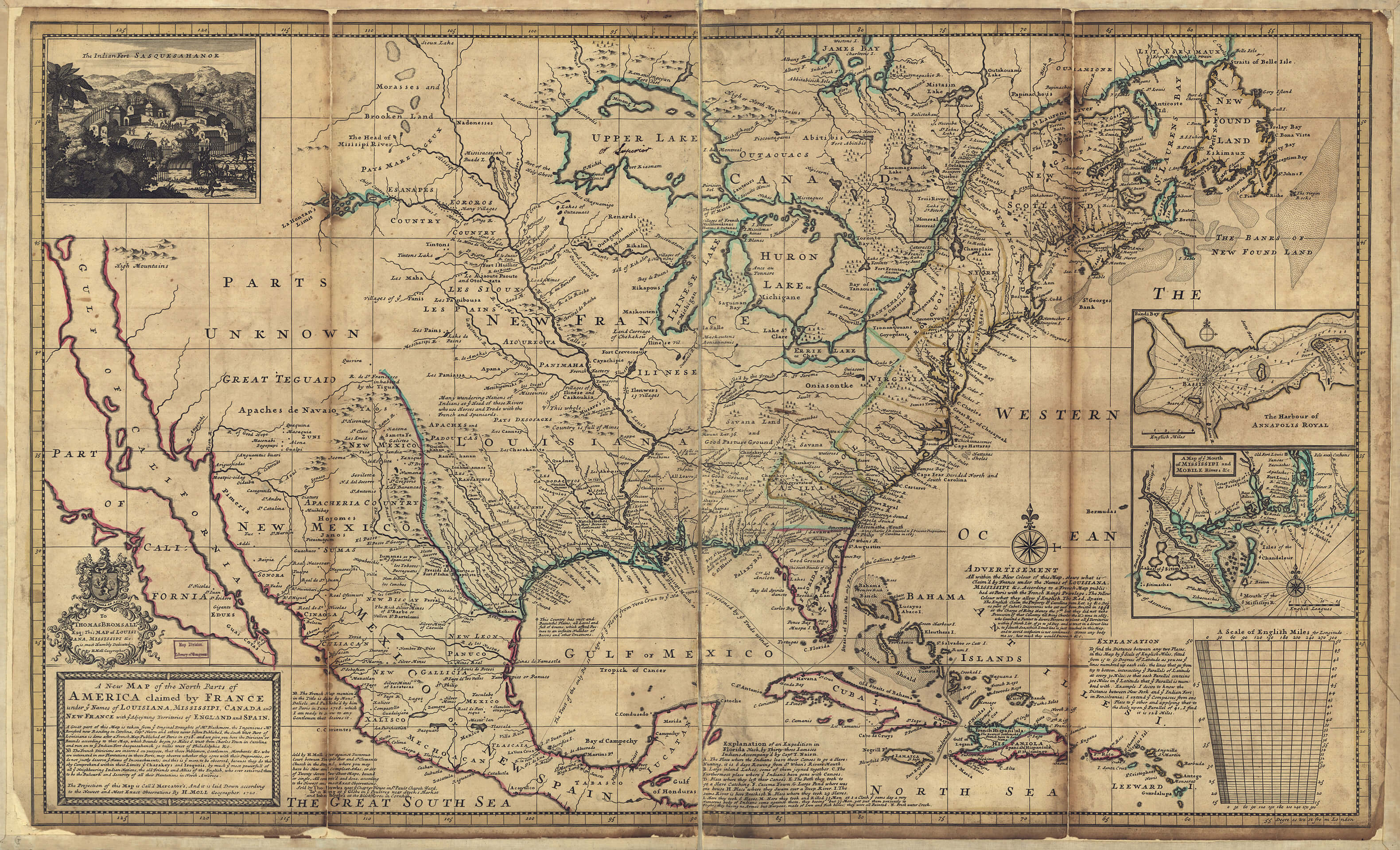
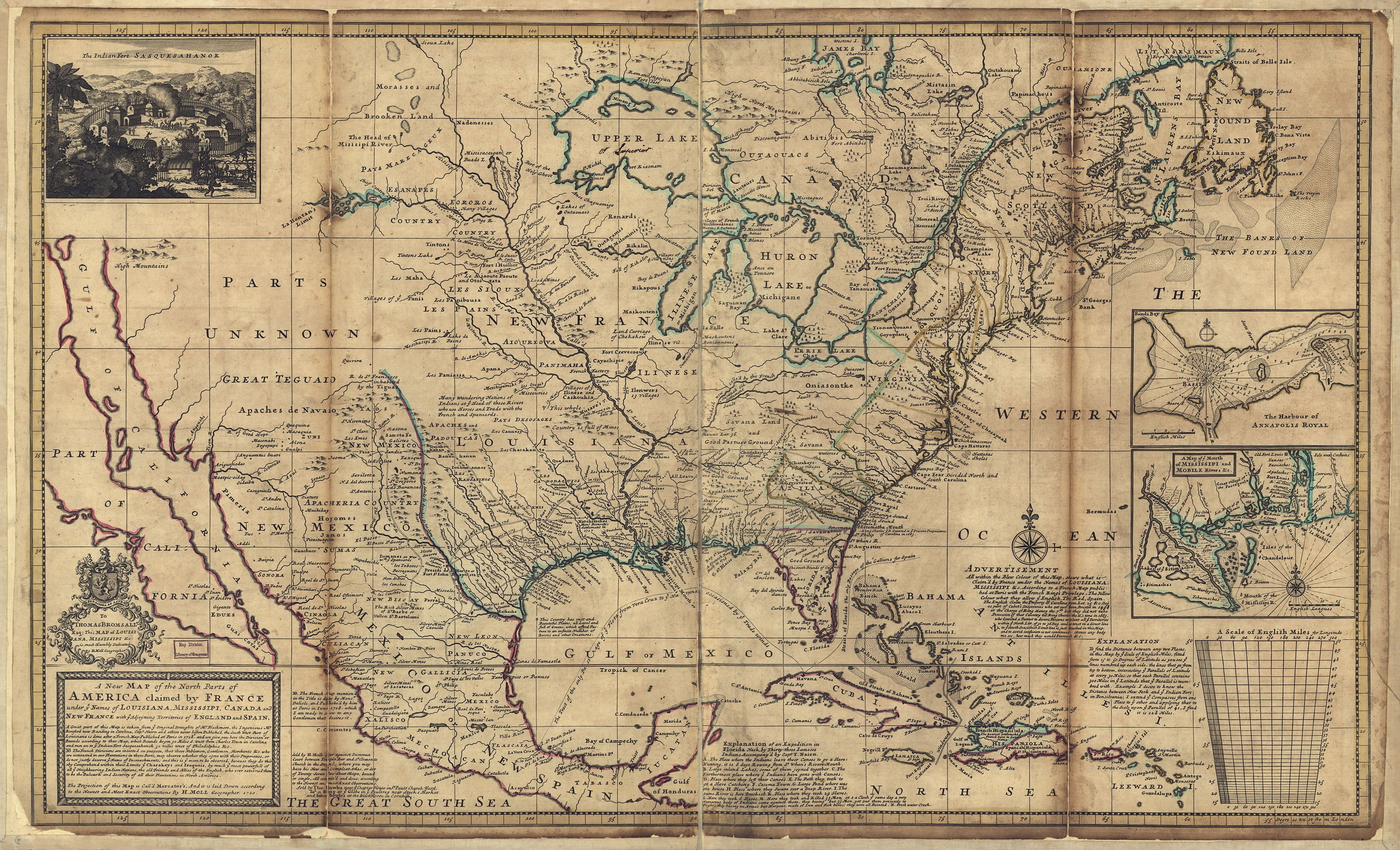
Moll-Map-of-1720-small
Moll’s map of 1720 has “Savannah Old Settlement” at the mouth of the Cumberland, showing that the term Savannah was sometimes applied to the Western as well as to the eastern band
These western Shawnee may possibly be the people mentioned in the Jesuit Relation of 1648, under the name of “Ouchaouanag,” in connection with the Mascoutens, who lived in northern Illinois. In the Relation of 1670 we find the “Chaouanon” mentioned as having visited the Illinois the preceding year, and they are described as living some distance to the south east of the latter. From this period until their removal to the north they are frequently mentioned by the French writers, sometimes under some form of the collective Iroquois name Toagenha, but generally under their Algonquian name Chaouanon. La Harpe, about 1715, called them Tongarois, another form of Toagenha. All these writers concur in the statement that they lived upon a large southern branch of the Ohio, at no great distance east of the Mississippi. This was the Cumberland River of Tennessee and Kentucky, which is called the River of the Shawnee on all the old maps down to about the year 1770.
 
When the French traders first came into the region the Shawnee had their principal village on that river near the present Nashville, Tennessee. They seem also to have ranged northeastward to Kentucky River and southward to the Tennessee. It will thus be seen that they were not isolated from the great body of the Algonquian tribes, as has frequently been represented to have been the case, but simply occupied an interior position, adjoining the kindred Illinois and Miami, with whom they kept up constant communication. As previously mentioned, the early maps plainly distinguish these Shawnee on the Cumberland from the other division of the tribe on Savannah River.

These western Shawnee are mentioned about the year 1672 as being harassed by the Iroquois, and also as allies and neighbors of the Andaste, or Conestoga, who were themselves at war with the Iroquois. As the Andaste were then incorrectly supposed to live on the upper waters of the Ohio River, the Shawnee would naturally be considered their neighbors. The two tribes were probably in alliance against the Iroquois, as we find that when the first body of Shawnee removed from South Carolina to Pennsylvania, about 1678, they settled adjoining the Conestoga, and when another part of the same tribe desired to remove to the Delaware in 1694 permission was granted on condition that they make peace with the Iroquois. Again, in 1684, the Iroquois justified their attacks on the Miami by asserting that the latter had invited the Satanas (Shawnee) into their country to make war upon the Iroquois. This is the first historic mention of the Shawnee evidently the western division in the country north of the Ohio River. As the Cumberland region was out of the usual course of exploration and settlement, but few notices of the western Shawnee are found until 1714, when the French trader Charleville established himself among them near the present Nashville. They were then gradually leaving the country in small bodies in consequence of a war with the Cherokee, their former allies, who were assisted by the Chickasaw. From the statement of Iberville in 1702 8 it seems that this was due to the latter’s efforts to bring them more closely under French influence. It is impossible now to learn the cause of the war between the Shawnee and the Cherokee. It probably did not begin until after 1707, the year of the final expulsion of the Shawnee from South Carolina by the Catawba, as there is no evidence to show that the Cherokee took part in that struggle.

From Shawnee tradition the quarrel with the Chickasaw would seem to be of older date. After the reunion of the Shawnee in the north they secured the alliance of the Delawares, and the two tribes turned against the Cherokee until the latter were compelled to ask peace, when the old friendship was renewed. Soon after the coming of Charleville, in 1714, the Shawnee finally abandoned the Cumberland valley, being pursued to the last moment by the Chickasaw. In a council held at Philadelphia in 1715 with the Shawnee and Delawares, the former, “who live at a great distance,” asked the friendship of the Pennsylvania government. These are evidently the same who about this time were driven from their home on Cumberland river.

To Be Continued Winter 2018
 
Piqua Shawnee Tribe
"Piqua Shawnee"


Friday, September 14, 2018

History Of The Shawnee: Part 2

PART 2:

As published in the Official Newsletter of the Piqua Shawnee (Fall 2018)

By Barbara Lehmann, Piqua Shawnee Tribal Historic Preservation Officer


Barbara’s History Corner:
 
On De l’Isle’s map, also, we find the Savannah River called “R.des Chouanons,” with the “Chaouanons” located upon bothbanks in its middle course. As to Gallatin’s statement that the name of the Savannahs is dropped after Lawson’s mention in 1701, we learn from numerous references, from old records, in Logan’s Upper South Carolina, published after Gallatin’s time, that all through the period of the French and Indian war, 50 years after Lawson wrote, the “Savannahs” were constantly making inroads on the Carolina frontier, even to the vicinity of Charleston. They are described as “northern savages” and friends of the Cherokee, and are undoubtedly the Shawnee. In
1749 Adair, while crossing the middle of Georgia, fell in with a strong party of “the French Shawano,” who were on their way, under Cherokee guidance, to attack the English traders near Augusta. After committing some depredations they escaped to the Cherokee. In another place he speaks of a party of “Shawano Indians,” who, at the instigation of the French, had attacked a frontier settlement of Carolina, but had been taken and imprisoned. Through a reference by Logan it is found that these prisoners are called Savannahs in the records of that period. In 1791 Swan mentions the “Savannas” town among the Creeks, occupied by “Shawanese refugees.” Having shown that the Savannah and the Shawnee are the same tribe, it remains to be seen why and when they removed from South Carolina to the north. The removal was probably owing to dissatisfaction with the English setters, who seem to have favored the Catawba at the expense of the Shawnee. Adair, speaking of the latter tribe, says they had formerly lived on the Savannah River, “till by our foolish measures they were forced to withdraw northward in defense of their, freedom.” In another place he says, “by our own misconduct we twice lost the Shawano Indians, who have since proved very hurtful to our colonies in general.” The first loss referred to is probably the withdrawal of
the Shawnee to the north, and the second is evidently their alliance with the French in consequence of the encroachments of the English in Pennsylvania.
 
Their removal from South Carolina was gradual, beginning about 1677 and continuing at intervals through a period of more than 30 years. The ancient Shawnee villages formerly on the sites of Winchester, Virginia, and Oldtown, near Cumberland, Maryland, were built and occupied probably during this migration. It was due mainly to their losses at the hands of the Catawba, the allies of the English, that they were forced to abandon their country on the Savannah; but after the reunion of the tribe in the north they pursued their old enemies with unrelenting vengeance until the Catawba were almost exterminated. The hatred cherished by the Shawnee toward the English is shown
by their boast in the Revolution that they had killed more of that nation than had any other tribe.
 
The first Shawnee seem to have removed from South Carolina in 1677 or 1678, when, according to Drake, about 70 families established themselves on the Susquehanna adjoining the Conestoga in Lancaster County, Pennsylvania, at the mouth of Pequea creek. Their village was called Pequea, a form of Piqua. The Assiwikales (Hathawekela) were a part of the later migration. This, together with the absence of the Shawnee names Chillicothe and Mequachake east of the Alleghanies, would seem to show that the Carolina portion of the tribe belonged to the first named divisions. The chief of Pequea was Wapatha, or Opessah, who made a treaty with Penn at Philadelphia in 1701, and more than 50 years afterward the Shawnee, then in Ohio, still preserved a copy of this treaty. There is no proof that they had a part in Penn’s first treaty in 1682.
 
In 1694, by invitation of the Delawares and their allies, another large party came from the south probably from Carolina and settled with the Munsee on the Delaware, the main body fixing themselves at the mouth of Lehigh river, near the present Easton, Pennsylvania, while some went as far down as the Schuylkill. This party is said to have numbered about 700, and they were several months on the journey. Permission to settle on the Delaware was granted by the Colonial government on condition of their making peace with the Iroquois, who then received them as “brothers,” while the Delawares acknowledged them as their “second sons,” i. e. grandsons. The Shawnee today refer to the Delawares as their grandfathers. From this it is evident that the Shawnee were never conquered by the Iroquois, and, in fact, we find the western band a few years previously assisting the Miami against the latter. As the Iroquois, however, had conquered the lands of the Conestoga and Delawares, on which the Shawnee settled, the former still claimed the prior right of domain. Another large part of the Shawnee probably left South Carolina about 1707, as appears from a statement made by Evans in that year 5, which shows that they were then hard pressed in the south. He says: “During our abode at Pequehan [Pequea] several of the Shaonois Indians from ye southward came to settle here, and were admitted so to do by Opessah, with the governor’s consent, at the same time an Indian, from a Shaonois town near Carolina came in and gave an account that four hundred and fifty of the flat headed Indians [Catawba] had besieged them, and that in all probability the same was taken.
 
To Be Continued
 
Piqua Shawnee Tribe
"Piqua Shawnee"


Wednesday, September 12, 2018

Smithsonian: Museum of The American Indian

Nation to Nation: Treaties Between the United States and American Indian Nations

Exhibit: September 21, 2014–2021
Washington, DC

Muscogee (Creek) bandolier bag, ca. 1814. Alabama. Wool fabric and tassels, silk fabric, dye, glass beads, cotton thread. Photo by Ernest Amoroso, NMAI. (24/4150)

From a young age, most Americans learn about the Founding Fathers, but are told very little about equally important and influential Native diplomats and leaders of Indian Nations. Treaties lie at the heart of the relationship between Indian Nations and the United States, and Nation to Nation: Treaties Between the United States and American Indian Nations is the story of that relationship, including the history and legacy of U.S.–American Indian diplomacy from the colonial period through the present.
Generous support for the exhibition is provided by:
Shakopee Mdewakanton Sioux Community - Bank of America - San Manuel Band of Mission Indians - Interface Media Group
http://www.nmai.si.edu/explore/exhibitions/item/?id=934
Piqua Shawnee
Piqua Shawnee Tribe

Thursday, August 23, 2018

The Piqua Shawnee Tribe


Visit the State of Alabama Indian Affairs Commission website for more information

http://aiac.state.al.us/tribes_piquaShawnee.aspx

Early History
The state of Alabama has long been the home of many Shawnee people. In fact, some historians state that perhaps the Shawnee people have inhabited Alabama for a longer period of time than any other geographic region. Some archaeologists set the date of 1685 as the first evidence of Shawnee settlement in Alabama. However, oral tradition states that we have been here much longer than that. Ancient burial sites that use burial methods common to the Shawnee have been located in several sections of the state. Early accounts can be confusing since what is now called Alabama was once a part of Georgia territory. Several early maps show Shawnee settlements in what is now called Alabama.

Early French and English maps show several Shawnee towns in what would be considered Upper Creek territory in Alabama. Some of the most notable were near modern Alabama towns. One village was near present day Talladega and was known in English as Shawnee Town. Another town was near Sylacauga. In 1750 the French took a census mentioning the Shawnee at Sylacauga as well as enumerating another Shawnee town called Cayomulgi, (currently spelled Kyamulga town) that was located nearby. Kiamulgatown was also listed in an 1832 census. A 1761 English census names Tallapoosa Town. This town was also named in a 1792 census by Marbury. There are French military records that mention a Shawnee presence at Wetumpka near Fort Toulouse. In most cases the traders called Alabama Indians “Creeks” because they lived on the numerous creeks and waterways in the area. Many of these “Creeks” were not of the same tribe or nation. Rather they went by a large number of names. Each group maintained their own unique heritage while living side by side with their neighbors.

Piqua Shawnee

Piqua Shawnee Tribe

Monday, December 18, 2017

Tecumseh, Quote

Tecumseh -

Shawnee Quote

So live your life that the fear of death can never enter your heart. 
Trouble no one about their religion; respect others in their view, and 
demand that they respect yours. Love your life, perfect your life, beautify 
all things in your life. Seek to make your life long and its purpose in the service
of your people. 

Prepare a noble death song for the day when you go over the great divide. 
Always give a word or a sign of salute when meeting or passing a friend, even 
a stranger, when in a lonely place. Show respect to all people and grovel to none. 
When you arise in the morning give thanks for the food and for the joy of living. 

If you see no reason for giving thanks, the fault lies only in yourself. Abuse 
no one and no thing, for abuse turns the wise ones to fools and robs the 
spirit of its vision. 

When it comes your time to die, be not like those whose 
hearts are filled with the fear of death, so that when their time comes they 
weep and pray for a little more time to live their lives over again in a different way. 

Sing your death song and die like a hero going home.


Piqua Shawnee

Friday, December 15, 2017

Organizer of Indian Condfederation

Organizer of Indian confederation - Tecumseh

 
With inexhaustible energy, Tecumseh began to form an Indian confederation to resist white pressure. He made long journeys in a vast territory, from the Ozarks to New York and from Iowa to Florida, gaining recruits (particularly among the tribes of the Creek Confederacy, to which his mother’s tribe belonged). The tide of settlers had pushed game from the Indians’ hunting grounds, and, as a result, the Indian economy had broken down.
In 1811, while Tecumseh was in the South, William Henry Harrison, governor of the Indiana Territory, marched up the Wabash River and camped near the brothers’ settlement. The Prophet unwisely attacked Harrison’s camp and was so decisively defeated in the ensuing Battle of Tippecanoe that his followers dispersed, and he, having lost his prestige, fled to Canada and ceased to be a factor in Tecumseh’s plans.
Seeing the approach of war (the War of 1812) between the Americans and British, Tecumseh assembled his followers and joined the British forces at Fort Malden on the Canadian side of the Detroit River. There he brought together perhaps the most formidable force ever commanded by a North American Indian, an accomplishment that was a decisive factor in the capture of Detroit and of 2,500 U.S. soldiers (1812).
Fired with the promise of triumph after the fall of Detroit, Tecumseh departed on another long journey to arouse the tribes, which resulted in the uprising of the Alabama Creeks in response to his oratory, though the Chickasaws, Choctaws, and Cherokees rebuffed him. He returned north and joined the British general Henry A. Procter in his invasion of Ohio. Together they besieged Fort Meigs, held by William Henry Harrison, on the Maumee River above Toledo, where by a stratagem Tecumseh intercepted and destroyed a brigade of Kentuckians under Colonel William Dudley that had been coming to Harrison’s relief. He and Procter failed to capture the fort, however, and were put on the defensive by Oliver Hazard Perry’s decisive victory over the British fleet on Lake Erie (September 10, 1813). Harrison thereupon invaded Canada. Tecumseh with his Indians reluctantly accompanied the retiring British, whom Harrison pursued to the Thames River, in present-day southern Ontario. There, on October 5, 1813, the British and Indians were routed, and Harrison won control of the Northwest. Tecumseh, directing most of the fighting, was killed. His body was carried from the field and buried secretly in a grave that has never been discovered. Nor has it ever been determined who killed Tecumseh. Tecumseh’s death marked the end of Indian resistance in the Ohio River valley and in most of the lower Midwest and South, and soon thereafter the depleted tribes were transported beyond the Mississippi River.
Glenn Tucker
 
www.Britannica.com
https://www.britannica.com/biography/Tecumseh-Shawnee-chief#ref252112

Piqua Shawnee
www.Piquashawnee.com

Monday, November 27, 2017

Tecumseh (U.S. National Park Service)


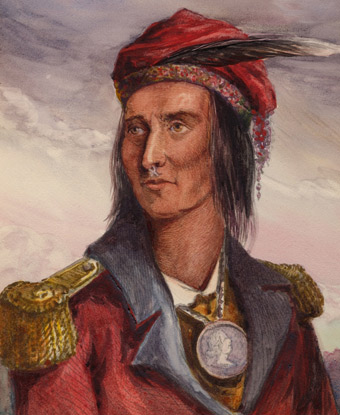
Portrait of Shawnee chief Tecumseh
Portrait of Shawnee chief Tecumseh based on sketch by Benson John Lossing
Attributed to Owen Staples

Quick Facts

Significance:Shawnee leader
Place of Birth:Scioto River, Ohio
Date of Birth:March 9, 1768
Place of Death:Chatham-Kent, Canada
Date of Death:October 5, 1813
Tecumseh began life in the Shawnee village of Piqua, Ohio on March 9, 1768 as a great meteor flashed and burned its way across the heavens. This event accounts for his name: The Shooting Star, or Celestial Panther Lying in Wait. Tecumseh grew to be a famous warrior and dynamic orator. These skills, paired with his belief that the white man would never rest until all American Indians were dispossessed, made him a powerful and influential force. 

Tecumseh conceived of an alliance of all remaining native people, from Canada to the Gulf of Mexico, from the prairies of the Midwest to the swamplands of Florida. All Indian people would set aside their ancestral rivalries and unite into a single movement to defend their culture, their homelands, and their very lives. 

Providing spiritual impetus for Tecumseh's movement was the teaching of his younger brother, known as Tenskwatawa, The Open Door, or The Prophet. In 1808, the Shawnee brothers established a new capital on the banks of the Wabash and Tippecanoe rivers, while Tecumseh traveled extensively in an effort to build his alliance. 

In the summer of 1811 Tecumseh traveled south to meet with the Creek, Chickasaw, and Choctaw people. The Shawnee leader had promised a sign of his power, and as he arrived in Alabama a huge comet appeared, brightening the skies and fading after his departure. Then, shortly after he left for Prophetstown, a series of violent earthquakes arched out of their epicenter in southeastern Missouri to destroy lives and property throughout the midwest and south. In the minds of the Creek and many others, Tecumseh had made good on his promises. 

Meanwhile, growing tensions between the U.S. and Great Britain exploded into war. Tecumseh saw the War of 1812 as his final opportunity to construct an independent Indian nation. He journeyed to Canada in July of 1812 and forged an alliance with the British. General Isaac Brock placed Tecumseh in command of all Native American forces with the understanding that, should the British and Indians be victorious, the Old Northwest would comprise an independent Indian nation under British protection. 

Despite a number of victories, this partnership turned fatal on October 5, 1813, at the Battle of the Thames River. Outnumbered three-to-one by General William Henry Harrison's army, the Indian and British forces were overwhelmed, without fortifications, and ultimately doomed.
Tecumseh's vision of a unified American Indian homeland was never fully realized. Within 35 years of Tecumseh's death at Moraviantown, many Native nations east of the Mississippi River were forcibly relocated. But today the great Tecumseh is still revered for his intelligence, leadership, and military skills, and he is honored throughout North America.


Read more about Tecumseh:

https://www.nps.gov/people/tecumseh.htm

www.piquashawnee.com

Piqua Shawnee


Tuesday, November 21, 2017

The Shawnees and the War for America by Colin Calloway (Author)


With the courage and resilience embodied by their legendary leader Tecumseh, the Shawnees waged a war of territorial and cultural resistance for half a century. Noted historian Colin G. Calloway details the political and legal battles and the bloody fighting on both sides for possession of the Shawnees? land, while imbuing historical figures such as warrior chief Tecumseh, Daniel Boone, and Andrew Jackson with all their ambiguity and complexity. More than defending their territory, the Shawnees went to war to preserve a way of life and their own deeply held vision of what their nation should be.


Editorial Reviews

From Publishers Weekly

In placing the Shawnee center stage, Calloway (editor of the Penguin Library of American Indian History and Dartmouth Native American studies chair) achieves a remarkably accessible distillation of Shawnee history. He guides the reader through a thicket of wandering as the Shawnees' forced movement scatters them from the Ohio Valley during the late 17th century, before they reassembled in Ohio in the mid-18th century, and then gathered again in Oklahoma in the 19th century. The Shawnees stand out as hard liners when it came to defending Native lands, Native rights, and Native ways of life, says Calloway. Indeed, their history is a cycle of killings and revenge killings, battles and massacres by both sides, swallowing up those who made accommodations (Black Hoof and the model farm at Wapakoneta) as well as those who resisted (the legendary brothers, Tenskwatawa and Tecumseh). Daniel Boone, who played a key role in destroying the Shawnees' world in Kentucky, is part of that history, as is General Amherst, who advocated using germ warfare. The treks and treaties are not always easy reading, but Calloway's text is enlivened with judicious first-person excerpts and his passion for his subject. His heart is with the Shawnees, but he writes with balance of the fateful meeting of the cultures on the frontiers. (July)
Copyright © Reed Business Information, a division of Reed Elsevier Inc. All rights reserved. --This text refers to an out of print or unavailable edition of this title.

  • Paperback: 256 pages
  • Publisher: Penguin Books; Reprint edition (June 24, 2008)
  • Language: English
  • ISBN-10: 0143113917
  • ISBN-13: 978-0143113911
Available on Amazon.com 

Visit Piqua Shawnee at www.piquashawnee.com 

Friday, November 17, 2017

George Blanchard's Shawnee Language Revitalization


George Blanchard's Shawnee Language Revitalization


Absentee-Shawnee Elder George Blanchard's Shawnee language classes were profiled on the PBS show "The American Experience" in 2009.

George Blanchard describes the importance of the Shawnee language to the identity of the tribe.

Colonial Williamsburg's Center for Teaching, Learning, and Leadership provides American history and civics materials nationwide. For more great videos, lesson plans, interactive games and more, create a free account on the Colonial Williamsburg Education Resource Library: resourcelibrary.history.org.


Learn More:
https://www.youtube.com/watch?v=VczoCnbJDUk

http://www.wikiwand.com/en/Shawnee_language 

https://en.wikipedia.org/wiki/Shawnee_language 

https://colonialwilliamsburg.com/


Visit:
Piqua Shawnee at www.piquashawnee.com

Thursday, November 16, 2017

2010 U.S. Census Report American Indian Populations


2010 U.S. Census Report American Indian Populations

UNITED STATES TRIBES & PEOPLE

There are 562 federally recognized tribes in the United States. Of these 229 are located in Alaska and the remainder are spread across 33 other states.

The 2010 U.S. Census reported 2.9 million people with pure American Indian and Alaska Native ancestry. Native Americans of mixed race totaled 2.3 million.

The combined U.S. population in 2010 was 5.2 million American Indians and Alaska Natives. The 5 states with the most population are these:
California
Oklahoma
Arizona
New Mexico
Texas
362,801
321,687
296,529
193,222
170,972
For all state populations and more census information, visit the census report titled "The American Indian and Alaska Native Population: 2010".


Visit the Complete Census Report
https://www.census.gov/2010census/


Look up Tribes by State:
https://500nations.com/500_Tribes.asp

Piqua Shawnee
Piquashawnee.com

Tuesday, November 14, 2017

Shawnee - Prehistory

Shawnee - Prehistory

Fort Ancient Monongahela cultures by Herb Roe
Fort Ancient Monongahela cultures by Herb Roe 
 
Some scholars believe that the Shawnee are descendants of the people of the precontact Fort Ancient culture of the Ohio region, although this is not universally accepted.[5][6][7] Fort Ancient culture flourished from 1000 to 1650 CE among a people who predominantly inhabited lands along the Ohio River in areas of southern Ohio, northern Kentucky and western West Virginia. They were mound builders. Fort Ancient culture was once thought to have been an extension of the Mississippian culture. But, scholars now believe Fort Ancient culture developed independently and was descended from the Hopewell culture (100 BCE—500 CE), also a mound builder people.

Serpent Mound, Peebles, Ohio
Serpent Mound, Peebles, Ohio 
 
Uncertainty surrounds the fate of the Fort Ancient people. Most likely their society, like the Mississippian culture to the south, was severely disrupted by waves of epidemics from new infectious diseases carried by the first Spanish explorers in the 16th century.[8] After 1525 at Madisonville, the type site, the village's house sizes became smaller and fewer, with evidence showing the people changed from their previously "horticulture-centered, sedentary way of life".[8][9]
There is a gap in the archaeological record between the most recent Fort Ancient sites and the oldest sites of the Shawnee. The latter were recorded by European (French and English) explorers as occupying this area at the time of encounter. Scholars generally accept that similarities in material culture, art, mythology, and Shawnee oral history linking them to the Fort Ancient peoples can be used to support the connection from Fort Ancient society and development as the historical Shawnee society.[10]

The Shawnee traditionally considered the Lenape (or Delaware) of the East Coast mid-Atlantic region, who were also Algonquian speaking, as their "grandfathers." The Algonquian nations of present-day Canada regarded the US Shawnee as their southernmost branch. Along the East Coast, the Algonquian-speaking tribes were mostly located in coastal areas, from Quebec to the Carolinas.
Algonquian languages have words similar to the archaic shawano (now: shaawanwa) meaning "south". However, the stem šawa- does not mean "south" in Shawnee, but "moderate, warm (of weather)": See Voegelin "šawa (plus -ni, -te) MODERATE, WARM. Cp. šawani 'it is moderating...".[11] In one Shawnee tale, "Sawage" (šaawaki) is the deity of the south wind.[12] Curtin translates Sawage as 'it thaws', referring to the warm weather of the south. šaawaki is attested as the spirit of the South, or the South Wind, in this account, in one of Voegelin's tales,[13] and in a song collected by Voegelin.[14]

Read more:
http://www.wikiwand.com/en/Shawnee#/Prehistory

Piqua Shawnee
www.piquashawnee.com

Monday, November 13, 2017

Shawnee Tribe: Genealogy


Shawnee Tribe

Updated: January 13, 2015 | , , , , , , , , , , ,

Shawnee Indians (from shawŭn, ‘south’; shawŭnogi, ‘southerners.’ ). Formerly a leading tribe of South Carolina, Tennessee, Pennsylvania, and Ohio. By reason of the indefinite character of their name, their wandering habits, their connection with other tribes, and because of their interior position away from the traveled routes of early days, the Shawnee were long a stumbling block in the way of investigators. Attempts have been made to identify them with the Massawomec of Smith, the Erie of the early Jesuits, and the Andaste of a somewhat later period, while it has also been claimed that they originally formed one tribe with the Sauk and Foxes. None of these theories, however, rests upon sound evidence, and all have been abandoned. Linguistically the Shawnee belongs to the group of Central Algonquian dialects, and is very closely related to SaukFox. The name “Savanoos,” applied by the early Dutch writers to the Indians living upon the north bank of Delaware river, in New Jersey, did not refer to the Shawnee, and was evidently not a proper tribal designation, but merely the collective term, “southerners,” for those tribes southward from Manhattan island, just as Wappanoos, “easterners,” was the collective term for those living toward the east. Evelin, who wrote about 1646, gives the names of the different small bands in the south part of New Jersey, while Ruttenber names those in the north, but neither mentions the Shawnee.

Shawnee History
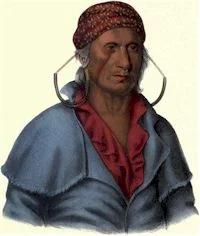
Payta Kootha
Payta Kootha, Shawanoe Warrior (Shawnee)
Flying Clouds or Captain Reed

The tradition of the Delawares, as embodied in the Walam Olum, makes themselves, the Shawnee, and the Nanticoke, originally one people, the separation having taken place after the traditional expulsion of the Talligewi (Cherokee) from the north, it being stated that the Shawnee went south. Beyond this it is useless to theorize on the origin of the Shawnee or to strive to assign them any earlier location than that in which they were first known and where their oldest traditions place them in the Cumberland basin in Tennessee, with an outlying colony on the middle Savannah in South Carolina. In this position, as their name may imply, they were the southern advance guard of the Algonquian stock.
Their real history begins in 1669-70. They were then living in two bodies at a considerable distance apart, and these two divisions were not fully united until nearly a century later, when the tribe settled in Ohio. The attempt to reconcile conflicting statements without a knowledge of this fact has occasioned much of the confusion in regard to the Shawnee. The apparent anomaly of a tribe living in two divisions at such a distance from each other is explained when we remember that the intervening territory was occupied by the Cherokee, who were at that time the friends of the Shawnee. The evidence afforded by the mounds shows that the two tribes lived together for a considerable period, both in South Carolina and in Tennessee, and it is a matter of history that the Cherokee claimed the country vacated by the Shawnee in both states after the removal of the latter to the north. It is quite possible that the Cherokee invited the Shawnee to settle upon their eastern frontier in order to serve as a barrier against the attacks of the Catawba and other enemies in that direction. No such necessity existed for protection on their northwestern frontier. The earliest notices of the Carolina Shawnee represent them as a warlike tribe, the enemies of the Catawba and others, who were also the enemies of the Cherokee. In Ramsey’s Annals of Tennessee is the statement, made by a Cherokee chief in 1772, that 100 years previously the Shawnee, by permission of the Cherokee, removed from Savannah river to the Cumberland, but were afterward driven out by the Cherokee, aided by the Chickasaw, in consequence of a quarrel with the former tribe. While this tradition does not agree with the chronological order of Shawnee occupancy in the two regions, as borne out by historical evidence, it furnishes additional proof that the Shawnee occupied territory upon both rivers, and that this occupancy was by permission of the Cherokee.
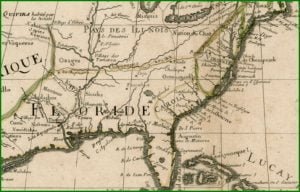
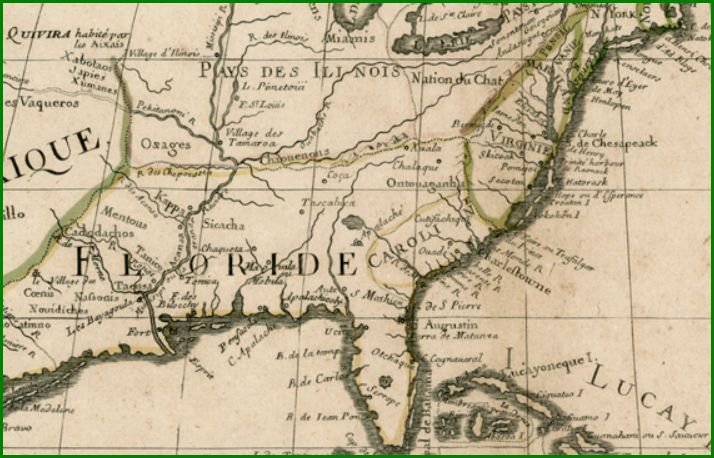
De l'Isle Map Detail 1700
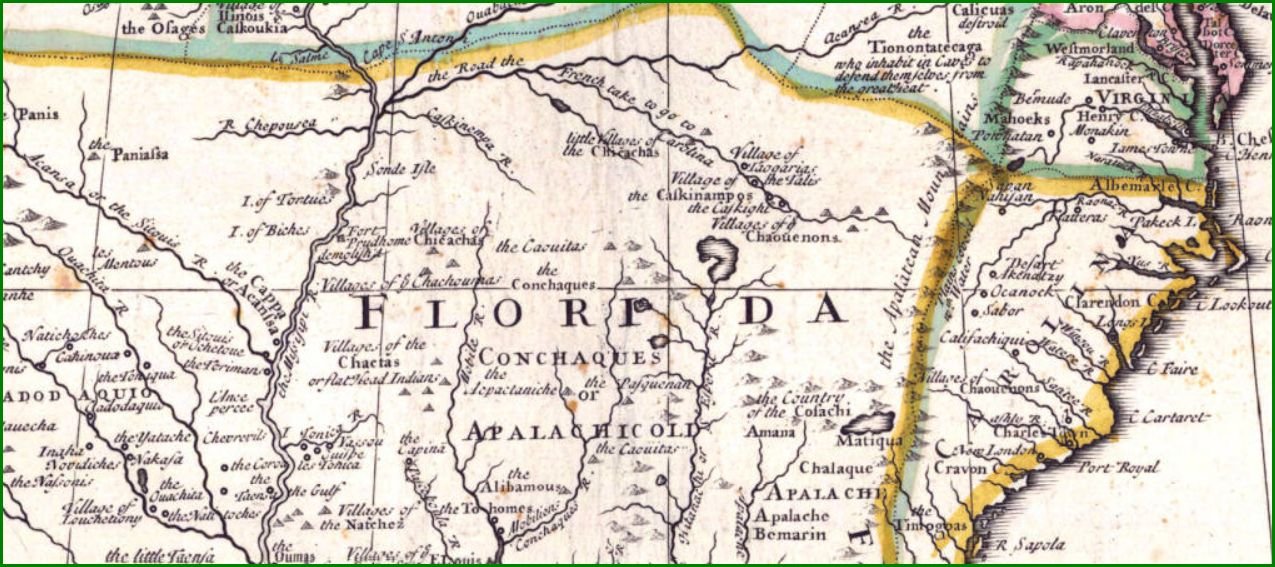
De l’Isle’s map of 1700 places the “Ontouagannha.” which here means the Shawnee, on the headwaters of the Santee and Pedee rivers in South Carolina, while the “Chiouonons” are located on the lower Tennessee river.

De l’Isle’s map of 1700 places the “Ontouagannha.” which here means the Shawnee, on the headwaters of the Santee and Pedee rivers in South Carolina, while the “Chiouonons” are located on the lower Tennessee river. Senex’s map of 1710 locates a part of the “Chaouenons” on the headwaters of a stream in South Carolina, but seems to place the main body on the Tennessee. Moll’s map of 1720 has “Savannah Old Settlement” at the mouth of the Cumberland 1, showing that the term Savannah was sometimes applied to the Western as well as to the eastern band.
The Shawnee of South Carolina, who included the Piqua and Hathawekela divisions of the tribe, were known to the early settlers of that state as Savannahs, that being nearly the form of the name in use among the neighboring Muskhogean tribes. A good deal of confusion has arisen from the fact that the Yuchi and Yamasee, in the same neighborhood, were sometimes also spoken of as Savannah Indians. Bartram and Gallatin particularly are confused upon this point, although, as is hardly necessary to state, the tribes are entirely distinct. Their principal village, known as Savannah Town, was on Savannah river, nearly opposite the present Augusta, Ga. According to a writer of 1740 2 it was at New Windsor, on the north bank of Savannah river, 7 miles below Augusta. It was an important trading point, and Ft Moore was afterward built upon the site. The Savannah river takes its name from this tribe, as appears from the statement of Adair, who mentions the “Savannah river, so termed on account of the Shawano Indians having formerly lived there,” plainly showing that the two names are synonyms for the same tribe. Gallatin says that the name of the river is of Spanish origin, by which he probably means that it refers to “savanas,” or prairies, but as almost all the large rivers of the Atlantic slope bore the Indian names of the tribes upon their banks, it is not likely that this river is an exception, or that a Spanish name would have been retained in an English colony. In 1670, when South Carolina was first settled, the Savannah were one of the principal tribes southward from Ashley river. About 10 years later they drove hack the Westo, identified by Swanton as the Yuchi, who had just previously nearly destroyed the infant settlements in a short but bloody war. The Savannah seem to have remained at peace with the whites, and in 1695, according to Gov. Archdale, were “good friends and useful neighbors of the English.” By a comparison of Gallatin’s paragraph 3 with Lawson’s statements 4 from which he quotes, it will be seen that he has misinterpreted the earlier author, as well as misquoted the tribal forms.
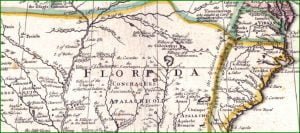
1710 Senex Map Portion
Senex’s map of 1710 locates a part of the “Chaouenons” on the headwaters of a stream in South Carolina, but seems to place the main body on the Tennessee.

Lawson traveled through Carolina in 1701, and in 1709 published his account, which has passed through several reprints, the last being in 1860. He mentions the “Savannas” twice, and it is to be noted that in each place he calls them by the same name, which, however, is not the same as any one of the three forms used by Gallatin in referring to the same passages. Lawson first mentions them in connection with the Congaree as the “Savannas, a famous, warlike, friendly nation of Indians, living to the south end of Ashley river.” In another place he speaks of “the Savanna Indians, who formerly lived on the banks of the Messiasippi, and removed thence to the head of one of the rivers of South Carolina, since which, for some dislike, most of them are removed to live in the quarters of the Iroquois or Sinnagars [Seneca], which are on the heads of the rivers that disgorge themselves into the bay of Chesapeak.” This is a definite statement, plainly referring to one and the same tribe, and agrees with what is known of the Shawnee.

On De l’Isle’s map, also, we find the Savannah river called “R. des Chouanons,” with the “Chaouanons” located upon both banks in its middle course. As to Gallatin’s statement that the name of the Savannahs is dropped after Lawson’s mention in 1701, we learn from numerous references, from old records, in Logan’s Upper South Carolina, published after Gallatin’s time, that all through the period of the French and Indian war, 50 years after Lawson wrote, the “Savannahs” were constantly making inroads on the Carolina frontier, even to the vicinity of Charleston. They are described as “northern savages” and friends of the Cherokee, and are undoubtedly the Shawnee. In 1749 Adair, while crossing the middle of Georgia, fell in with a strong party of “the French Shawano,” who were on their way, under Cherokee guidance, to attack the English traders near Augusta. After committing some depredations they escaped to the Cherokee. In another place he speaks of a party of “Shawano Indians,” who, at the instigation of the French, had attacked a frontier settlement of Carolina, but had been taken and imprisoned. Through a reference by Logan it is found that these prisoners are called Savannahs in the records of that period. In 1791 Swan mentions the “Savannas” town among the Creeks, occupied by “Shawanese refugees.”

Having shown that the Savannah and the Shawnee are the same tribe, it remains to be seen why and when they removed from South Carolina to the north. The removal was probably owing to dissatisfaction with the English setters, who seem to have favored the Catawba at the expense of the Shawnee. Adair, speaking of the latter tribe, says they had formerly lived on the Savannah river, “till by our foolish measures they were forced to withdraw northward in defense of their, freedom.” In another place he says, “by our own misconduct we twice lost the Shawano Indians, who have since proved very hurtful to our colonies in general.” The first loss referred to is probably the withdrawal of the Shawnee to the north, and the second is evidently their alliance with the French in consequence of the encroachments of the English in Pennsylvania.

Their removal from South Carolina was gradual, beginning about 1677 and continuing at intervals through a period of more than 30 years. The ancient Shawnee villages formerly on the sites of Winchester, Virginia, and Oldtown, near Cumberland, Maryland, were built and occupied probably during this migration. It was due mainly to their losses at the hands of the Catawba, the allies of the English, that they were forced to abandon their country on the Savannah; but after the reunion of the tribe in the north they pursued their old enemies with unrelenting vengeance until the Catawba were almost exterminated. The hatred cherished by the Shawnee toward the English is shown by their boast in the Revolution that they had killed more of that nation than had any other tribe.

The first Shawnee seem to have removed from South Carolina in 1677 or 1678, when, according to Drake, about 70 families established themselves on the Susquehanna adjoining the Conestoga in Lancaster County, Pennsylvania, at the mouth of Pequea creek. Their village was called Pequea, a form of Piqua. The Assiwikales (Hathawekela) were a part of the later migration. This, together with the absence of the Shawnee names Chillicothe and Mequachake east of the Alleghanies, would seem to show that the Carolina portion of the tribe belonged to the first named divisions. The chief of Pequea was Wapatha, or Opessah, who made a treaty with Penn at Philadelphia in 1701, and more than 50 years afterward the Shawnee, then in Ohio, still preserved a copy of this treaty. There is no proof that they had a part in Penn’s first treaty in 1682.

In 1694, by invitation of the Delawares and their allies, another large party came from the south probably from Carolina and settled with the Munsee on the Delaware, the main body fixing themselves at the mouth of Lehigh river, near the present Easton, Pennsylvania, while some went as far down as the Schuylkill. This party is said to have numbered about 700, and they were several months on the journey. Permission to settle on the Delaware was granted by the Colonial government on condition of their making peace with the Iroquois, who then received them as “brothers,” while the Delawares acknowledged them as their “second sons,” i. e. grandsons. The Shawnee to-day refer to the Delawares as their grandfathers. From this it is evident that the Shawnee were never conquered by the Iroquois, and, in fact, we find the western band a few years previously assisting the Miami against the latter. As the Iroquois, however, had conquered the lands of the Conestoga and Delawares, on which the Shawnee settled, the former still claimed the prior right of domain. Another large part of the Shawnee probably left South Carolina about 1707, as appears from a statement made by Evans in that year 5, which shows that they were then hard pressed in the south. He says: “During our abode at Pequehan [Pequea] several of the Shaonois Indians from ye southward came to settle here, and were admitted so to do by Opessah, with the governor’s consent, at the same time an Indian, from a Shaonois town near Carolina came in and gave an account that four hundred and fifty of the flat-headed Indians [Catawba] had besieged them, and that in all probability the same was taken. Bezallion informed the governor that the Shaonois of Carolina he was told had killed several Christians; whereupon the government of that province raised the said flat-headed Indians, and joined some Christians to them, besieged and have taken, as it is thought, the said Shaonois town.” Those who escaped probably fled to the north and joined their kindred in Pennsylvania. In 1708 Gov. Johnson, of South Carolina, reported the “Savannahs” on Savannah river as occupying 3 villages and numbering about 150 men 6. In 1715 the “Savanos” still in Carolina were reported to live 150 miles northwest of Charleston, and still to occupy 3 villages, but with only 233 inhabitants in all.
The Yuchi and Yamasee were also then in the same neighborhood 7.

A part of those who had come from the south in 1694 had joined the Mahican and become a part of that tribe. Those who had settled on the Delaware, after remaining there some years, removed to the Wyoming valley on the Susquehanna and established themselves in a village on the west bank near the present Wyoming, Pennsylvania. It is probable that they were joined here by that part of the tribe which had settled at Pequea, which was abandoned about 1730. When the Delawares and Munsee were forced to leave the Delaware river in 1742 they also moved over to the Wyoming valley, then in possession of the Shawnee, and built a village on the east bank of the river opposite that occupied by the latter tribe. In 1740 the Quakers began work among the Shawnee at Wyoming and were followed two years later by the Moravian Zinzendorf. As a result of this missionary labor the Shawnee on the Susquehanna remained neutral for some time during the French and Indian war, which began in 1754, while their brethren on the Ohio were active allies of the French. About the year 1755 or 1756, in consequence of a quarrel with the Delawares, said to have been caused by a childish dispute over a grasshopper, the Shawnee abandoned the Susquehanna and joined the rest of their tribe on the upper waters of the Ohio, where they soon became allies of the French. Some of the eastern Shawnee had already joined those on the Ohio, probably in small parties and at different times, for in the report of the Albany congress of 1754 it is found that some of that tribe had removed from Pennsylvania to the Ohio about 30 years previously, and in 1735 a Shawnee band known as Shaweygria (Hathawekela), consisting of about 40 families, described as living with the other Shawnee on Allegheny river, refused to return to the Susquehanna at the solicitation of the Delawares and Iroquois. The only clue in regard to the number of these eastern Shawnee is Drake’s statement that in 1732 there were 700 Indian warriors in Pennsylvania, of whom half were Shawnee from the south. This would give them a total population of about 1,200, which is probably too high, unless those on the Ohio are included in the estimate.

Having shown the identity of the Savannah with the Shawnee, and followed their wanderings from Savannah river to the Ohio during a period of about 80 years, it remains to trace the history of the other, and apparently more numerous, division upon the Cumberland, who preceded the Carolina band in the region of the upper Ohio river, and seem never to have crossed the Alleghanies to the eastward. These western Shawnee may possibly be the people mentioned in the Jesuit Relation of 1648, under the name of “Ouchaouanag,” in connection with the Mascoutens, who lived in northern Illinois. In the Relation of 1670 we find the “Chaouanon” mentioned as having visited the Illinois the preceding year, and they are described as living some distance to the south east of the latter. From this period until their removal to the north they are frequently mentioned by the French writers, sometimes under some form of the collective Iroquois name Toagenha, but generally under their Algonquian name Chaouanon. La Harpe, about 1715, called them Tongarois, another form of Toagenha. All these writers concur in the statement that they lived upon a large southern branch of the Ohio, at no great distance east of the Mississippi. This was the Cumberland river of Tennessee and Kentucky, which is called the River of the Shawnee on all the old maps down to about the year 1770.

When the French traders first came into the region the Shawnee had their principal village on that river near the present Nashville, Tennessee. They seem also to have ranged northeastward to Kentucky river and southward to the Tennessee. It will thus be seen that they were not isolated from the great body of the Algonquian tribes, as has frequently been represented to have been the case, but simply occupied an interior position, adjoining the kindred Illinois and Miami, with whom they kept up constant communication. As previously mentioned, the early maps plainly distinguish these Shawnee on the Cumberland from the other division of the tribe on Savannah river.
These western Shawnee are mentioned about the year 1672 as being harassed by the Iroquois, and also as allies and neighbors of the Andaste, or Conestoga, who were themselves at war with the Iroquois. As the Andaste were then incorrectly supposed to live on the upper waters of the Ohio river, the Shawnee would naturally be considered their neighbors. The two tribes were probably in alliance against the Iroquois, as we find that when the first body of Shawnee removed from South Carolina to Pennsylvania, about 1678, they settled adjoining the Conestoga, and when another part of the same tribe desired to remove to the Delaware in 1694 permission was granted on condition that they make peace with the Iroquois. Again, in 1684, the Iroquois justified their attacks on the Miami by asserting that the latter had invited the Satanas (Shawnee) into their country to make war upon the Iroquois. This is the first historic mention of the Shawnee evidently the western division in the country north of the Ohio river. As the Cumberland region was out of the usual course of exploration and settlement, but few notices of the western Shawnee are found until 1714, when the French trader Charleville established himself among them near the present Nashville. They were then gradually leaving the country in small bodies in consequence of a war with the Cherokee, their former allies, who were assisted by the Chickasaw. From the statement of Iberville in 1702 8 it seems that this was due to the latter’s efforts to bring them more closely under French influence. It is impossible now to learn the cause of the war between the Shawnee and the Cherokee. It probably did not begin until after 1707, the year of the final expulsion of the Shawnee from South Carolina by the Catawba, as there is no evidence to show that the Cherokee took part in that struggle. From Shawnee tradition the quarrel with the Chickasaw would seem to be of older date. After the reunion of the Shawnee in the north they secured the alliance of the Delawares, and the two tribes turned against the Cherokee until the latter were compelled to ask peace, when the old friendship was renewed. Soon after the coming of Charleville, in 1714, the Shawnee finally abandoned the Cumberland valley, being pursued to the last moment by the Chickasaw. In a council held at Philadelphia in 1715 with the Shawnee and Delawares, the former, “who live at a great distance,” asked the friendship of the Pennsylvania government. These are evidently the same who about this time were driven from their home on Cumberland river.
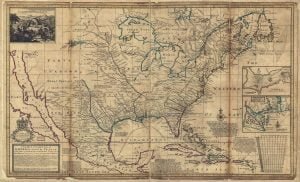
Moll Map of 1720
Moll’s map of 1720 has “Savannah Old Settlement” at the mouth of the Cumberland, showing that the term Savannah was sometimes applied to the Western as well as to the eastern band.

On Moll’s map of 1720 we find this region marked as occupied by the Cherokee, while “Savannah Old Settlement” is placed at the mouth of the Cumberland, indicating that the removal of the Shawnee had then been completed. They stopped for some time at various points in Kentucky, and perhaps also at Shawneetown, Ill., but finally, about the year 1730, collected along the north bank of the Ohio river, in Ohio and Pennsylvania, extending from the Allegheny down to the Scioto. Sawcunk, Logstown, and Lowertown were probably built about this time. The land thus occupied was claimed by the Wyandot, who granted permission to the Shawnee to settle upon it, and many years afterward threatened to dispossess them if they continued hostilities against the United States. They probably wandered for some time in Kentucky, which was practically a part of their own territory and not occupied by any other tribe. Blackhoof (Catahecassa), one of their most celebrated chiefs, was born during this sojourn in a village near the present Winchester, Kentucky. Down to the treaty of Greenville, in 1795, Kentucky was the favorite hunting ground of the tribe. In 1748 the Shawnee on the Ohio were estimated to number 162 warriors or about 600 souls. A few years later they were joined by their kindred from the Susquehanna, and the two bands were united for the first time in history. There is no evidence that the western band, as a body, ever crossed to the east side of the mountains. The nature of the country and the fear of the Catawba would seem to have forbidden such a movement, aside from the fact that their eastern brethren were already beginning to feel the pressure of advancing civilization. The most natural line of migration was the direct route to the upper Ohio, where they had the protection of the Wyandot and Miami, and were within easy reach of the French.

For a long time an intimate connection existed between the Creeks and the Shawnee, and a body of the latter, under the name of Sawanogi, was permanently incorporated with the Creeks. These may have been the ones mentioned by Pénicaut as living in the vicinity of Mobile about 1720. Bartram 9, in 1773, mentioned this band among the Creeks and spoke of the resemblance of their language to that of the Shawnee, without knowing that they were a part of the same tribe. The war in the northwest after the close of the Revolution drove still more of the Shawnee to take refuge with the Creeks. In 1791 they had 4 villages in the Creek country, near the site of Montgomery, Alabama, the principal being Sawanogi. A great many also joined the hostile Cherokee about the same time. As these villages are not named in the list of Creek towns in 1832 it is possible that their inhabitants may have joined the rest of their tribe in the west before that period. There is no good evidence for the assertion by some writers that the Suwanee in Florida took its name from a band of Shawnee once settled upon its banks.
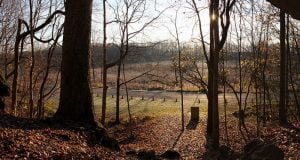
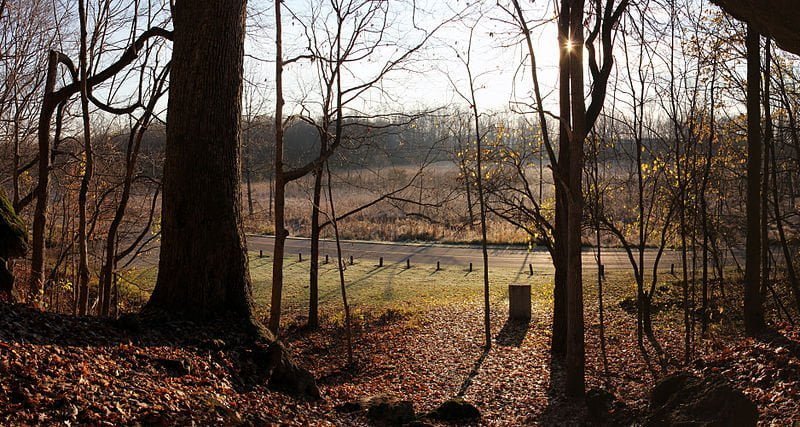
Prophet's Rock view
The view from Prophet’s Rock, a stone outcropping in rural Tippecanoe County, Indiana near Battle Ground. The Shawnee leader Tenskwatawa (“The Prophet”), brother of Tecumseh, sang from this site to encourage his fellow warriors during the fight against William Henry Harrison’s soldiers at the Battle of Tippecanoe, November 7, 1811. Photo looks southeast across Prophet’s Rock Road toward Burnett’s Creek and the battlefield site beyond.

The history of the Shawnee after their reunion on the Ohio is well known as a part of the history of the Northwest territory, and may be dismissed with brief notice. For a period of 40 years from the beginning of the French and Indian war to the treaty of Greenville in 1795 they were almost constantly at war with the English or the Americans, and distinguished themselves as the most hostile tribe in that region. Most of the expeditions sent across the Ohio during the Revolutionary period were directed against the Shawnee, and most of the destruction on the Kentucky frontier was the work of the same tribe. When driven back from the Scioto they retreated to the head of the Miami river, from which the Miami had withdrawn some years before. After the Revolution, finding themselves left without the assistance of the British, large numbers joined the hostile Cherokee and Creeks in the south, while a considerable body accepted the invitation of the Spanish government in 1793 and settled, together with some Delawares, on a tract near Cape Girardeau, Missouri, between the Mississippi and the Whitewater rivers, in what was then Spanish territory. Wayne’s victory, followed by the treaty of Greenville in 1795, put an end to the long war in the Ohio valley. The Shawnee were obliged to give up their territory on the Miami in Ohio, and retired to the headwaters of the Auglaize. The more hostile part of the tribe crossed the Mississippi and joined those living at Cape Girardeau. In 1798 a part of those in Ohio settled on White River in Indiana, by invitation of the Delawares. A few years later a Shawnee medicine-man, Tenskwatawa, known as The Prophet, the brother of the celebrated Tecumseh, began to preach a new doctrine among the various tribes of that region. His followers rapidly increased and established themselves in a village at the mouth of the Tippecanoe River in Indiana. It soon became evident that his intentions were hostile, and a force was sent against him under Gen. Harrison in 1811, resulting in the destruction of the village and the total defeat of the Indians in the decisive battle of Tippecanoe. Tecumseh was among the Creeks at the time, endeavoring to secure their aid against the United States, and returned in time to take command of the northwest tribes in the British interest in the War of 1812. The Shawnee in Missouri, who formed about half of the tribe, are said to have had no part in this struggle. By the death of Tecumseh in this war the spirit of the Indian tribes was broken, and most of them accepted terms of peace soon after. The Shawnee in Missouri sold their lands in 1825 and removed to a reservation in Kansas. A large part of them had previously gone to Texas, where they settled on the headwaters of the Sabine river, and remained there until driven out about 1839 (see Cherokee). The Shawnee of Ohio sold their remaining lands at Wapakoneta and Hog Creek in 1831, and joined those in Kansas. The mixed band of Seneca and Shawnee at Lewistown, Ohio, also removed to Kansas about the same time.

A large part of the tribe left Kansas about 1845 and settled on Canadian river, Indian Territory (Oklahoma), where they are now known as Absentee Shawnee. In 1867 the Shawnee living with the Seneca removed also from Kansas to the Territory and are now known as Eastern Shawnee. In 1869, by inter-tribal agreement, the main body became incorporated with the Cherokee Nation in the present Oklahoma, where they are now residing. Those known as Black Bob’s band refused to remove from Kansas with the others, but have since joined them.

For Further Study

The following articles and manuscripts will shed additional light on the Shawnee as both an ethnological study, and as a people.

Footnotes:
1. Royce in Abstr. Trans. Anthr. Soc. Wash., 1881
2. Ga. Hist. Soc. Coll., ii, 72, 1842
3. Trans. Am. Antiq. Soc., ii, 66, 1836
4. Lawson, Hist. Car., 75, 279-280, ed. 1860
5. Day, Penn, 391,1843
6. Johnson in Rivers, S. C., 236, 1856
7. Barnwell, 1715, in Rivers, Hist. South Carolina, 94, 1874
8. Margry, Déc., iv, 519, 1880
9. Bartram, Travels, 464, 1792


https://www.accessgenealogy.com/native/shawnee-tribe.htm