TRAVEL: Looking for Native American culture in the U.S.? Here's where to go.
Dana Joseph, for CNN • Updated 12th May 2015
(CNN) — Think Native American culture has been co-opted by casinos, twisted by inaccurate films, relegated to the rez or buried with arrowheads? No chance.
American Indian culture is alive and thriving in modern galleries, powwows, museum exhibits, film festivals and restaurants.
Here are some of the best places in the United States to experience Native America (arranged in a roughly east-to-west geographic order).
1. George Gustav Heye Center (New York)
The George Gustav Heye Center in New York is part of the National Museum of the American Indian.
"The Heye Center began as the personal collection of George Gustav Heye, a wealthy investment banker who collected nearly a million items that became the largest collection of American Indian items in the world," says NMAI director Kevin Gover (Pawnee).
Heye's will stipulates that his collection always be made available to the people of New York, and since 1994, it's been on view for all to see in Lower Manhattan across from Battery Park, in the historic Alexander Hamilton U.S. Custom House.
Highlights of the collection include 10 headdresses from different Native tribes and duck decoys from Lovelock Cave, Nevada (at ca. 400 B.C.-A.D. 100, they're the oldest known in the world). Nursing moms will especially appreciate the Yup'ik jacket that holds junior on Mom's back till feeding time, when the jacket can be ingeniously turned forward.
Elsewhere in New York City, which, by the way, has the largest indigenous population of any city in the country, the Queens County Farm Museum holds the Thunderbird American Indian Mid-Summer Pow Wow, the city's largest and oldest (July 25-27, 2014).
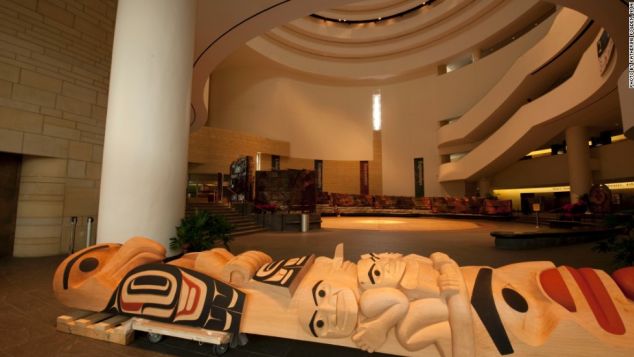 |
| Totem pole by Tsimshian carver David R. Boxley at the National Museum of American Indian. |
2. National Museum of the American Indian (D.C.)
The National Museum of the American Indian is the Smithsonian Institution's great national repository of American Indian art and culture on the National Mall.
"Our world-class collection covers cultures from North, Central and South America and totals more than 800,000 items," says museum director Kevin Gover. "Our Mitsitam Native Foods Cafe was the first Zagat-rated museum cafe in Washington and has a devoted following."
The museum presents a full calendar of public programs, including concerts, festivals, symposiums and theater, along with one-of-a-kind temporary exhibitions featuring the likes of esteemed Native artists such as Fritz Scholder, George Morrison, Brian Jungen and Allan Houser.
It's Native inside and out: the design of the grounds has reintroduced a landscape indigenous to the Washington area before "contact."
3. Oklahoma
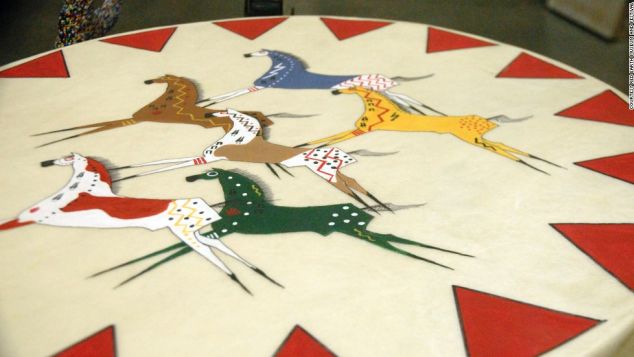 |
| Painted drum at the Red Earth Festival. |
Painted drum at the Red Earth Festival.
In Oklahoma City, lots of the almost 40,000 indigenous residents turn out for the three-day Red Earth Festival every June (in 2014, June 5-7).
It kicks off with a parade and keeps right on kicking with dancing, singing, storytelling, poetry, music and art.
In Shawnee, The Jim Thorpe Native American Games bring together athletes representing 70 different tribes from across the country.
The Games honor Jim Thorpe (Sac and Fox), the athletic legend who was born in Indian Territory near the town of Prague, Oklahoma, and went on to become a pro baseball player, pro football player and an Olympic Gold medalist in record-setting wins of the pentathlon and decathlon in the 1912 Olympics.
Inaugurated in 2012 to honor the man often called The Greatest Athlete of the 20th Century, the Native Games host thousands of athletes competing in 10 sports. The 2014 Games will be held in Shawnee June 8-14. And coming to Oklahoma City in 2017, the $10 million American Indian Cultural Center and Museum.
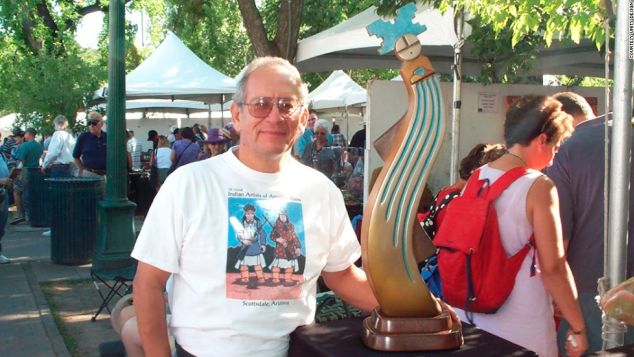 |
| Artist Upton Greyshoes Ethelbah at his booth during the Santa Fe Indian Market. |
4. Santa Fe, New Mexico
Experiencing Santa Fe's rich American Indian culture requires more than a couple of days -- and many return trips.
American Indian vendors line the historic Plaza, selling authentic silver and turquoise jewelry and other Native crafts.
Galleries like Shiprock on the Plaza, Blue Rain on Lincoln and the many along Canyon Road are a gateway to a life-altering addiction to Native arts, from painting and sculpture, to textiles, pottery and jewelry.
The city is also filled with world-class museums: The Wheelwright Museum of the American Indian, Museum of Indian Arts and Culture and Museum of Contemporary Native Arts.
For a one-fell-swoop approach, you can hit Santa Fe during August's world-renowned Indian Market, when the parking is horrible but the historic center overflows with booths devoted to Native arts and eats.
"This is the biggest and the best venue for we Native American artists," says sculptor Upton Greyshoes Ethelbah (Apache). "Collectors arrive for the two-day show by the tens of thousands (estimates range from 80,000 to 100,000).
"Visitors to the Santa Fe Indian Market are treated to the best diverse Native American art in the country, with over 10 different classifications, from stone and bronze sculpture, which is my specialty, to pottery, beadwork, jewelry, painting, weaving and even filmmaking."
The Indian Market is an opportunity to share cultures not only with visitors unfamiliar with Native differences, but among different tribes as well.
"There are over 562 different tribal groups in the U. S. with different languages, ceremonies and traditions," he says. "Everyone benefits by experiencing the great variation of artwork that emerges from these many tribes and nations. Virtually every individual item offered to the collector by over a thousand Indian artists originates in tribal tradition or symbology, and artists are eager to share with the collector the inspiration and the historical or spiritual meaning of their work."
The Inn and Spa at Loretto is an architectural re-creation of the famed Taos Pueblo.
As soon as you see it, you'll know why it's one of the most photographed buildings in the country.
5. Gathering of Nations (Albuquerque, New Mexico)
The fourth weekend of April, Native America flocks to Albuquerque for the Gathering of Nations.
Billed as the world's largest Native American cultural event, it's a tribal extravaganza in all its flying fringe and bodacious beading.
Where else but North America's most prominent powwow are you going to find the crowning of Miss Indian World and more than 700 tribes doing their thing?
"The Gathering of Nations strives to be a positive cultural experience that is exhilarating for everyone," says Derek Mathews, founder of the event, which marked its 31st year in 2014. "The powwow features thousands of dancers performing different styles from many regions and tribes, offers the finest in Native American arts and crafts in the Indian Traders Market, a delicious variety of Native American and Southwest cuisine and the best in contemporary entertainment performances."
The Grand Entry is special -- thousands of Native American dancers simultaneously enter the University of New Mexico's arena in full regalia to the beating of hundreds of drums.
Between Albuquerque and Santa Fe, the Hyatt Regency Tamaya Resort and Spa is located on the sacred lands of the Santa Ana Pueblo.
The resort offers golf, pools, spa, restaurants and all the usual upscale amenities but distinguishes itself with American Indian cultural experiences.
There are Pueblo bread-baking demonstrations by tribal members using a traditional oven called a huruna, flute and tribal dance performances on certain weekends, a cultural museum with personal tours hosted by a tribal member, hiking and riding (horses or bikes) through cottonwoods along the Rio Grande on trails used by the Tamayame people for centuries and creation stories told under the stars by a Native American storyteller (followed by s'mores).
In the city, you can stay at the funky, artsy Nativo Lodge (American Indian meets modern meets retro boutique hotel/motel) and make an extra day of the Indian Pueblo Cultural Center and Petroglyph National Monument.
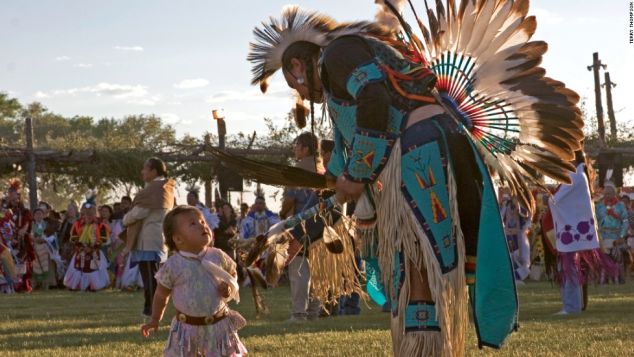 |
| Taos Pueblo Powwow. |
6. Taos, New Mexico
Taos is crazy with galleries and museums highlighting Native American culture.
The Millicent Rogers Museum is one of the best -- it houses important collections of Native American arts, including pottery and jewelry.
Just outside of town is the Taos Pueblo -- a settlement of adobe dwellings and ceremonial buildings that dates to the late 13th century, the pueblo is still a living community.
It's both a UNESCO World Heritage Site and a National Historic Landmark and open to the public for guided walking tours, shopping and fry bread eating. (Check ahead for hours and entry fee.)
The Rio Grande Gorge is located just outside of Taos. You can cross the famous long-span bridge over the incredible 600-foot-deep gorge.
7. Shiprock, New Mexico/Monument Valley
With more than 17 million acres, the Navajo Nation encompasses the entire northeast quarter of Arizona, and spills into New Mexico and Utah.
Shiprock, which is much easier to pronounce than its Navajo name, Tsé Bitʼaʼí, is located in the northwest corner of New Mexico. The "rock with wings" or "winged rock," which is said to have brought tribes here from the north, rises 1,583 feet from the plain and looks every foot the sacred and mythological heavyweight it is in Navajo culture.
The approach is practically a religious experience. From Shiprock, it's two-and-a half-hour drive to Monument Valley, on the Arizona-Utah border.
One of the world's most famous film locations for its miles and miles of mesas, buttes and rock spires sculpted by eons of water and wind, Monument Valley is also a tribal park of the Navajo Nation.
The 17-mile scenic drive takes in Mitten Buttes, Merrick Buttes and other iconic formations. Navajo guides (compulsory if you want to get off the road) can take you into some of the park's 92,000 acres.
At the Navajo-staffed The View Hotel you can watch the sun rise over the Mittens.
8. Phoenix
Arizona is home to 22 federally recognized tribes, and Native history and landmarks are found throughout the state, from "Sky Island" mountains and rock formations in Chiracahua National Monument to urban centers like Phoenix, which is home to almost 45,000 indigenous people.
Haven't heard of The Heard? As in the Heard Museum? It's only one of the Phoenix area's earliest and best cultural attractions, and a terrific destination for learning about American Indian arts and cultures.
"The Heard Museum offers a unique and memorable visitor experience with 11 galleries that present the best of American Indian traditional and contemporary art," says museum director of curation and education Ann Marshall. "Within a year, six to eight new exhibits are presented, so return visits always bring something new.
The museum's annual Indian Fair and Market in March (Arizona's largest) features more than 700 Native artists.
Just outside of downtown Phoenix, the Pueblo Grande Museum and Archaeological Park sits on a 1,500-year-old site, which includes a short trail through a prehistoric Hohokam archaeological village complete with a partially excavated platform mound, ball court and replicated prehistoric houses.
In December, an Indian Market features music and dance performances, artist demonstrations, children's crafts and, naturally, fry bread.
Arizona is home to a number of highly regarded American Indian restaurants.
As a 2013 Boston Globe story noted, "Talented [Native] chefs are returning to local, old-fashioned ingredients (think tepary beans, Saguaro cactus seeds, sumac and chollo buds) and adding creative twists to the traditional dishes of indigenous peoples, spurring a hot, new culinary trend."
The Globe's three top recommendations for American Indian dining in Phoenix: the Fry Bread House, which, despite being "no-frills," was "one of only five restaurants nationwide to win the 2012 James Beard American Classics Award, and the only Native American restaurant ever to receive it"; the "five-star, five diamond" KAI; and the "health-focused" Desert Rain Café.
9. Mesa Verde (Colorado)
The ancestral Puebloans who lived at Mesa Verde from A.D. 600 to 1300 left behind some of the best-preserved sites in the country.
An interpretive tour of their ancient cliff dwellings and mesa-top sites is the way to get the most out of this stunning setting. Afterward, you can get a nice meal with an incomparable view at the lodge's Metate Room restaurant.
With rooms starting at $106, the Far View Lodge inside the national park has spectacular vistas and stargazing opportunities.
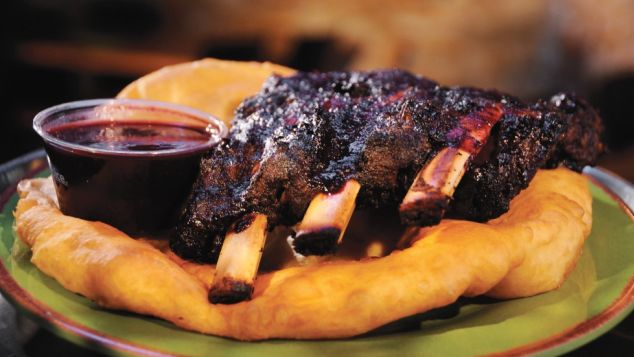 |
| Bison ribs with blackberry barbecue sauce at Tocabe: An American Indian Eatery in Denver. |
10. Denver, Colorado
The Denver Art Museum is internationally known for its holdings of American Indian art, with permanent collections and exhibitions showing everything from ancient ceramics to 19th-century Arapaho beaded garments to contemporary glasswork.
The museum puts on the Friendship Powwow and American Indian Cultural Celebration, which celebrates its 25th year in September 2014.
There are American Indian dancers, drum groups, artists, vendors, and, need we say it, fry bread.
The Mile High City is also home to the Denver March Powwow -- second largest indoor powwow after Albuquerque's Gathering of Nations -- celebrating its 40th year March 20-22, 2015, at the Denver Coliseum.
Who cooks all the Indian tacos at the Denver March Powwow?
It just might be Tocabe: An American Indian Eatery -- you can try their tacos anytime at Tocabe's Denver restaurant.
Partners Ben Jacobs and Matt Chandra call it "fast, casual," sort of the community-minded Chipotle of Native American food. The shredded bison American Indian taco is a fan favorite. Bison ribs is another signature dish.
"We're trying to showcase American Indian cuisine in the 21st century," Chandra says. "This is food that speaks to tradition but also shows that it can progress and have the ability to adapt and become a part of mainstream cuisine."
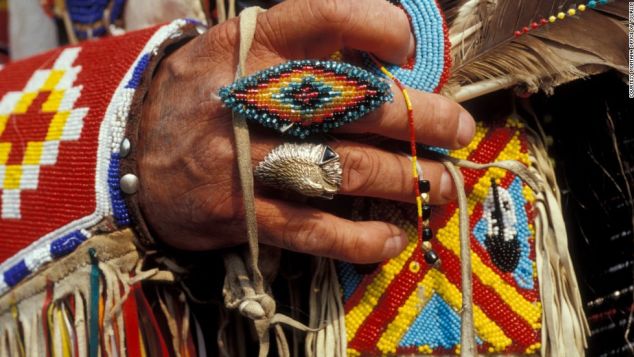 |
| Native American beadwork in Montana. |
11. Crow Fair (Montana)
Parade cars draped in serape blankets and 1,500 tepees under Montana's Big Sky -- it could only be Crow Fair.
Every third week of August, Crow Agency (60 miles south of Billings off I-90) becomes the Tepee Capital of the World when it hosts the largest modern-day American Indian encampment in the nation, and the largest gathering of the year for the Apsaalooke Nation.
Daily parades, evening powwows, All Indian rodeo, Indian relay horse races, the closing Dance Through Camp -- the Crow Fair is a week of incredible displays of Native American culture.
Attractions in the area include Little Bighorn Battlefield National Monument (where the Sioux and Cheyenne famously defeated the U.S. Army's 7th Cavalry); Custer Battlefield Museum; and Bighorn Canyon National Recreation Area (must-do: Devil's Canyon Overlook).
12. American Indian Film Festival (San Francisco)
Seeing American Indian life through the lens of Native filmmakers is one of the best ways to understand the modern Native experience.
One of the best places to do that (aside from the indie film category on Netflix) is the American Indian Film Festival in San Francisco.
It's the mission of the American Indian Film Institute to empower American Indian media artists, and the AIFI's annual film festival has been bringing Native stories to a growing audience for nearly 40 years.
"There are other American Indian film festivals around the country," says festival founder and president Michael Smith. "But the AIFI festival in San Francisco is the longest-running and has the most content. Last year, there were more than 85 films."
The 39th annual American Indian Film Festival takes place November 1-9, 2014.
If you're lucky, you might catch filmmaker Chris Eyre (Cheyenne, Arapaho), an AIFI and Sundance favorite since his debut film, "Smoke Signals," won honors at both festivals in 1998.
It's hard to imagine from modern American Indian film subjects and the festival's Bay Area setting that the lands south of the Golden Gate Bridge were once home to the Ohlone, or Costanoan, tribe, and north of the bridge, especially in what's now Marin County, to the Miwok tribe.
For a small taste of what the region was like when American Indians inhabited it centuries before high-tech modernity, you can visit the Marin Museum of the American Indian in Novato's Miwok Park.
It's on the site of an actual Miwok village, in a peaceful and pristine setting that's about as far from the influence of Silicon Valley as you can get in these parts.
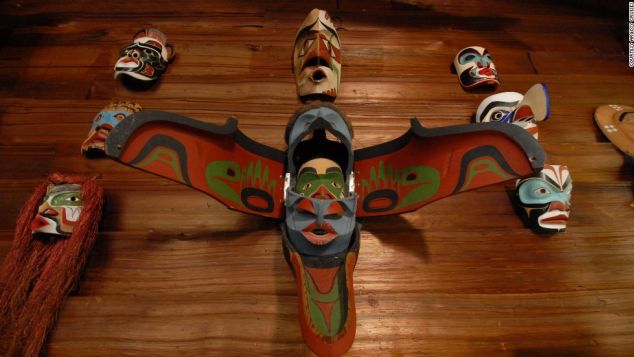 |
| Tillicum Village on Blake Island State Park in Washington. |
13. The Salish Sea (Pacific Northwest)
As much as it might now be about coffee and grunge culture, the Pacific Northwest is also formline art, totem pole, longhouse and dugout canoe country.
Puget Sound, the Strait of Juan de Fuca and the Strait of Georgia are all part of the Salish Sea.
You could do all sorts of things in the region to get a feel for the richness of its tribal past.
Blake Island has its Tillicum Village, where you can take in a Northwest Coast Indian dance performance with a traditional salmon bake dinner.
You can pay your respects at Chief Seattle's gravesite and learn about the longhouse tradition in Suquamish, Washington, on the Port Madison Indian Reservation, where the great chief lived and died.
And you can immerse yourself in the history and culture of the Puget Sound Salish Tribes (particularly the Suquamish) at the new and niftily designed Suquamish Museum and Cultural Center.
Just across the water/border in Vancouver, Canada, you can get intensely ethnographic at University of British Columbia's Museum of Anthropology with its a vast collection of Aboriginal art and artifacts, including traditional canoes, masks, jewelry, carvings, longhouse replicas and totem poles.
Not to be outdone, the Royal BC Museum in Victoria on nearby Vancouver Island has one of the most comprehensive collections of First Nations cultural material, from ceremonial and utilitarian objects to artistic masterworks.
Back in Vancouver's Stanley Park, there are the much-visited totem poles, tribal dance performances, Aboriginal foods and storytelling, a Spirit Catcher Train through the forest and activities at the Klahowya Aboriginal Village.
There's more to experience at Capilano Suspension Bridge Park, where you can top off First Nations cedar chiseling demonstrations, Totem Park, and the displays and weaving and beadwork demonstrations at Kia'palano First Nations cultural center with views of the Pacific Northwest rainforest from the bridge over the Capilano River.


