Showing posts with label Shawnee Leader. Show all posts

Monday, December 18, 2017

Tecumseh, Quote

Tecumseh -

Shawnee Quote

So live your life that the fear of death can never enter your heart. 
Trouble no one about their religion; respect others in their view, and 
demand that they respect yours. Love your life, perfect your life, beautify 
all things in your life. Seek to make your life long and its purpose in the service
of your people. 

Prepare a noble death song for the day when you go over the great divide. 
Always give a word or a sign of salute when meeting or passing a friend, even 
a stranger, when in a lonely place. Show respect to all people and grovel to none. 
When you arise in the morning give thanks for the food and for the joy of living. 

If you see no reason for giving thanks, the fault lies only in yourself. Abuse 
no one and no thing, for abuse turns the wise ones to fools and robs the 
spirit of its vision. 

When it comes your time to die, be not like those whose 
hearts are filled with the fear of death, so that when their time comes they 
weep and pray for a little more time to live their lives over again in a different way. 

Sing your death song and die like a hero going home.


Piqua Shawnee

Friday, December 15, 2017

Organizer of Indian Condfederation

Organizer of Indian confederation - Tecumseh

 
With inexhaustible energy, Tecumseh began to form an Indian confederation to resist white pressure. He made long journeys in a vast territory, from the Ozarks to New York and from Iowa to Florida, gaining recruits (particularly among the tribes of the Creek Confederacy, to which his mother’s tribe belonged). The tide of settlers had pushed game from the Indians’ hunting grounds, and, as a result, the Indian economy had broken down.
In 1811, while Tecumseh was in the South, William Henry Harrison, governor of the Indiana Territory, marched up the Wabash River and camped near the brothers’ settlement. The Prophet unwisely attacked Harrison’s camp and was so decisively defeated in the ensuing Battle of Tippecanoe that his followers dispersed, and he, having lost his prestige, fled to Canada and ceased to be a factor in Tecumseh’s plans.
Seeing the approach of war (the War of 1812) between the Americans and British, Tecumseh assembled his followers and joined the British forces at Fort Malden on the Canadian side of the Detroit River. There he brought together perhaps the most formidable force ever commanded by a North American Indian, an accomplishment that was a decisive factor in the capture of Detroit and of 2,500 U.S. soldiers (1812).
Fired with the promise of triumph after the fall of Detroit, Tecumseh departed on another long journey to arouse the tribes, which resulted in the uprising of the Alabama Creeks in response to his oratory, though the Chickasaws, Choctaws, and Cherokees rebuffed him. He returned north and joined the British general Henry A. Procter in his invasion of Ohio. Together they besieged Fort Meigs, held by William Henry Harrison, on the Maumee River above Toledo, where by a stratagem Tecumseh intercepted and destroyed a brigade of Kentuckians under Colonel William Dudley that had been coming to Harrison’s relief. He and Procter failed to capture the fort, however, and were put on the defensive by Oliver Hazard Perry’s decisive victory over the British fleet on Lake Erie (September 10, 1813). Harrison thereupon invaded Canada. Tecumseh with his Indians reluctantly accompanied the retiring British, whom Harrison pursued to the Thames River, in present-day southern Ontario. There, on October 5, 1813, the British and Indians were routed, and Harrison won control of the Northwest. Tecumseh, directing most of the fighting, was killed. His body was carried from the field and buried secretly in a grave that has never been discovered. Nor has it ever been determined who killed Tecumseh. Tecumseh’s death marked the end of Indian resistance in the Ohio River valley and in most of the lower Midwest and South, and soon thereafter the depleted tribes were transported beyond the Mississippi River.
Glenn Tucker
 
www.Britannica.com
https://www.britannica.com/biography/Tecumseh-Shawnee-chief#ref252112

Piqua Shawnee
www.Piquashawnee.com

Tuesday, December 12, 2017

Blackfish (c. 1729-1779) Shawnee Leader

Blackfish (c. 1729-1779) Shawnee Leader


https://en.wikipedia.org/wiki/Blackfish_(Shawnee_leader)

Little is known about him, since he only appears in written historical records during the last three years of his life, primarily because of his interactions with the famous American frontiersmen Daniel Boone and Simon Kenton.

When the Shawnees were defeated by Virginia in Dunmore's War in 1774 , the resulting peace treaty made the Ohio River the boundary between western Virginia (what is now Kentucky and West Virginia) and American Indian lands in the Ohio Country. Although this treaty was agreed to by Shawnee leaders such as Cornstalk, Blackfish and a number of other leaders refused to acknowledge the loss of their traditional hunting grounds in Kentucky.

Violence along the border escalated with the outbreak of the American Revolutionary War in 1775. As a result, the Chillicothe Shawnees moved their town on the Scioto River further west to the Little Miami River, near what is now Xenia, Ohio. Encouraged and supplied by British officials in Detroit, Blackfish and others launched raids against American settlers in Kentucky, hoping to drive them out of the region. In revenge for the murder of Cornstalk by American militiamen in November 1777, Blackfish set out on an unexpected winter raid in Kentucky, capturing American frontiersman Daniel Boone and a number of others on the Licking River on February 7, 1778. Boone, respected by the Shawnees for his extraordinary hunting skills, was taken back to Chillicothe and adopted into the tribe. The traditional tale is that Boone was adopted by Blackfish himself, although historian John Sugden suggests that Boone was probably adopted by another family.

Boone escaped in June 1778 when he learned that Blackfish was launching a siege of the Kentucky settlement of Boonesborough, which commenced in September of that year. The siege of Boonesborough was unsuccessful, and the Kentuckians, led by Colonel John Bowman, counterattacked Chillicothe the following spring. This raid was also unsuccessful, but Blackfish was shot in the leg, a wound which became infected and was eventually fatal.

References

  • Faragher, John Mack. Daniel Boone: The Life and Legend of an American Pioneer. New York: Holt, 1992.
  • Lofaro, Michael. Daniel Boone: An American Life. Lexington, KY: University Press of Kentucky, 2003.
  • Sugden, John. "Blackfish" in American National Biography. Oxford University Press, 1999.

Piqua Shawnee
www.piquashawnee.com

Friday, December 8, 2017

Tecumseh, Shawnee Leader


Tecumseh, Shawnee Leader 

Archaeology
Ruled ca. A.D. 1789-1813
Tuesday, July 16, 2013


tecumseh-shawnee
(The Bridgeman Art Library, The Art Archive at Art Resource, NY)
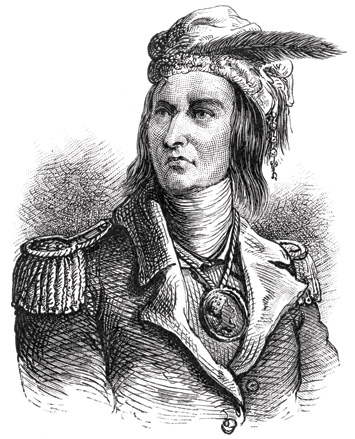
Tecumseh in an 1881 engraving
Throughout history in many cultures, preserving the physical remains of great figures has been considered vital for religious, cultural, or political reasons. Many Native Americans don’t share that outlook. The burial of Shawnee leader Tecumseh is a case in point. Tecumseh, whose name means “shooting star” or “panther in the sky,” led the Shawnee and a coalition of other native groups in resisting American settlement of the Ohio and Indiana territories in the early nineteenth century. He allied his forces with the English during the War of 1812 but was abandoned by them in 1813, at the Battle of the Thames in what is now Ontario. Refusing to retreat, Tecumseh died leading his outnumbered forces against American troops led by future president William Henry Harrison. According to eyewitnesses, Tecumseh’s slain body was taken up by his warriors, who buried him close to the battlefield.


No record exists of the exact location of Tecumseh’s grave. But Ken Tankersley, a University of Cincinnati archaeologist who is an enrolled member of the Piqua Shawnee and sits on the tribe’s Council of Elders, says that isn’t important. “For indigenous people, and the Shawnee in particular, what’s important is for the dead to ‘make the journey,’ or allowing the body to decompose, creating nutrients in the soil, and thus allow the cycle of life to continue.” Tankersley notes that Shawnee will occasionally visit the battlefield and leave a tobacco offering. “We know where the battle was, and the whole battlefield is considered a sacred site, and that is close enough.” He predicts that protests would erupt if an archaeologist or anyone else ever tried to find Tecumseh’s remains. Even using noninvasive remote-sensing technology to locate the burial would be considered unacceptable, says Tankersley. “No one should ever go looking for Tecumseh.”


https://www.archaeology.org/issues/100-features/lost-tombs/1095-tecumseh-shawnee-battle-thames-ontario

Piqua Shawnee
Piquashawnee.com