Showing posts with label War of 1812. Show all posts

Friday, September 28, 2018

The War of 1812 and Kentucky's Role

https://www.ket.org/history/the-war-of-1812-and-kentuckys-role/

By Joyce West | 6/07/17 9:30 AM

Often called the United States’ “forgotten war,” the War of 1812 left an indelible mark on our nation’s history. Kentuckians played a vital role and paid dearly for it: 64 percent of Americans killed in the war were Kentuckians.

Kentucky Life followed the trail of Kentucky’s soldiers who fought in the war, from Michigan to New Orleans.

What prompted so many Kentuckians to join the fight?
Watch the Video https://ket.org/episode/KKYLI+002103
“The big thing here was…the history between the Indian nations and the British and the citizens of the commonwealth of Kentucky,” explained John Trowbridge, command historian of the Kentucky National Guard. Kentucky was the site of continuing warfare between settlers and the Native Americans, who were backed by the British.

Kentuckians were eager to fight, and Lexington’s Henry Clay was a leader of the War Hawks in Congress.
Six congressmen from Kentucky fought in the war. “People who voted for the war actually followed up their votes and fought in the war, and some of them died in the war,” said James C. Klotter, Ph.D., state historian of Kentucky.

Leading men into battle were William Henry Harrison, governor of Indiana territory, as well as Isaac Shelby, who was serving his second term as governor of Kentucky.
Another faction in the conflict was a confederation of numerous Native American tribes formed to block American expansion. Leading this alliance was the Shawnee leader Tecumseh. “Tecumseh is quite an incredible figure,” said John Bowes, Ph.D., associate professor history at Eastern Kentucky University. “Tecumseh is seen as the leader of this movement, this unique movement seeking to develop this pan-Indian confederacy that is bringing all these different tribes together.”
The First Nations confederacy had as its spiritual leader Tecumseh’s half-brother, known as the Prophet. “What is so often marginalized and put to the side is the very spiritual foundation for that confederacy,” Bowes said.

The Militia and the Long Rifle
When it came time to go to war, men of the commonwealth brought with them their Kentucky long rifles. Harold Edwards, historian and gunsmith at the William Whitley House in Crab Orchard, said the rifle was used every day by the settlers for hunting and protecting the family as well as for sport.
“It was their pastime, and they became very proficient with it. You know, the average range was probably a hundred yards,” Edwards said.

The British were still fighting in Napoleonic style, marching en masse with muskets, which had a range of 50-60 yards, Edwards said. “It was an old style of warfare dying fast, and unfortunately they learned it a little too late,” said Edwards.

What kind of soldiers were these Kentuckians? There is debate about that, Klotter said.
“Were they good soldiers or bad soldiers? They were a little of both,” said Klotter. “They were really good fighters, when they fought. But the militiamen of Kentucky were not trained. They wanted a quick fight, and then go home. They weren’t particularly good in following orders sometimes.”
This reputation led the British to compare the Native Americans with the undisciplined Kentucky fighters, said Trowbridge.

“The warfare in the West was viewed as a bit more savage,” said Bowes. “For the Americans it’s because of the presence of all these Indian allies. And for the British, it’s in part because of the Kentuckians.”

Remember the Raisin
On Aug. 12, 1812, more than a thousand Kentuckians headed north toward Michigan in summer clothing for what they expected to be a short war.

“After fighting their way up here…they arrived here in the winter of 1813, January, when Michigan was experiencing a very cold winter,” said Dan Downing, chief of interpretation at the River Raisin Battlefield National Park in Michigan.

Historians believe about 100 men died from starvation and exposure to the elements. Even so, the Americans won a victory at Frenchtown over the British. Then they set up for the next battle in haste.
“They don’t fortify the position,” said Klotter. “They know the British are on their way, but they put people in open fields, without any trenches or any kind of earthworks to protect them.”
The British and their Native American allies attacked at 6 in the morning on Jan. 22, 1813. One wing of the American forces was massacred, Klotter said. The other wing fought well but ran out of ammunition and was surrounded. The Americans surrendered, with 500 captured, 400 dead, and 100 who got away, Klotter said.

The captured, wounded men who could not travel stayed behind in cabins. “The great controversy is whether or not the British did all they could to protect those who were unable to travel back to Fort Malden in Canada,” said Downing.

The Native Americans, remembering the Kentuckians’ previous attacks on their villages, sought vengeance. “When an opportunity came to exact revenge, they took the opportunity,” said Downing.
The Native Americans went from cabin to cabin, killing 65 men, in what became known as the massacre of the River Raisin.

The Battle of the River Thames
More defeats that year lowered morale among the Americans, but the tide turned in the fall of 1813 when Americans won control of Lake Erie.

The British and their allies were retreating from Detroit into Canada. “From that moment forward, Tecumseh’s angry,” said Bowes. “Tecumseh cannot believe that the British are essentially surrendering that territory.”

On Oct. 5, 1813, the Kentuckians met the British and their allies again, this time in Ontario, at the Battle of the River Thames.

Twenty mounted Kentuckians, commanded by 64-year-old William Whitley of Kentucky, charged the Native American lines in what was called “Forlorn Hope.” The strategy was to draw fire, then send on the American infantry before the Native Americans could reload. “Only a couple of guys actually survived that charge,” said Trowbridge.

The British pulled back, and Tecumseh was killed. Whitley also was killed, and is buried on the battlefield in an unmarked grave.

The End of the War
After the victories in the West, the flashpoint of the war shifted eastward, to Washington, D.C. and Baltimore. The United States was pushed to the brink of bankruptcy because of the British naval blockade. Britain was war weary with its battles in North America and in Europe with Napoleon.
Negotiations to end the war began, and both sides tried to secure as much territory as possible.
All eyes turned to the port of New Orleans. The British sent a fleet of 8,000 men to take the city. Kentuckians were called to defend the port.

“The people of Kentucky were warmly welcomed here to New Orleans in anticipation of the battle,” said April Antonellis, the War of 1812 Bicentennial Coordinator for the National Park Service.
Andrew Jackson assembled a force of 5,000 to defend the city against the British. On Jan. 8, 1815, the Battle of New Orleans was waged on an old sugar plantation just outside the city limits.
The British, again relying on tactics used in the Napoleonic wars, were slaughtered by the Americans firing long rifles from behind earthworks. In a little more than 25 minutes, the British lost 2,600 men. The Americans lost 71.

“There were errors on the part of the British, leaving some supplies behind, most notably scaling ladders that they were supposed to use to come up over this rampart that the Americans had created,” Antonellis said.

The War of 1812 is often called the Second American Revolution.

“If the British had won this battle, New Orleans certainly would have become a British colony or a British territory,” she said. “I think it’s easy to say that much of the United States could have easily fallen to the British as well. Anywhere west of the Appalachian Mountains that had to trade on the Mississippi River, they would have to pass through the port of New Orleans. If that’s a British city, then it would be very difficult to maintain American control in that area.”

Who won the war? Strategists say it was a draw. In the end, Native Americans paid the ultimate price.
The treaty ending the War of 1812 was negotiated without their participation, and the Native American alliance lost territory it had hoped to hold. In the years after the war’s end, Indiana, Alabama, Illinois, and Mississippi became states.

“The floodgates opened in the aftermath of the war of 1812,” said Bowes.

Piqua Shawnee

"Piqua Shawnee"

Piqua Shawnee Tribe

Monday, September 10, 2018

Traveling Through Time - Shawnee Indians

Shawnee Indians
A monument commemorates their departure in Hardin

The Shawnee Indians, also of Algonquian stock, lived in the east and Midwest. Their first contact with white men came in the 1600s. Early estimates of their population range from 3,000 to 50,000, although 10,000 appears to be the most probable estimate. Shawnee comes from the Algonquian word ‘Shawun’ (shawunogi) meaning ‘southerner.’ The application of southerner is indicative of their location vis-a-vis the other Algonquian tribes who lived to the Shawnee’s north, around the Great Lakes. A symbol of the Shawnee authority is the eagle feather headdress.

During the 1600s, they were forced to leave their traditional lands, including the Ohio Valley, by the marauding Iroquois during the Beaver Wars. In the 1700s, they once again began to call the Ohio Valley their home, settling initially along the Ohio River where conflict with white settlers became a routine occurrence. Allying themselves with the British during the Revolutionary War, combined with being absolutely against white expansion beyond the Appalachian Mountains, did not endear them to the Americans. Led into battle by Chief Cornstalk, they were severely defeated by colonial troops in 1774 in the area of Point Pleasant, West Virginia.

The loss resulted in a split in the Shawnee tribe that caused many of them to move west beyond the Mississippi River. Those that stayed behind in Ohio rallied behind Tecumseh until the 1811 Tippecanoe defeat and the death of Tecumseh in Canada during the War of 1812.

The Shawnee village of Piqua (Piquea), located four miles southwest of Springfield, Ohio, was attacked by American soldiers under the command of General George Rogers Clark on August 8, 1780. It was a ferocious battle that ended with the total destruction of the Shawnee village, and their agricultural crops.

Seeking a new area in which to build a village, the Indians traveled northwest until they reached the Great Miami River where they chose a location on the west side of the river, just north of where the Johnston Indian Agency would eventually be constructed. They named this new village, upper Piqua. The Miami Indians village of Pickawillany, along with Fort Pickawillany, was at this same site until it was abandoned in 1763 after an earlier unsuccessful attack by the Shawnee.

At the same time, they established another village in the area, on the east side of the river, on a site that is now occupied by the city of Piqua. The Shawnee named this second village lower Piqua. They had lived in the Piqua area for two years when, in 1782, General Clark and 1,000 Kentuckians moved north into Ohio. The Shawnee decided to abandon their Piqua villages without a fight and moved to a location on the Auglaize River. After the Greene Ville Treaty was signed, they moved back to the area, locating villages in Wapakoneta, north of the new treaty line, Hog Creek (southwest part of Lima) and Lewistown.

In 1832, they ceded the last of their Ohio lands to the government, and in a sorrowful procession through Hardin, Piqua, Greenville and Richmond, the last of the mighty Shawnee rode their horses to a new home in eastern Kansas.

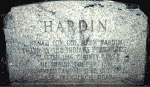
Today, most of the Shawnee live in Oklahoma or have merged into this region’s population. A monument can bshawneemarkerhardin.gif (79750 bytes)e seen today in the small park area in Hardin, six miles west of Sidney, at the intersection of State Route 47 and Hardin-Wapak Road. It is located on the southeast corner of the park. This monument commemorates not only the killing of Colonel Hardin by the Indians, but also marks the spot where the Shawnee camped in October, 1832, on their last trek from Ohio.

'Indian' segment written in December, 1997 by David Lodge

Piqua Shawnee
Piqua Shawnee Tribe

Friday, September 7, 2018

The War of 1812 in Alabama and the Creek War, 1813-1814


Causes:
The Federal Road divided the traditional Upper Creeks from more assimilated Lower Creeks.
  • Creek ownership of traditional lands was endangered as land-hungry whites moved across it or settled illegally on it.
  • The British sent Tecumseh, a Shawnee chief, from the Great Lakes to unite all Indians against white Americans and form an alliance with England and Spain.
  • England and Spain incited the Creeks against American settlers and supplied Creeks with guns and ammunition.
Battles raged on the frontier between Creek "Red Sticks" and American militia led by General Andrew Jackson. The last and most famous battle, the Battle of Horseshoe Bend (now a National Military Park) destroyed the strength of the Creek Nation. General Jackson forced the Creeks to sign the Treaty of Fort Jackson, ceding some forty thousand square miles of land to the United States.
Consequences:
  • Foreign influence among Indians was destroyed.
  • United States took Mobile from Spain, the only additional land acquired in War of 1812.
  • The Fort Jackson Treaty, acquiring Creek lands, began a series of forced land-cession treaties by the United States with other southern tribes until all were removed west.
  • General Andrew Jackson became a national hero for defeating the Creeks, a victory that helped pave his way to become President of the United States.

BIBLIOGRAPHY
Halbert, Henry S. and Timothy H. Ball. The Creek War of 1813-1814. 1895. Reprints, edited, with introductions and notes, by Frank L. Owsley Jr., Tuscaloosa: University of Alabama, 1969 and 1995.
In vivid detail, Halbert and Ball recount everything they could find about this conflict. The names of participants (their ancestors and children), locations of battles with full descriptions of gory scenes, and comments on accounts of informants and other writers make this a wonderful source. Students will find textbook accounts of the Fort Mims massacre pale compared to this one. The question of what caused the Creek conflict, whether it was a civil war brought on by factionalism between Lower Creeks and Upper Creeks, is debated.

Holland, James W. Andrew Jackson and the Creek: Victory at the Horseshoe. Tuscaloosa: University of Alabama Press, 1968. Reprint, 1990.
This fifty-page booklet, published to promote Horseshoe Bend National Military Park, offers a concise story of the events that brought an end to the Creek Nation in the South. Students will enjoy this well-illustrated, lively account.

Martin, Joel W. Sacred Revolt: The Muskogees' Struggle for a New World. Boston: Beacon Press, 1991.Martin approaches the history of the Muskogees (Creeks) from a religious point-of-view. According to his theory, their "culture of the sacred" determined how they interacted with and reacted to Europeans and, later, Americans. To support his theory, he discusses their spiritual, economic, and social background. He compares their revolt against the Americans in the Creek War with struggles of other native Americans to retain their traditions. It is an interesting theory that can provide an introduction to the religious beliefs of the Creeks.

Wright, J. Leitch Jr. Creeks and Seminoles: The Destruction and Regeneration of the Muscogulge People. Lincoln: University of Nebraska Press, 1986.

The names Creek and Seminole were attached to the Muscogulge people for the convenience of European and U.S. governments who wanted to address nations. The Muscogulge lived in Georgia, Alabama, and Florida—geographically close, but not unified under one leader. Although some had ancient common origins, many spoke different languages and often could not understand each other. Wright explains the background of the Muscogulges and describes their culture in language readily understood. He defines words that he believes might be unfamiliar to the general reader. He elaborates on familiar topics such as trade, relations with European powers and the U.S. government, the Creek Wars with Andrew Jackson and his pursuit of the survivors into Florida, and finally removal, dispersal, and survival. This book is an enlightening inside view of the Muscogulges' heroic struggle for survival; it is also an indictment of the U.S. Government.

Piqua Shawnee
Piqua Shawnee Tribe

http://www.archives.alabama.gov/results.html?q=shawnee

Tuesday, September 4, 2018

Cornstalk's Death


Many Shawnee hoped to remain neutral during the American Revolution, but violence perpetrated by American settlers pushed the Shawnee to the British side. One of the loudest advocates for peace and neutrality was the Maquachake chief, Cornstalk, who corresponded regularly with Congressional Indian agent George Morgan. Cornstalk and other Maquachake leaders were so committed to neutrality that they announced plans to separate their peace faction and found a new town. In October 1777, Cornstalk led a peace delegation to Fort Randolph on the Kanawha River. There he was captured and detained by the fort commander, Captain Matthew Arbuckle. Captain Arbuckle then imprisoned Cornstalk's son, Elinipsico, who had come to Fort Randolph to inquire about his father's condition. The Shawnees remained imprisoned through early November 1777, when a party of local militia, seeking retaliation for the death of a white settler, broke into the fort and killed all of the Shawnee under guard, including Cornstalk.

While Cornstalk's death was officially denounced by Congress, Pennsylvania, and Virginia, Shawnee outrage at the chief's killing fueled a wave of retaliation and pushed most Shawnee away from the American side, at least during the Revolutionary war. One noted battle that occurred in the wake of Cornstalk's death was a raid by a Chillicothe war chief, Black Fish, in which he captured Kentucky settler Daniel Boone. Interestingly, Cornstalk's Maquachakes continued to pursue a policy of peace and neutrality with the Americans and the British. Most of the other Shawnee towns relocated closer to Sandusky and Detroit after the winter of 1777–1778. Beyond a faction of the Maquachakes, led by Chief Moluntha, most Shawnee sided with the British.

After the Peace of Paris, most Shawnee kept the United States at arm's length. The Shawnee did not join in the Treaty of Fort McIntosh (1785) and resoundingly rejected the "conquest theory" formulation of sovereignty that the Confederation Congress put forward in 1784 and after. While some Shawnee leaders (mostly Maquachake, Cornstalk's heir as the advocate for peace and coexistence) signed the subsequent Treaty of Fort Finney (1786), the majority still did want a treaty with the Americans. Their forbearance was understandable. As later in 1786, Kentucky militiamen attacked the Maquachake towns and killed chief Moluntha. During the 1790s, the Shawnee formed a large part of the pan-Indian resistance to the federal government led by the Miami chief, Little Turtle. In 1795, the Shawnee signed the Treaty of Greenville, terminating the resistance. However, a minority of the Shawnee, driven primarily by the Kispoki leader, Tecumseh, and his brother Tenskwatawa, would continue the resistance against the Americans until Tecumseh's death in Ontario at the battle of the Thames River (1813) during the War of 1812. After the War of 1812, the Shawnee were removed west of the Mississippi by the United States government, with most ending up in Oklahoma.

"Shawnee." Encyclopedia of the American Revolution: Library of Military History. . Encyclopedia.com. 3 Sep. 2018 http://www.encyclopedia.com.

www.piquashawnee.com
Piqua Shawnee
Piqua Shawnee Tribe

Friday, August 24, 2018

6 Things You May Not Know About Tecumseh

History.com
By Jesse Greenspan

Tecumseh lost three close family members to frontier violence.

Born in 1768 in present-day Ohio, Tecumseh lived during an era of near-constant conflict between his Shawnee tribe and white frontiersmen. At age 6, Lord Dunmore’s War broke out after a series of violent incidents, including one in which about a dozen Native Americans were plied with whiskey and challenged to a target shooting match before being slaughtered. Tecumseh’s father, Puckeshinwa, participated in the war, losing his life during a retreat across the Ohio River in the October 1774 Battle of Point Pleasant. As he lay dying, he supposedly told his son, Chiksika, to never make peace with the Virginians and to supervise the warrior training of his other male children. In 1788, a year after the U.S. Congress precipitated the settlement of Shawnee lands by passing the Northwest Ordinance, Chiksika was fatally wounded while attacking a stockade in present-day Tennessee. And in 1794, another of Tecumseh’s brothers, Sauwauseekau, was shot and killed at the Battle of Fallen Timbers.

Tecumseh took part in the worst defeat ever inflicted by Native Americans on U.S. forces.

In fall 1790, the Shawnee and Miami tribes repelled an assault on their villages near modern Fort Wayne, Indiana, killing 183 U.S. troops in the process. President George Washington authorized a new campaign the following year, in which he put Governor Arthur St. Clair of the Northwest Territory in charge of some 2,300 men. On the march north from modern Cincinnati, hundreds of them deserted as the weather worsened and food supplies ran low. For nearly two months, the remaining troops had little contact with native tribes. On November 3, the soldiers set up camp along the Wabash River in western Ohio. Washington had advised St. Clair to “beware of surprise,” but he posted few guards and built no barricades. The next morning, as the soldiers prepared breakfast, a force of Native Americans attacked and immediately overran them. Poorly trained militiamen fled, whereas the regulars who kept their position were decimated. When the dust cleared a few hours later, at least 623 American soldiers and dozens of camp followers were dead, and hundreds more were wounded. In comparison, fewer than 300 U.S. troops died during the much-more-famous Battle of the Little Bighorn. Tecumseh did not play a major role in the clash with St. Clair, but he scouted the U.S. soldiers during their advance north. Throughout the battle itself, in which only 21 Native Americans were reportedly killed, he watched the rear trail to make sure no reinforcements arrived.

Tecumseh tried to unite all tribes against white expansion.

The victory over St. Clair proved to be short lived, as the 1794 Battle of Fallen Timbers forced the Native Americans to give up most of present-day Ohio and part of Indiana. Tecumseh did not abide by such agreements, believing that every tribal leader who signed them “should have his thumb cut off.” He began envisioning a confederacy that would bring all of the tribes together—even longtime enemies—to resist the whites’ insatiable desire for land. Tecumseh and his brother Tenskwatawa, best known as “the Prophet,” also started preaching against cultural assimilation. In 1808 the brothers founded Prophetstown in northwestern Indiana, which they envisioned as the capital of their confederacy. That same year, Tecumseh met with British officials in Canada. He then traveled widely in the Midwest, gaining followers among such tribes as the Seneca, Wyandot, Sac, Fox, Winnebago, Potawatomi, Kickapoo, Chippewa, Ottawa, Delaware, Miami and, of course, Shawnee. Tecumseh even made it as far south as present-day Alabama and Mississippi, where he preached with limited success to Chickasaws, Choctaws and Creeks. “I have heard many great orators, but I never saw one with the vocal powers of Tecumseh, or the same command of the muscles in his face,” recalled a white soldier who saw one of his speeches.
 

The U.S. Army invaded while Tecumseh was away.

While Tecumseh was down south in fall 1811, William Henry Harrison, then governor of the Indiana Territory, decided to march on Prophetstown. Tecumseh had told his brother to avoid war with the Americans, but when soldiers advanced to within a mile of the town on November 6, the Prophet greenlighted a preemptive strike. He assured his followers that white bullets could not hurt them, and during the next morning’s fighting he purportedly sat on a rock singing incantations. In the end, though the Native Americans likely suffered fewer casualties than their opponents in the Battle of Tippecanoe, they were forced to retreat and abandon Prophetstown. Harrison then burned it to the ground. Upon returning home in January 1812, Tecumseh found his brother’s reputation destroyed and his confederacy badly weakened.

Tecumseh allied himself with the British during the War of 1812.

When the War of 1812 broke out in June of that year, Tecumseh and his supporters immediately joined with the British. During one of the first engagements of the conflict, U.S. General William Hull and about 2,000 men invaded Canada from Detroit. They were quickly repelled, however, in part due to Tecumseh’s interception of a supply train. British commander Isaac Brock, who became friends with Tecumseh, subsequently besieged Fort Detroit. In an act of psychological warfare, Brock informed Hull that his Native American allies “will be beyond my control the moment the contest commences.” A terrified Hull surrendered a day later. The following year, Tecumseh participated in failed sieges of two forts in Ohio. He then reluctantly retreated with the British back into Canada. U.S. troops under Harrison’s command caught up with the British and Native Americans along the Thames River, winning a battle there that cost Tecumseh his life. Afterwards, the surviving Shawnee divided into groups and dispersed in various directions. Most eventually ended up in Oklahoma.
 

Many myths sprang up around Tecumseh.

No one knows for sure who killed Tecumseh, but that didn’t stop a number of people from taking credit. Richard M. Johnson, for example, rode his reputation as Tecumseh’s killer to the vice presidency in 1836. Four years later Harrison used the slogan, “Tippecanoe and Tyler Too,” to take the White House. Meanwhile, since Tecumseh did no interviews and left behind no letters or journals, storytellers filled the gaps in his life with wild tales. One account held that he courted the blond, blue-eyed daughter of an Indian fighter, with whom he read the Bible and Shakespeare, and another held that his great-grandfather was South Carolina’s governor. Both accounts, and many others like them, are almost certainly untrue.

Monday, December 11, 2017

Tecumseh


Tecumseh was born in 1768 near Chillicothe, Ohio. His father, Puckshinwau was a minor Shawnee war chief. His mother Methotaske was also Shawnee. Tecumseh came of age during the height of the French and Indian War and in 1774 his father was killed at the Battle of Point Pleasant during Lord Dunmore’s War. This had a lasting effect on Tecumseh and he vowed to become a warrior like his father. As a teenager he joined the American Indian Confederacy under the leadership of Mohawk Chief Joseph Brant. Brant encouraged tribes to share ownership of their territory and pool their resources and manpower to defend that territory against encroaching settlers. Tecumseh led a group of raiders in these efforts, attacking American boats trying to make their way down the Ohio River. These raids were extremely successful, nearly cutting off river access to the territory for a time. In 1791 he further proved himself at the Battle of the Wabash as one of the warriors who defeated General Arthur St. Clair and his army. Tecumseh fought under Blue Jacket and Little Turtle and the American Indian Confederacy was victorious slaying 952 of the 1,000 American soldiers in St. Clair’s army. St. Clair was forced to resign. In 1794 Tecumseh also fought in the Battle of Fallen Timbers. This decisive conflict against General Anthony Wayne and his American forces ended in a brutal defeat for the American Indian Confederacy. A small contingency of about 250 stayed with Tecumseh after the battle, following him eventually to what would become Prophetstown and a new pan-Indian alliance.

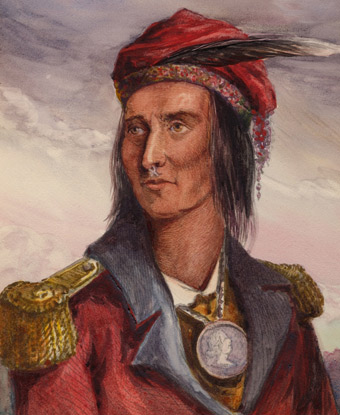
Portrait of the Shawnee military and political leader Tecumseh, ca. 1800-1813. He worked with his brother Tenskwatawa, known as 'The Prophet,' to unite American Indian tribes in the Northwest Territory to defend themselves against white settlers.

Tecumseh’s brother Tenskwatawa joined him at Prophetstown, also known as Tippecanoe in Indiana Territory and in 1808 the two men began recruiting a large multi-tribal community of followers under a message of resistance to settlers, the American government, and assimilation. Tecumseh traveled north to Canada and south to Alabama in an effort to recruit men to his cause. Meanwhile, William Henry Harrison, governor of Indiana Territory was negotiating treaties and utilizing American forces to put pressure on those tribes still in Indiana and especially those allied with Prophetstown. In 1809 Harrison, signed the Treaty of Fort Wayne which allotted him a massive amount of American Indian territory thus increasing Tecumseh’s efforts and amplifying his message. Tecumseh was away from Prophetstown on a recruitment journey when Harrison launched a sneak attack now known as the Battle of Tippecanoe. The American forces cleared the encampment and then burned it to the ground. It was a severe blow to the confederacy and a harbinger of war to come.

On June 1, 1812 under the advisement of President Madison, Congress declared war on Great Britain. In the Northwest Territory, American Indian tribes found themselves pulled in two separate directions – side with the British or with the Americans. Tecumseh and his confederacy sided with the British. He and his men were assigned to overtake the city of Detroit with Major General Isaac Brock. The siege of Detroit was a success due in no small part to Tecumseh’s military strategy. He continued to support British efforts under Major-General Procter at the Siege of Fort Meigs. The siege failed and morale waned as a result.

In the fall of 1813 as conditions around Detroit worsened, Procter began a retreat east toward Niagara. Tecumseh requested arms so that his men could stay in the Northwest Territory and continue to defend their lands. Procter agreed to make a stand at the forks of the Thames River. However, when forces reached the site communication broke down and some men deserted while others continued east. When the Americans attacked, large sections of forces broke leaving about 500 hundred American Indians to hold back 3,000 Americans. Tecumseh was fatally wounded in the battle. It is unknown who killed him or what happened to his remains. His death began a rapid decline in American Indian resistance and the War of 1812 is marked as the beginning of removal in the upper Midwest.

Piqua Shawnee
Piquashawnee.com

Monday, November 27, 2017

Tecumseh (U.S. National Park Service)


Portrait of Shawnee chief Tecumseh
Portrait of Shawnee chief Tecumseh based on sketch by Benson John Lossing
Attributed to Owen Staples

Quick Facts

Significance:Shawnee leader
Place of Birth:Scioto River, Ohio
Date of Birth:March 9, 1768
Place of Death:Chatham-Kent, Canada
Date of Death:October 5, 1813
Tecumseh began life in the Shawnee village of Piqua, Ohio on March 9, 1768 as a great meteor flashed and burned its way across the heavens. This event accounts for his name: The Shooting Star, or Celestial Panther Lying in Wait. Tecumseh grew to be a famous warrior and dynamic orator. These skills, paired with his belief that the white man would never rest until all American Indians were dispossessed, made him a powerful and influential force. 

Tecumseh conceived of an alliance of all remaining native people, from Canada to the Gulf of Mexico, from the prairies of the Midwest to the swamplands of Florida. All Indian people would set aside their ancestral rivalries and unite into a single movement to defend their culture, their homelands, and their very lives. 

Providing spiritual impetus for Tecumseh's movement was the teaching of his younger brother, known as Tenskwatawa, The Open Door, or The Prophet. In 1808, the Shawnee brothers established a new capital on the banks of the Wabash and Tippecanoe rivers, while Tecumseh traveled extensively in an effort to build his alliance. 

In the summer of 1811 Tecumseh traveled south to meet with the Creek, Chickasaw, and Choctaw people. The Shawnee leader had promised a sign of his power, and as he arrived in Alabama a huge comet appeared, brightening the skies and fading after his departure. Then, shortly after he left for Prophetstown, a series of violent earthquakes arched out of their epicenter in southeastern Missouri to destroy lives and property throughout the midwest and south. In the minds of the Creek and many others, Tecumseh had made good on his promises. 

Meanwhile, growing tensions between the U.S. and Great Britain exploded into war. Tecumseh saw the War of 1812 as his final opportunity to construct an independent Indian nation. He journeyed to Canada in July of 1812 and forged an alliance with the British. General Isaac Brock placed Tecumseh in command of all Native American forces with the understanding that, should the British and Indians be victorious, the Old Northwest would comprise an independent Indian nation under British protection. 

Despite a number of victories, this partnership turned fatal on October 5, 1813, at the Battle of the Thames River. Outnumbered three-to-one by General William Henry Harrison's army, the Indian and British forces were overwhelmed, without fortifications, and ultimately doomed.
Tecumseh's vision of a unified American Indian homeland was never fully realized. Within 35 years of Tecumseh's death at Moraviantown, many Native nations east of the Mississippi River were forcibly relocated. But today the great Tecumseh is still revered for his intelligence, leadership, and military skills, and he is honored throughout North America.


Read more about Tecumseh:

https://www.nps.gov/people/tecumseh.htm

www.piquashawnee.com

Piqua Shawnee


Tuesday, September 26, 2017

The Battle for Ohio and Adulthood - Tecumseh

The Battle for Ohio and Adulthood

From the Oxford Research Libraries

Tecumseh, Shawnee Land, Piqua Shawnee

From the beginning to the end of Tecumseh’s life, he and his people fought increasing numbers of settlers determined to cross the Ohio River. Settlers invaded Shawnee lands from the south, steadily expanding their sovereignty over all but the northwestern corner of Ohio, a region then known as the Great Black Swamp. For most Native peoples determined to remain in Ohio, the area of the Maumee and Auglaize region, known as “the Glaize,” became a site of resistance to American expansion. By 1785 villages led by two Shawnee leaders, Blue Jacket and Buckongehelas (Captain Johnny), and one Miami chief, Little Turtle, dotted the landscape. Situated within ten miles of each other for mutual defense, seven main towns (three Shawnee, two Delaware, one Miami, and a European trading town) joined forces. In 1790, and again in 1791, these allied villagers defeated American armies. In the second battle, the 1791 conflict now known as St. Clair’s Defeat, in which Tecumseh did not participate, the allied Indians inflicted approximately nine hundred casualties on a force of nearly seventeen hundred soldiers. Amounting to “possibly the worst defeat in US military history,” these victories convinced Little Turtle, Blue Jacket, and Buckongehelas that together they could defeat the Americans and preserve their Ohio homeland. 10 These pan-Indian forces tended to fight against irregular militias, composed of both Kentuckians and Ohioans. For example, Arthur St. Clair, the commanding general of the army during the 1791 defeat, was the first governor of the Northwest Territory.

The victories of 1790 and 1791 proved to be short-lived. After these American defeats, the U.S. government assumed greater control of American expansion, and assigned to General “Mad” Anthony Wayne the task of breaking the allied communities at the Glaize. Wayne was an accomplished leader and a tough-minded disciplinarian who had prepared his troops for battle. Before the main battle, he had the audacity to build Fort Defiance at the traders’ town on the Glaize. On August 20, 1794, Tecumseh, Tenskwatawa, and their brother Sauwauseekau fought Wayne’s army at Fallen Timbers with not many more than four hundred warriors. Sauwauseekau fell in battle while fighting alongside his brothers. The Battle of Fallen Timbers resulted in the devastating Treaty of Greenville (1795), which laid the groundwork for the United States’ ultimate possession of the Old Northwest.11

After Fallen Timbers, President George Washington and his increasingly confident administration enacted a series of land policies that were designed to divest Native peoples of their lands. In 1796, Henry Knox, Washington’s secretary of war, worked with Congress to create a system of government trading houses. Continued under both the Adams and Jefferson administrations, and run by the federal government, these trading houses turned Native peoples into debtors of the United States. Like Washington before him, President Thomas Jefferson recognized that when “debts get beyond what the individuals can pay, they [Indians] become willing to lop them off by a cession of lands.” William Henry Harrison, a man widely regarded as “Mr. Jefferson’s hammer,” believed that one white hunter killed “more game than five of the common Indians.” Trading houses and increasing numbers of frontiersmen decimated deer herds, leading to starvation of the Native peoples in Ohio in the first decade of the 19th century.12

As a young adult, Tecumseh lived in villages that had experienced more than two decades of incessant violence. Settlers who once had to cross the Appalachian Mountains to reach them now lived in close proximity. Older chiefs who had struggled against these migrants for decades came to believe that peace and accommodation, rather than continued resistance, offered the best hope for survival. For example, in the aftermath of the Battle of Fallen Timbers, both the Shawnee leader Black Hoof and Little Turtle became convinced that living with Americans, behind a constantly advancing frontier, offered the best strategy for the survival of their people. Approximately eight hundred people lived at Wapakoneta, Black Hoof’s village on the Auglaize River in northwestern Ohio. At the same time, not more than forty Shawnees supported the Shawnee brothers. Their foremost adherents tended to be younger men. Notable exceptions included Blue Jacket, one of Little Turtle’s and Black Hoof’s allies from the wars of the 1790s.13

However ardent their desire to return to their traditional beliefs and values, pan-Indian leaders proposed deep innovations in Indian country. First among them was the idea that a shared history of oppression at the hands of colonizers had enabled Native peoples to reimagine themselves as a race of people, rather than as members of separate tribes. In 1810, when he was at the height of his power, Tecumseh explained that Indians “could never be good friends with the United States until [the Americans] abandoned the idea of acquiring lands by purchase from the Indians, without the consent of all tribes.” Tecumseh argued that tribal leaders no longer had the authority to speak, or to sign treaties, with the United States.14

American officials recognized the threat posed by pan-Indian leaders of revitalization and reform. Historian Sami Lakomäki explains that revitalization movements are “common among colonized peoples around the globe.” Anthropologist A. F. C. Wallace defines these worldwide phenomena as “deliberate, organized, conscious effort(s) by members of a society to construct a more satisfying culture.” Tecumseh’s idea of a “more satisfying culture” hinged upon his ability to unite all of the Native peoples of the eastern half of North America. In his own words, Tecumseh aspired to “collect the different nations to form one settlement” in order to “preserve their country from all encroachments.”15

Federal officials ignored these demands and continued to sign treaties, largely in secret, with small numbers of leaders committed to older, tribal understandings of identity and politics. American officials hoped to transform tribes into nation-states modeled after the United States. Jefferson himself consulted with one of Tecumseh’s rivals, Black Beard, assuring him that “if the United States can be of any service in bringing you [the Shawnees] all together in one place, we will willingly assist you.” William Wells, then Indian agent at Fort Wayne, believed that “each nation should be collected together and some regular sistam [sic] of government established among them.” Jefferson, Wells, and Tecumseh’s arch-rival, the territorial governor of Indiana, William Henry Harrison, worked assiduously to defeat Tecumseh by consolidating authority in the hands of tribal leaders sometimes called “government chiefs” because of their desire to live peacefully, as sovereign nations, within the United States. Tecumseh recognized the U.S. strategy, accusing village chiefs of “ruining our Country” by ceding so much land to the Americans.16

Americans ignored the long history of Native reform and revitalization. They preferred to see revitalization movements as the brainchildren of competing empires determined to thwart the United States’ continental aspirations. They could not imagine that Native people themselves could develop such a sophisticated response to American expansion. For example, in February 1803, Secretary of War Henry Dearborn believed that “certain persons among Indian nations . . . were agents from the French or Spanish government” who were trying to “engage the several tribes” in a general war against the United States. General James Wilkinson, who was in 1805 governor of Louisiana Territory, feared a pan-Indian attack. Ironically, it was Wilkinson himself who dreamed of joining forces with another empire. In 1805 he was “secretly on the Spanish government’s payroll” in order to bring new territories into New Spain.17

Among Indians of the Great Lakes–Ohio valley region, Tecumseh embodied a social movement decades in the making. As historian Richard White has written, Tecumseh was “the culmination of the complicated village and imperial politics of the middle ground.”18 Religion was a vital component of the movement. For example, Tecumseh’s brother inspired the pan-Indian movement that Tecumseh later championed. For many years, Tecumseh lived in the shadow of this more famous younger brother, Tenskwatawa, or “the Open Door.” It had not always been so. Prior to Tenskwatawa’s conversion experience, sometime between April and November of 1805, this brother, also known as the “Shawnee Prophet,” had been called Lalawethika, or “the rattle/loudmouth.” He was blind in one eye from a hunting accident as a boy. And while he was coming of age, Chiksika had refused to take him along on his many hunting trips. According to most accounts, he was a failed hunter and an alcoholic who depended on his older brother to feed and clothe his wife and children. Lalawethika embodied the worst effects of colonialism. His circumstances began to improve when he began listening to “an aging shaman” known as Penagashea, or “Changing Feathers.”

After Penagashea died in 1804, Lalawethika fell into a trance so deep that his relatives believed he was dead. Miraculously, he awoke with a vision of reform that featured some of the components of sin and salvation common during the Second Great Awakening in places such as Cane Ridge, Kentucky. Tenskwatawa described an Indian hell in which alcoholics were forced to swallow molten lead for all time. But he also preached that polygamy, hide hunting, and relying on personal medicine bundles were sins. Both the five Shawnee divisions and individual Shawnees possessed medicine bundles that conferred special powers on those who took care of them. In asking his supporters to destroy them, Tenskwatawa asked his followers to abandon their individual power and follow him. For many, this had to have been a terrible choice, because it meant forsaking sacred powers conferred on them during their vision quests. Shawnees regarded their bundles as living beings, other-than-human persons, tasked with protecting the individual and advancing his interests. In abandoning them, Tenskwatawa hoped to lead them into a new way of life. He also demanded that Indian women married to non-Indian husbands must leave them and return to agricultural pursuits. In contrast, Indian men had to abandon domesticated animals, from chickens to cattle, and return to hunting for meat rather than trading. Those who ignored his demands, and continued to believe in their bundles, were often accused of directing the power contained within them against their followers. Witchcraft allegations led to the deaths of Shawnees, Wyandots, and Delawares in both Ohio and Missouri. Those who were killed tended to be tribal leaders, Christian converts, and men deeply invested in trading with the Americans. Such advocates of living in a plural world, behind the frontier, were an affront to Tenskwatawa and the reforms he promoted.19

In 1805 the Shawnee brothers established a new town at Greenville, Ohio, where they intended to consolidate all of the Shawnees and their neighbors in a single, revitalized community. It was a place freighted with meaning. They built their town near the site of the infamous Treaty of Greenville, where Native peoples resigned themselves to American power in the wake of the Battle of Fallen Timbers. Establishing a pan-Indian community there symbolized Native people’s desire to rise, phoenix-like, from the ashes of that defeat. But for American officials, Tecumseh offered a more philanthropic rationale. He explained: “The Shawnese have heretofore been scattered about in parties, which we have found has been attended with bad consequences. We are now going to collect them all together to one town that the chief may keep them in good order and prevent drunkenness from coming among them, and try to raise corn and stock to live upon.”20 Tecumseh and Tenskwatawa attempted to build their coalition at Greenville for the next three years. However, living in such close proximity to their Native opponents, as well as traders and government agents allied with them, was not a winning strategy. In the spring of 1808 they moved farther west, on the Tippecanoe River, a tributary of the Wabash River, which granted them easier access to western tribes that were more sympathetic to their cause. By May 1810, Harrison wrote, “The Prophets force at present consists in part of his own Tribe, which has always been attached to him; nearly all the Kickapoos, a number of winebagoes, some Hurons from Detrot who have lately joined him, a number of Potawatomis, 20 or 30 Muskoes or Creeks and some stragglers from the Ottawas. Chippways and other tribes in all perhaps from 6 to 800.”21

In a speech to Harrison in August 1808, Tenskwatawa proclaimed that his supporters “were once different people, they are now but one.” Such rhetoric belied the fact that most of these supporters came from lands to the north and west of the middle Ohio valley. Tribes such as the Kickapoos, Potawatomis, Ojibwes, and Ho-Chunks were central to the revitalization movement. In contrast, tribes in the vicinity of Greenville (1805–1808) and Prophetstown (1808–1811) opposed the reforms.
As their revitalization movement gained momentum, Governor Harrison fueled Tecumseh’s and Tenskwatawa’s popularity by confronting Native peoples between 1803 and 1809 with the most aggressive series of treaties they had ever encountered. His treaty making culminated with the Treaty of Fort Wayne, which ceded more than three million acres of land along the southern Indiana-Illinois border and east-central Indiana.22 These treaties galvanized his opponents, and Tenskwatawa became more and more bellicose. Harrison sent spies such as Michel Brouilett and John Tanner in an attempt to gauge the prospects of war. The Prophet discovered them and responded by telling Harrison “that his people should not come any nearer to him, that they should not settle on the Vermillion River—he smelt them too strong already.” Prophetstown became a prominent resting place for Potawatomis, Kickapoos, Sauks, Meskwakis, and Ho-Chunks on their way to consult and trade with the British at Amherstburg. To accommodate the traffic, village dwellers built a large dwelling they dubbed “The House of the Stranger.”23

Like most Americans, Harrison believed that the British were ultimately responsible for all anti-American actions on the frontier. He could not imagine that Native peoples acted on their own. In his opinion, they were little more than British pawns. And so, in an 1810 letter to Secretary of War William Eustis, he wrote, “I have as little doubt that the scheme originated with the British and that the Prophet is inspired by the superintendent of Indian affairs for Upper Canada, rather than the Great Spirit, from whom he pretends to derive his authority.”24

Between 1808 and 1811, Tecumseh traveled far and wide in search of people willing to join the revitalization movement. He visited the Sauks and Meskwakis in Illinois and Iowa, and his own kinsmen at Cape Girardeau, Missouri. But his central aim remained the unification of southern and northern tribes into a grand confederacy. Like so many Shawnee leaders before him, including Peter Chartier in the 1740s and, more recently, Black Beard in the first decades of the 19th century, Tecumseh had a deep connection with the large confederacies of the Southeast, and the Creeks and Cherokees in particular. His awareness of southeastern protocols, combined with his mother’s Creek lineage, gained Tecumseh favor among the Creeks. He arrived at Tukabatchee in mid-September, just in time for the meeting of the Creek national council. And it was here that Tecumseh competed for the Creeks’ attention with Benjamin Hawkins, the southern superintendent of Indian affairs. Hawkins advocated a “civilization plan” that included slave ownership, stock raising, and the privatization of land. In public speeches, Tecumseh asked his allies to “unite in peace and friendship among themselves and cultivate the same with their white neighbors.” But in Hawkins’s recollection of Tecumseh’s visit, he demanded that the Creeks “kill the old Chiefs, friends to peace; kill the cattle, the hogs, the fowls; do not work, destroy the wheels and looms, throw away your ploughs, and everything used by the Americans.”25 Small numbers of Creeks did travel with Tecumseh and fight with him during the War of 1812. But more importantly, Tecumseh helped to ignite the Redstick War of 1813–1814, a Creek civil war over Hawkins’s civilization plan that Tecumseh’s Creek supporters ultimately lost.

During Tecumseh’s travels, Tenskwatawa became the leader at Prophetstown. Aware of Tecumseh’s absence, Harrison seized the opportunity and marched north from Vincennes, along the Wabash River, to Prophetstown. Warriors tracked his army’s progress and, on November 6, sent a delegation in an attempt to forestall combat. But inside Prophetstown, the diverse inhabitants of the village called for war. Tenskwatawa headed their demands, and chose to initiate conflict with Harrison’s army in the predawn hours of November 7, 1811. The Battle of Tippecanoe lasted approximately two and a half hours. After their initial surprise, Harrison’s men rallied, and Tenskwatawa’s men retreated from the battlefield. When the dust settled, approximately 35 warriors had been killed. In contrast, 62 Americans had been killed and another 126 wounded.26 When Tecumseh learned of the battle, he threatened to kill Tenskwatawa. Indeed, their movement never again obtained the same level of support. Harrison’s men’s burned food stores and made it difficult for Prophetstown to rise to power once more. However, by disbursing Tecumseh’s and Tenskwatawa’s followers, Harrison vastly expanded the field of combat between settlers and Native peoples. The revitalization movement fragmented, but it did not fall apart.

Piqua Shawnee
www.piquashawnee.com 

Monday, September 11, 2017

The Trail of Tecumseh (1917) by Paul G. Tomlinson

The Trail of Tecumseh


Publication date
Digitizing sponsor Kahle/Austin Foundation
Language English
 
Preface:
Tecumseh has long been recognized as one of the most romantic characters in American history. A
Shawnee chieftain of boundless courage, devoted patriotism, and great tenacity of purpose, for many
years he was a source of perplexity as well as of trouble on the frontier.

Visit the Official Web Site of the Piqua Shawnee at Piquashawnee.com

Thursday, September 7, 2017

Powder Horn Tecumseh at the National Army Museum, London

National Army Museum - Chelsea London

Powder horn, 1812 (c).

 
Powder Horn is believed to have belonged to Tecumseh (1768-1813)

This powder horn is believed to have belonged to Tecumseh (1768-1813), a warrior chief of the Shawnee people, who were allied to the British in the American War of 1812. A powder horn was used to pour gunpowder into the barrel of a weapon.

NAM Accession Number

NAM. 1963-10-202-1

Copyright/Ownership

National Army Museum Copyright

Location

National Army Museum, Study collection

Object URL

https://collection.nam.ac.uk/detail.php?acc=1963-10-202-1


Visit the Official Web Site of the Piqua Shawnee  www.piquashawnee.com

Monday, August 28, 2017

Native American Chiefs & Leaders Series: Tecumseh

Native American Chiefs & Leaders Series: Tecumseh


“A single twig breaks, but the bundle of twigs is strong.”
These are words spoken by Chief Tecumseh, a Shawnee warrior who was a great orator and a fine leader. Tecumseh had the ability to bring tribes together and the ability to create respect among his contemporaries, Native American and white as well as ally and foe. Tecumseh’s words were revered as being honest and from his heart, yet tempered with sometimes biting honesty at the way he believed circumstances should be and the way they were.

Tecumseh
Tecumseh

It is the “single twig” quote that I find so very valuable because it rings just as true today as it did in the early 1800s. Tecumseh realized that the numerous Native American tribes in and around the Ohio River valley were much stronger as a united “bundle of twigs” against the American militia of the time. He understood that most anything is stronger and able to withstand external pressure when reinforced with other allies that share similar values and beliefs.

Tecumseh experienced a lifetime of strife as the edge of the United States kept expanding into what had been Native American lands. His father was killed in a battle in West Virginia with state militia as they pushed west, and Tecumseh himself had to move several times while growing up as their settlements pushed them further and further west.

During the War of 1812, Tecumseh felt he would be better served to assist the British in their fight against the U.S. (To this point, my own great, great grandfather also fought against the U.S. in this same war.)  Tecumseh believed the U.S. would never honor a treaty and that it was not possible for a treaty – words on paper – to keep the whites from encroaching on and stealing their lands whenever they saw fit.

To this end, Tecumseh stood for the principle of doing what was right:  fighting to protect the U.S. from continuing to take Native American lands while violently killing their previous inhabitants or simply forcing them farther and farther westward. Tecumseh used his oratory skills to successfully unite many tribes against the U.S. He continued speaking out against the way tribes were treated by the U.S. until his death at the 1813 Battle of the Thames in Canada (during the war).
Pub. at http://bit.ly/CanadaPost_ca

While Tecumseh was as much a human being as any one of us, he possessed a very special talent for speaking about matters in a way that transcended ethnicity or alliances and simply reverberated as human.

Tecumseh’s main legend was that by coming together, uniting for a noble and just cause, you can accomplish so much more, and be stronger, and able to withstand much more as a collective than as a singular person or entity… That when you come together “as a bundle of twigs” you are strengthened not just in physical fortitude but also in spirit… That you become the sum of your parts.

Applying Tecumseh’s viewpoint and way of life today, we can all look for opportunities to unite and work together, to see and use the best in all of us for the greater good, in business and in life.

Wednesday, August 23, 2017

Tecumseh Biography.com Military Leader (c. 1768–1813)

Tecumseh Military Leader (c.1768-1813)

BIOGRAPHY.COM
April 18, 2016


Young Warrior

During his teenage years, Tecumseh joined a confederation of Native Americans led by Mohawk chief Joseph Brant. Brant encouraged tribes to pool their resources and defend their territory against the white man’s encroachment. Tecumseh led a raiding party attacking white settlers’ boats making their way down the Ohio River and was successful in cutting off their access for a time. However, Tecumseh was appalled by the brutality displayed by both white and Native Americans, and after witnessing a white man burned at the stake, Tecumseh vehemently chastised his fellow tribesmen for their actions.

In 1791, under the leadership of Shawnee chief Blue Jacket, Tecumseh led a scouting party against U.S. General Arthur St. Clair at the Battle of the Wabash, where 952 of 1,000 American soldiers were killed. In June 1794, Tecumseh, led an unsuccessful attack against Major General Anthony Wayne at Fort Recovery, and two months later, his force was decidedly defeated at Fallen Timbers

Forming a Confederation of Native American Tribes

Tecumseh was so bitter about the defeat that he refused to attend the subsequent negotiations or to acknowledge the Treaty of Greenville. He sharply criticized the “peace” chiefs who signed away land that he believed wasn’t theirs to give, asserting that the land was like the air and water, a common possession of all Native Americans.

With a small contingency of a few hundred tribesmen, around 1808 Tecumseh traveled to what is now Indiana and joined his brother Tenskwatawa, who had recently become a prominent Native American religious leader known as the Prophet.

Using his superior oratory skills, over time Tecumseh transformed his brother’s religious following into a political movement, discouraging Native Americans from assimilation into the white world. Headquartered at Prophetstown, near the juncture of the Tippecanoe and Wabash rivers, Tecumseh began recruiting different tribes throughout the Northwest Territory and southern United States.


 READ the Full Biography at:  
 https://www.biography.com/people/tecumseh-9503607

Visit the Official Website of the Piqua Shawnee at www.piquashawnee.com

Tuesday, August 22, 2017

A Native Nations Perspective on the War of 1812 - PBS.ORG

A Native Nations Perspective on the War of 1812

By Donald Fixico
PBS.ORG


The War of 1812 was an important conflict with broad and lasting consequences, particularly for the native inhabitants of North America.  During the pivotal years before the war, the United States wanted to expand its territories, a desire that fueled the invasion of native homelands throughout the interior of the continent. Tribal nations of the lower Great Lakes, including the Shawnee, Potawatomi, Ojibwa, and others saw their lands at risk.  The same was true for the Muscogee Creek, Seminole, Choctaw, Cherokee and Chickasaw in the south.

The Native leaders who emerged in response to this expansion shared a single concern, that of protecting tribal lands. There were Indians who sided with the Americans -- Red Jacket and Farmer’s Brother led a Seneca faction to help the Americans at the Battles of Fort George and Chippewa. But most Indian nations sided with the British against the U.S, believing that a British victory might mean an end to expansion.  In all, more than two dozen native nations participated in the war. In addition to the Lower Great Lakes Indians, led by Tecumseh, and Southern Indians, the Mohawks fought under Chief John Norton to hold onto their lands in southern Quebec and eastern Ontario.

Read the full essay, that covers these pivotal events:
The Indian Confederation under Tecumseh

Tippecanoe and the Aftermath 

The Loss of a Leader 

About the Author:  Donald Fixico is the Distinguished Foundation Professor of History at Arizona State University, and the author of Treaties with American Indians: An Encyclopedia of Rights, Conflicts and Sovereignty and Rethinking American Indian History. 

http://www.pbs.org/wned/war-of-1812/essays/native-nations-perspective/

Visit the Official Website of the Piqua Shawnee Tribe of Alabama 

Monday, August 21, 2017

6 Things You May Not Know about Tecumseh

6 Things You May Not Know about Tecumseh

http://www.history.com/news/6-things-you-may-not-know-about-tecumseh
History.com


Tecumseh lost three close family members to frontier violence.
2. Tecumseh took part in the worst defeat ever inflicted by Native Americans on U.S. forces.
3. Tecumseh tried to unite all tribes against white expansion.
4. The U.S. Army invaded while Tecumseh was away.
5. Tecumseh allied himself with the British during the War of 1812.
6. Many myths sprang up around Tecumseh.

Wednesday, August 16, 2017

History Channel - Tecumseh

Native American History - Tecumseh

History Channel (2009) www.history.com


Shawnee Indian political leader and war chief Tecumseh (1768-1813) came of age amid the border warfare that ravaged the Ohio Valley in the late 18th century. He took part in a series of raids of Kentucky and Tennessee frontier settlements in the 1780s, and emerged as a prominent chief by 1800. Tecumseh transformed his brother’s religious following into a political movement, leading to the foundation of the Prophetstown settlement in 1808. After Prophetstown was destroyed during the Battle of Tippecanoe, the Shawnee chief fought with pro-British forces in the War of 1812 until his death in the Battle of the Thames.