Showing posts with label Shawnee. Show all posts

Friday, September 28, 2018

The War of 1812 and Kentucky's Role

https://www.ket.org/history/the-war-of-1812-and-kentuckys-role/

By Joyce West | 6/07/17 9:30 AM

Often called the United States’ “forgotten war,” the War of 1812 left an indelible mark on our nation’s history. Kentuckians played a vital role and paid dearly for it: 64 percent of Americans killed in the war were Kentuckians.

Kentucky Life followed the trail of Kentucky’s soldiers who fought in the war, from Michigan to New Orleans.

What prompted so many Kentuckians to join the fight?
Watch the Video https://ket.org/episode/KKYLI+002103
“The big thing here was…the history between the Indian nations and the British and the citizens of the commonwealth of Kentucky,” explained John Trowbridge, command historian of the Kentucky National Guard. Kentucky was the site of continuing warfare between settlers and the Native Americans, who were backed by the British.

Kentuckians were eager to fight, and Lexington’s Henry Clay was a leader of the War Hawks in Congress.
Six congressmen from Kentucky fought in the war. “People who voted for the war actually followed up their votes and fought in the war, and some of them died in the war,” said James C. Klotter, Ph.D., state historian of Kentucky.

Leading men into battle were William Henry Harrison, governor of Indiana territory, as well as Isaac Shelby, who was serving his second term as governor of Kentucky.
Another faction in the conflict was a confederation of numerous Native American tribes formed to block American expansion. Leading this alliance was the Shawnee leader Tecumseh. “Tecumseh is quite an incredible figure,” said John Bowes, Ph.D., associate professor history at Eastern Kentucky University. “Tecumseh is seen as the leader of this movement, this unique movement seeking to develop this pan-Indian confederacy that is bringing all these different tribes together.”
The First Nations confederacy had as its spiritual leader Tecumseh’s half-brother, known as the Prophet. “What is so often marginalized and put to the side is the very spiritual foundation for that confederacy,” Bowes said.

The Militia and the Long Rifle
When it came time to go to war, men of the commonwealth brought with them their Kentucky long rifles. Harold Edwards, historian and gunsmith at the William Whitley House in Crab Orchard, said the rifle was used every day by the settlers for hunting and protecting the family as well as for sport.
“It was their pastime, and they became very proficient with it. You know, the average range was probably a hundred yards,” Edwards said.

The British were still fighting in Napoleonic style, marching en masse with muskets, which had a range of 50-60 yards, Edwards said. “It was an old style of warfare dying fast, and unfortunately they learned it a little too late,” said Edwards.

What kind of soldiers were these Kentuckians? There is debate about that, Klotter said.
“Were they good soldiers or bad soldiers? They were a little of both,” said Klotter. “They were really good fighters, when they fought. But the militiamen of Kentucky were not trained. They wanted a quick fight, and then go home. They weren’t particularly good in following orders sometimes.”
This reputation led the British to compare the Native Americans with the undisciplined Kentucky fighters, said Trowbridge.

“The warfare in the West was viewed as a bit more savage,” said Bowes. “For the Americans it’s because of the presence of all these Indian allies. And for the British, it’s in part because of the Kentuckians.”

Remember the Raisin
On Aug. 12, 1812, more than a thousand Kentuckians headed north toward Michigan in summer clothing for what they expected to be a short war.

“After fighting their way up here…they arrived here in the winter of 1813, January, when Michigan was experiencing a very cold winter,” said Dan Downing, chief of interpretation at the River Raisin Battlefield National Park in Michigan.

Historians believe about 100 men died from starvation and exposure to the elements. Even so, the Americans won a victory at Frenchtown over the British. Then they set up for the next battle in haste.
“They don’t fortify the position,” said Klotter. “They know the British are on their way, but they put people in open fields, without any trenches or any kind of earthworks to protect them.”
The British and their Native American allies attacked at 6 in the morning on Jan. 22, 1813. One wing of the American forces was massacred, Klotter said. The other wing fought well but ran out of ammunition and was surrounded. The Americans surrendered, with 500 captured, 400 dead, and 100 who got away, Klotter said.

The captured, wounded men who could not travel stayed behind in cabins. “The great controversy is whether or not the British did all they could to protect those who were unable to travel back to Fort Malden in Canada,” said Downing.

The Native Americans, remembering the Kentuckians’ previous attacks on their villages, sought vengeance. “When an opportunity came to exact revenge, they took the opportunity,” said Downing.
The Native Americans went from cabin to cabin, killing 65 men, in what became known as the massacre of the River Raisin.

The Battle of the River Thames
More defeats that year lowered morale among the Americans, but the tide turned in the fall of 1813 when Americans won control of Lake Erie.

The British and their allies were retreating from Detroit into Canada. “From that moment forward, Tecumseh’s angry,” said Bowes. “Tecumseh cannot believe that the British are essentially surrendering that territory.”

On Oct. 5, 1813, the Kentuckians met the British and their allies again, this time in Ontario, at the Battle of the River Thames.

Twenty mounted Kentuckians, commanded by 64-year-old William Whitley of Kentucky, charged the Native American lines in what was called “Forlorn Hope.” The strategy was to draw fire, then send on the American infantry before the Native Americans could reload. “Only a couple of guys actually survived that charge,” said Trowbridge.

The British pulled back, and Tecumseh was killed. Whitley also was killed, and is buried on the battlefield in an unmarked grave.

The End of the War
After the victories in the West, the flashpoint of the war shifted eastward, to Washington, D.C. and Baltimore. The United States was pushed to the brink of bankruptcy because of the British naval blockade. Britain was war weary with its battles in North America and in Europe with Napoleon.
Negotiations to end the war began, and both sides tried to secure as much territory as possible.
All eyes turned to the port of New Orleans. The British sent a fleet of 8,000 men to take the city. Kentuckians were called to defend the port.

“The people of Kentucky were warmly welcomed here to New Orleans in anticipation of the battle,” said April Antonellis, the War of 1812 Bicentennial Coordinator for the National Park Service.
Andrew Jackson assembled a force of 5,000 to defend the city against the British. On Jan. 8, 1815, the Battle of New Orleans was waged on an old sugar plantation just outside the city limits.
The British, again relying on tactics used in the Napoleonic wars, were slaughtered by the Americans firing long rifles from behind earthworks. In a little more than 25 minutes, the British lost 2,600 men. The Americans lost 71.

“There were errors on the part of the British, leaving some supplies behind, most notably scaling ladders that they were supposed to use to come up over this rampart that the Americans had created,” Antonellis said.

The War of 1812 is often called the Second American Revolution.

“If the British had won this battle, New Orleans certainly would have become a British colony or a British territory,” she said. “I think it’s easy to say that much of the United States could have easily fallen to the British as well. Anywhere west of the Appalachian Mountains that had to trade on the Mississippi River, they would have to pass through the port of New Orleans. If that’s a British city, then it would be very difficult to maintain American control in that area.”

Who won the war? Strategists say it was a draw. In the end, Native Americans paid the ultimate price.
The treaty ending the War of 1812 was negotiated without their participation, and the Native American alliance lost territory it had hoped to hold. In the years after the war’s end, Indiana, Alabama, Illinois, and Mississippi became states.

“The floodgates opened in the aftermath of the war of 1812,” said Bowes.

Piqua Shawnee

"Piqua Shawnee"

Piqua Shawnee Tribe

Wednesday, September 26, 2018

Shawnee Indians - West Virginia

https://www.wvencyclopedia.org/articles/383
Williams, John Alexander "Shawnee." e-WV: The West Virginia Encyclopedia. 29 October 2010. Web. 26 September 2018.

The Shawnees were the southernmost of the Algonquian-speaking peoples of the eastern woodlands; hence their name, which derives from ‘‘southerner’’ in these languages. Originally centered in the mid-Ohio Valley, they descended, according to some archeologists, from the pre-historic Fort Ancient culture whose remains have been found in the Kanawha Valley, among other places. But they left this homeland during the 17th century, presumably in response to Iroquois attacks during the Beaver Wars, and were recorded by Europeans in such widely separated locations as Kentucky, Alabama, South Carolina, and Pennsylvania. A Shawnee companion of the French explorer, Robert Cavelier de la Salle, even traveled to Paris. The Shawnees entered frontier annals on a regular basis after Quaker missionaries found some of them living on Pequa Creek near present Lancaster, Pennsylvania, in 1692.

It is possible that the 17th century record represents the separate wanderings of the Shawnee’s principal divisions—Chalakaatha, Mequashake, Pekowi, Hathawikila, and Kishpoko—since the divisions traditionally lived in separate village clusters and were only loosely confederated. European transcriptions of these names in places such as Chillicothe and Piqua, Ohio, Sewickley, Pennsylvania, and Pickaway, West Virginia, testify to some of these wanderings. Thus it was the Pekowi who began the Shawnee return to the Ohio Valley when they moved from eastern to western Pennsylvania in 1728. By 1750, some 1,200 Shawnee were living in villages along the Ohio River, from which they launched attacks against the Virginia frontier during the French and Indian War and Pontiac’s Rebellion. Later they moved their villages to the Scioto River in southern Ohio, and after their defeat in Lord Dunmore’s War they moved again to the Miami River headwaters in southwest Ohio. They consistently claimed Virginia west of the Alleghenies to be their hunting lands, along with most of Kentucky. They also denied the right of the Iroquois to dispose of this territory, as the Iroquois did in land sales to colonial governments in 1744 and 1768.

Under the influence of a nativist religious revival first preached by the Delaware prophet Neolin, Shawnees took the lead in defending the Ohio country from the white advance across the Appalachians in Western Virginia and Kentucky and also sent emissaries to other tribes to preach the necessity of Indian unity. These efforts suffered a temporary setback with the Shawnee defeat in Dunmore’s War, but they continued during the American Revolution. During 1775–76, the Mequashake Shawnees led by Cornstalk adopted a neutralist position between the British and the rebel colonists, but members of other Shawnee bands formed war parties on their own or in concert with Mingos and militant Delawares. When Cornstalk was imprisoned and then murdered at Fort Randolph in 1777, the Mequashake joined the other bands in general warfare all along the frontier. White settlements along the Ohio, in the Kanawha Valley, and in Kentucky bore the brunt of these attacks, which continued through 1782, culminating in the famous second siege of Fort Henry at Wheeling in September of that year.

The Shawnees, along with other Indians resident in Ohio, were outraged when the British accepted Virginia’s claim to the territory between the Great Lakes and the Ohio and ceded this territory to the United States in the 1783 Treaty of Paris, following the Revolution. Disputing the validity of the British cession, Shawnee militants urged the other Ohio tribes and also the Cherokees to fight on. Assaults on the frontier and on white settlers traveling the Ohio River multiplied after 1786 and continued into the early 1790s. Though Euro-American beachheads were established in 1788 north of the Ohio at Marietta and Cincinnati, native resistance succeeded in defeating armies sent against their villages in 1790 and 1791. Only after a combined force of regular troops and militia commanded by Gen. Anthony Wayne defeated a Shawnee-led Indian force at the Battle of Fallen Timbers in northwest Ohio in 1794 did the militants agree to give up their Ohio lands.

The Treaty of Greenville in 1795 cleared the way for white settlement on both banks of the Ohio and ended the threat of raids in what is now West Virginia. Even then, however, the militant Shawnee spirit remained unconquered. In the early 19th century, a new revitalization movement spread under the leadership of the prophet Tenskwatawa and his warrior brother Tecumseh. This movement was centered in new Shawnee villages in what is now Indiana and did not directly affect West Virginia.


This Article was written by John Alexander Williams
Last Revised on October 29, 2010

Piqua Shawnee
Piqua Shawnee Tribe
"Piqua Shawnee"

Tuesday, September 25, 2018

Shawnee Indians - Texas

SHAWNEE INDIANS

TSHA - Texas State Historical Association
By Carol A. Lipscomb
 
SHAWNEE INDIANS. The Shawnees were one of many immigrant tribes from the United States who entered Texas in the late eighteenth and early nineteenth centuries. This eastern woodlands tribe originally inhabited the Ohio and Cumberland valleys in what is now Kentucky. Some Shawnee groups drifted farther south into the Piedmont area of Virginia, the Carolinas, and Georgia. The name Shawnee means "southerner" and identifies the tribe as one of the southernmost members of the Algonkian linguistic family.

The Shawnees moved about in search of game during winters. In the growing season they settled in rather large villages where they raised crops of corn, squash, and beans. The tribe carried on extensive trade in animal skins and salt; production of the latter was a major industry for the Shawnees, who extracted the mineral from the many salt springs in Kentucky. Because building material was abundant in the eastern woodlands, the tribe built permanent houses, called wigwams, and abandoned them when they moved. The wigwams were single-family dwellings made of poles and bark that could easily be constructed in a few days.

Shawnee clothing was made of dressed skins and consisted of a shirt for men and a longer overblouse for women. Both sexes wore leggings and moccasins. Their clothing was often decorated with dyed porcupine quills, bright-colored feathers, and paint.

The Shawnees came into contact with French missionaries, explorers, and fur traders in the mid-seventeenth century. During that same period, southern Shawnees began trading with the Spanish in Florida. By the early eighteenth century, the British were moving into Shawnee territory, and the tribe began a westward migration. During the American Revolution, the Shawnees fought fiercely to retain their hunting grounds, but after 1783 the rapid influx of whites into the trans-Appalachian region scattered them. By the early nineteenth century the tribe was spread from Ohio to Alabama.
Around 1790 a major Shawnee band migrated west of the Mississippi River to the area of Cape Girardeau, Missouri. By 1815 an estimated 1,200 Shawnees were settled there. They were joined by a large band of Delawares, and the two tribes became closely associated. In 1822 a band of the Missouri Shawnees, numbering about 270 families, migrated south into Texas, which was then a part of Mexico. They settled on the south bank of the Red River near Pecan Point. The Texas Shawnees petitioned the Mexican government for land, and in 1824 the governor of Coahuila and Texas, Rafael Gonzales, authorized the legislature to grant the tribe one square mile of land per family along the south bank of the Red River. The Shawnees became allies of the Cherokees and other immigrant tribes living in Texas, and all enjoyed a generally peaceful relationship with Mexican officials and a growing number of Anglo-American settlers. The Shawnees even aided the Mexicans in their war with the Comanches. In 1832 a party of Shawnees, led by chief John Linney, defeated a band of Penateka Comanches at Bandera Pass, west of San Antonio. When Texas became a republic, officials of the new government, under the leadership of President Sam Houston, worked to maintain good relations with the immigrant Indians, including the Shawnees. The tribe and their allies signed a treaty with Texas officials in February 1836. The agreement, however, which granted the Indians a designated tract of land, was never ratified by the Texas Senate. Houston's successor, Mirabeau B. Lamar, saw the immigrant Indians as unauthorized intruders and wanted them removed from Texas. In the summer of 1839, amid rumors of collusion between them and the Mexicans, he provoked the Cherokee War, which ultimately affected all of the immigrant Texas tribes. Lamar sent a message to Linney and the Shawnees asking them to remain neutral in the conflict, and most of the tribe complied with the request.

After the Cherokees were defeated, Shawnee leaders, including Chief Elanie, negotiated a treaty with Texas officials at Nacogdoches. According to its terms, the tribe promised to leave Texas peaceably if they received payment for improvements on their land, deserted crops, and all property left behind. The government agreed to provide transportation and supplies for the relocation. There is some evidence that Texas officials honored those treaty commitments, and by early 1840 most of the Texas Shawnees had moved north of the Red River into Indian Territory. The tribe settled on the Canadian River near the mouth of the Little River and became the nucleus of the present Absentee band of Shawnees. In 1846 they were joined by a large segment of Shawnees who had been forced to leave Kansas. The few scattered Shawnees who remained in Texas after the Cherokee War were consolidated in 1857 with remnants of other tribes on the Brazos Indian Reservation, near the site of present Graham. But the Texas reservation system was shortlived, and in 1859 the reserve Indians, including the Shawnees, were moved to Indian Territory. Those Shawnees joined the Absentee band on the Canadian River. Today many Shawnees still reside in eastern Oklahoma. The Loyal or Cherokee band is centered around White Oak in the northeastern corner of the state. The Absentee band is located in central Oklahoma between Tecumseh and Norman, and the Eastern band lives near Miami. Unlike most tribes now resident in Oklahoma, the Shawnees have managed to preserve to the present day their complete cycle of ceremonial dances and other religious observances.
 
Piqua Shawnee
"Piqua Shawnee"
Piqua Shawnee Tribe
 

Tuesday, September 18, 2018

Shawnee: Arkansas

Shawnee

 
Among the immigrant Native Americans who lived in territorial Arkansas were several Shawnee communities. They came from Indiana and Missouri at the invitation of the Cherokee after the Treaty of 1817 created the Cherokee Nation on land in the Ozarks between the White and Arkansas rivers. The Shawnee, who built settlements on Crooked Creek and White River, departed after more than a decade of life in Arkansas.

The Shawnee were a large Algonkian-speaking tribe, widely scattered across the eastern woodlands. By the middle of the eighteenth century, the majority of them were living in the area both north and south of the Ohio River. Euro-American settlers from the east brought on years of violence. In a peace treaty in 1774, the Shawnee were forced to cede Kentucky, and the continuing hostilities led some Shawnee in 1779 to move west across the Mississippi River to a large grant south of Ste. Genevieve that had been given by the Spanish government. From that new location, they became familiar with the Ozarks and the western prairies.

After the death of Tecumseh and the collapse of his fight against the United States in 1813, one faction of the Shawnee sought ways to coexist with the Americans, and some saw the migration of the whole tribe to the west as a good strategy. When the Western Cherokee, living in the Ozarks after 1817, became embroiled in skirmishes with the Osage, they invited eastern tribes, including the Shawnee, to move to their land west of the White River. One group, led by Quatawapea, also known as Captain or Colonel Lewis, settled on the White River, with their major town at Shawneetown, a location that later became Yellville (Marion County).

As guests of the Cherokee, the Shawnee were part of a larger group of immigrants into the White River Valley, a group that included the Delaware, Piankashaw, Miami, and other Indian groups. If they ever participated with the Cherokee in military campaigns against the Osage, the documents do not record it. No recorded instances exist of hostilities between the Shawnee and the American settlers, although the latter petitioned Washington for a military garrison for protection. In later years, several of the early settlers wrote their memoirs of that time, and they included several accounts of unpleasant encounters between the two groups, as well as visits to the Shawnee Green Corn ceremonies, hunting together, and a Shawnee-American marriage.

In 1828, the Western Cherokee entered a new treaty arrangement with the United States in which their Ozark holdings were traded for land in Indian Territory, present-day Oklahoma. They soon moved west and established Tahlequah, where the Cherokee tribal government remains today. Their Indian guests, left as squatters on government land, also moved away from Arkansas during the next few years. By 1833, the Shawnee had gone to Texas and Indian Territory, and the Ozark land was again open to American settlers. Modern Shawnee have few records of the Arkansas period in their complex history.

For additional information:Edmunds, R. David. The Shawnee Prophet. Lincoln: University of Nebraska Press, 1983.

Foreman, Grant. Indians and Pioneers: The Story of the American Southwest before 1830. Norman: University of Oklahoma Press, 1930.

Ingenthron, Elmo. Indians of the Ozark Plateau. Point Lookout, MO: School of the Ozarks Press, 1970.

Jeffery, A. C. Historical and Biographical Sketches of the Early Settlement of the Valley of White River Together with a History of Izard County. Edited by Dale Hanks. Richmond, VA: The Jeffery Historical Society, 1973.

Johnston, James J. “Searcy County Indians in Tradition and History.” Mid-America Folklore 12 (Spring 1984): 24–31.

Lankford, George E. “Shawnee Convergence: Immigrant Indians in the Ozarks.” Arkansas Historical Quarterly 58 (Winter 1999): 390–413.

Sugden, John. Tecumseh: A Life. New York: Henry Holt and Co., 1997.

Turnbo, Silas C. Turnbo’s Tales of the Ozarks: Schools, Indians, Hard Times and More Stories. Edited by Desmond Walls Allen. Conway, AR: Arkansas Research, 1987.

George E. Lankford
Batesville, Arkansas
Last Updated 6/21/2010
"Piqua Shawnee"
Piqua Shawnee
Piqua Shawnee Tribe

Monday, September 17, 2018

History of The Shawnee: Part 3

PART 3:
As published in the Official Newsletter of the Piqua Shawnee (Fall 2018)
By Barbara Lehmann, Piqua Shawnee Tribal Historic Preservation Officer
 
Barbara’s History Corner:
 
Bezallion informed the governor that the Shaonois of Carolina he was told had killed several Christians; whereupon the government of that province raised the said flat headed Indians, and joined some Christians to them, besieged and have taken, as it is thought, the said Shaonois town.” Those who escaped probably fled to the north and joined their kindred in Pennsylvania. In 1708 Gov. Johnson, of South Carolina, reported the “Savannahs” on Savannah River as occupying 3 villages and numbering about 150 men 6. In 1715 the “Savanos” still in Carolina were reported to live 150 miles northwest of Charleston, and still to occupy 3 villages, but with only 233 inhabitants in all.

A part of those who had come from the south in 1694 had joined the Mahican and become a part of that tribe. Those who had settled on the Delaware, after remaining there some years, removed to the Wyoming valley on the Susquehanna and established themselves in a village on the west bank near the present Wyoming, Pennsylvania. It is probable that they were joined here by that part of the tribe which had settled at Pequea, which was abandoned about 1730. When the Delawares and Munsee were forced to leave the Delaware River in 1742 they also moved over to the Wyoming valley, then in possession of the Shawnee, and built a village on the east bank of the river opposite that occupied by the latter tribe. In 1740 the Quakers began work among the Shawnee at Wyoming and were followed two years later by the Moravian Zinzendorf. As a result of this missionary labor the Shawnee on the Susquehanna remained neutral for some time during the French and Indian war, which began in 1754, while their brethren on the Ohio were active allies of the French. About the year 1755 or 1756, in consequence of a quarrel with the Delawares, said to have been caused by a childish dispute over a grasshopper, the Shawnee abandoned the Susquehanna and joined the rest of their tribe on the upper waters of the Ohio, where they soon became allies of the French. Some of the eastern Shawnee had already joined those on the Ohio, probably in small parties and at different times, for in the report of the Albany congress of 1754 it is found that some of that tribe had removed from Pennsylvania to the Ohio about 30 years previously, and in 1735 a Shawnee band known as Shaweygria (Hathawekela), consisting of about 40 families, described as living with the other Shawnee on Allegheny river, refused to return to the Susquehanna at the solicitation of the Delawares and Iroquois. The only clue in regard to the number of these eastern Shawnee is Drake’s statement that in 1732 there were 700 Indian warriors in Pennsylvania, of whom half were Shawnee from the south. This would give them a total population of about 1,200, which is probably too high, unless those on the Ohio are included in the estimate.

Having shown the identity of the Savannah with the Shawnee, and followed their wanderings from Savannah river to the Ohio during a period of about 80 years, it remains to trace the history of the other, and apparently more numerous, division upon the Cumberland, who preceded the Carolina band in the region of the upper Ohio river, and seem never to have crossed the Alleghanies to the eastward.
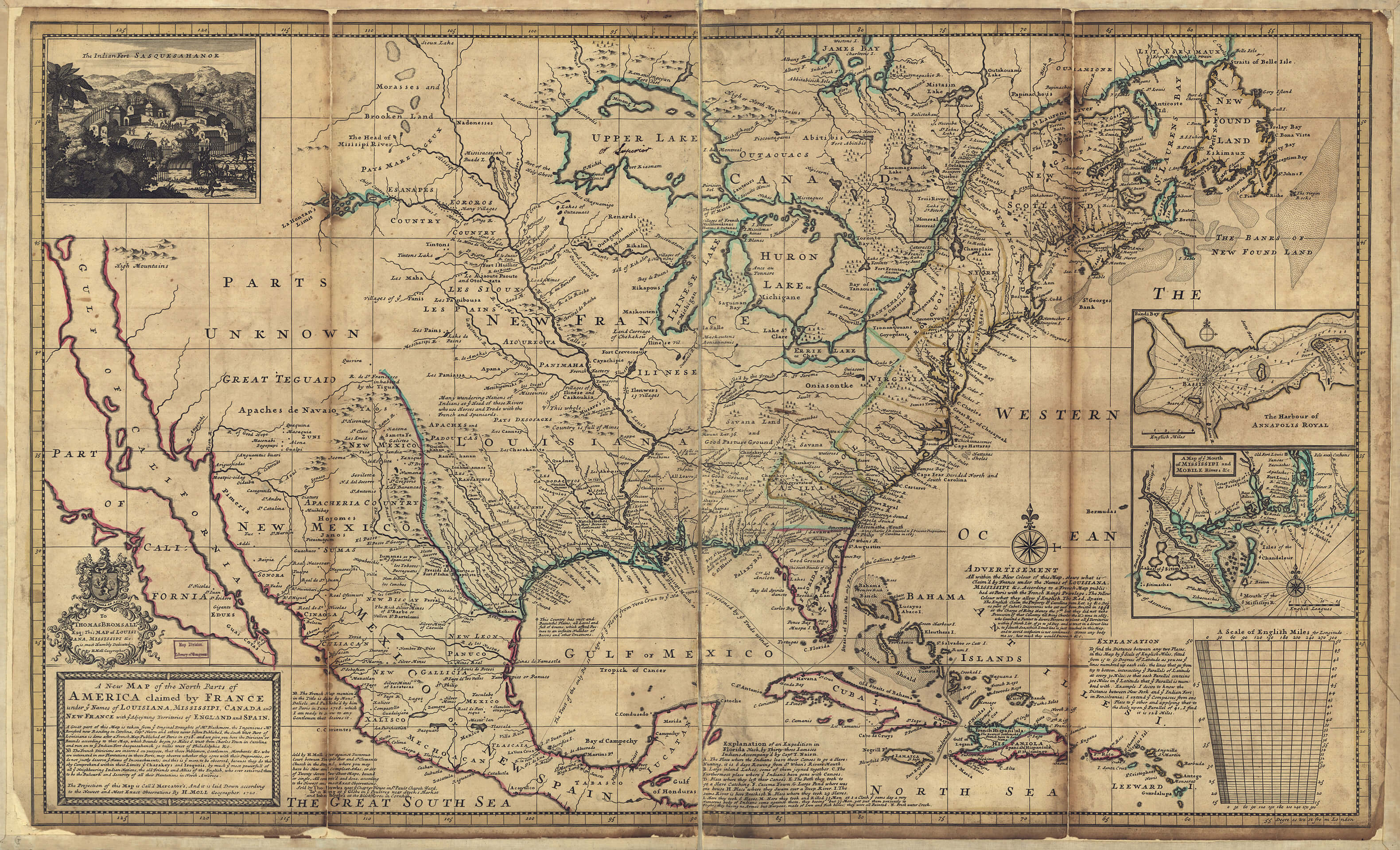
Moll-Map-of-1720-small
Moll’s map of 1720 has “Savannah Old Settlement” at the mouth of the Cumberland, showing that the term Savannah was sometimes applied to the Western as well as to the eastern band
These western Shawnee may possibly be the people mentioned in the Jesuit Relation of 1648, under the name of “Ouchaouanag,” in connection with the Mascoutens, who lived in northern Illinois. In the Relation of 1670 we find the “Chaouanon” mentioned as having visited the Illinois the preceding year, and they are described as living some distance to the south east of the latter. From this period until their removal to the north they are frequently mentioned by the French writers, sometimes under some form of the collective Iroquois name Toagenha, but generally under their Algonquian name Chaouanon. La Harpe, about 1715, called them Tongarois, another form of Toagenha. All these writers concur in the statement that they lived upon a large southern branch of the Ohio, at no great distance east of the Mississippi. This was the Cumberland River of Tennessee and Kentucky, which is called the River of the Shawnee on all the old maps down to about the year 1770.
 
When the French traders first came into the region the Shawnee had their principal village on that river near the present Nashville, Tennessee. They seem also to have ranged northeastward to Kentucky River and southward to the Tennessee. It will thus be seen that they were not isolated from the great body of the Algonquian tribes, as has frequently been represented to have been the case, but simply occupied an interior position, adjoining the kindred Illinois and Miami, with whom they kept up constant communication. As previously mentioned, the early maps plainly distinguish these Shawnee on the Cumberland from the other division of the tribe on Savannah River.

These western Shawnee are mentioned about the year 1672 as being harassed by the Iroquois, and also as allies and neighbors of the Andaste, or Conestoga, who were themselves at war with the Iroquois. As the Andaste were then incorrectly supposed to live on the upper waters of the Ohio River, the Shawnee would naturally be considered their neighbors. The two tribes were probably in alliance against the Iroquois, as we find that when the first body of Shawnee removed from South Carolina to Pennsylvania, about 1678, they settled adjoining the Conestoga, and when another part of the same tribe desired to remove to the Delaware in 1694 permission was granted on condition that they make peace with the Iroquois. Again, in 1684, the Iroquois justified their attacks on the Miami by asserting that the latter had invited the Satanas (Shawnee) into their country to make war upon the Iroquois. This is the first historic mention of the Shawnee evidently the western division in the country north of the Ohio River. As the Cumberland region was out of the usual course of exploration and settlement, but few notices of the western Shawnee are found until 1714, when the French trader Charleville established himself among them near the present Nashville. They were then gradually leaving the country in small bodies in consequence of a war with the Cherokee, their former allies, who were assisted by the Chickasaw. From the statement of Iberville in 1702 8 it seems that this was due to the latter’s efforts to bring them more closely under French influence. It is impossible now to learn the cause of the war between the Shawnee and the Cherokee. It probably did not begin until after 1707, the year of the final expulsion of the Shawnee from South Carolina by the Catawba, as there is no evidence to show that the Cherokee took part in that struggle.

From Shawnee tradition the quarrel with the Chickasaw would seem to be of older date. After the reunion of the Shawnee in the north they secured the alliance of the Delawares, and the two tribes turned against the Cherokee until the latter were compelled to ask peace, when the old friendship was renewed. Soon after the coming of Charleville, in 1714, the Shawnee finally abandoned the Cumberland valley, being pursued to the last moment by the Chickasaw. In a council held at Philadelphia in 1715 with the Shawnee and Delawares, the former, “who live at a great distance,” asked the friendship of the Pennsylvania government. These are evidently the same who about this time were driven from their home on Cumberland river.

To Be Continued Winter 2018
 
Piqua Shawnee Tribe
"Piqua Shawnee"


Thursday, September 13, 2018

History Of The Shawnee: Part 1

PART 1
As published in the Official Newsletter of the Piqua Shawnee (Summer 2018)
By Barbara Lehmann, Piqua Shawnee Tribal Historic Preservation Officer
Barbara’s History Corner:
The history of the Shawnee begins in 1669-70. They were then living in two bodies at a
considerable distance apart, and these two divisions were not fully united until nearly a century later, when the tribe settled in Ohio. The attempt to reconcile conflicting statements without a knowledge of this fact has occasioned much of the confusion in regard to the Shawnee. The apparent anomaly of a tribe living in two divisions at such a distance from each other is explained when we remember that the intervening territory was occupied by the Cherokee, who were at that time the friends of the Shawnee. The evidence afforded by the mounds shows that the two tribes lived together for a considerable period, both in South Carolina and in Tennessee, and it is a matter of history that the Cherokee claimed the country vacated by the Shawnee in both states after the removal of the latter to the north. It is quite possible that the Cherokee invited the Shawnee to settle upon their eastern frontier in order to serve as a barrier against the attacks of the Catawba and other enemies in that direction. No such necessity existed for protection on their northwestern frontier.
The earliest notices of the Carolina Shawnee represent them as a warlike tribe, the enemies of the Catawba and others, who were also the enemies of the Cherokee. In Ramsey’s Annals of Tennessee is the statement, made by a Cherokee chief in 1772, that 100 years previously the Shawnee, by permission of the Cherokee, removed from Savannah River to the Cumberland, but were afterward driven out by the Cherokee, aided by the Chickasaw, in consequence of a quarrel with the former tribe. While this tradition does not agree with the chronological order of Shawnee occupancy in the two regions, as borne out by historical evidence, it furnishes additional proof that the Shawnee occupied territory upon both rivers, and that this occupancy was by permission of the Cherokee.
De-lIsle-Map-Detail-1700
De l’Isle’s map of 1700

De l’Isle’s map of 1700 places the “Ontouagannha.” which here means the Shawnee, on the headwaters of the Santee and Pedee rivers in South Carolina, while the “Chiouonons” are located on the lower Tennessee River. Senex’s map of 1710 locates a part of the “Chaouenons” on the headwaters of a stream in South Carolina, but seems to place the main body on the Tennessee. Moll’s map of 1720 has “Savannah Old Settlement” at the mouth of the Cumberland, showing that the term Savannah was sometimes applied to the Western as well as to the eastern band.
The Shawnee of South Carolina, who included the Piqua and Hathawekela divisions of the tribe, were known to the early settlers of that state as Savannahs, that being nearly the form of the name in use among the neighboring Muskhogean tribes. A good deal of confusion has arisen from the fact that the Yuchi and Yamasee, in the same neighborhood, were sometimes also spoken of as Savannah Indians. Bartram and Gallatin particularly are confused upon this point, although, as is hardly necessary to state, the tribes are entirely distinct. Their principal village, known as Savannah Town, was on Savannah River, nearly opposite the present Augusta, Ga. According to a writer of 1740 it was at New Windsor, on the north bank of Savannah River, 7 miles below Augusta. It was an important trading point, and Ft Moore was afterward built upon the site. The Savannah river takes its name from this tribe, as appears from the statement of Adair, who mentions the “Savannah river, so termed on account of the Shawano Indians having formerly lived there,” plainly showing that the two names are synonyms for the same tribe. Gallatin says that the name of the river is of Spanish origin, by which he probably means that it refers to “savanas,” or prairies, but as almost all the large rivers of the Atlantic slope bore the Indian names of the tribes upon their banks, it is not likely that this river is an exception, or that a Spanish name would have been retained in an English colony. In 1670, when South Carolina was first settled, the Savannah were one of the principal tribes southward from Ashley River. About 10 years later they drove back the Westo, identified by Swanton as the Yuchi, who had just previously nearly destroyed the infant settlements in a short but bloody war. The Savannah seem to have remained at peace with the whites, and in 1695, according to Gov. Archdale, were “good friends and useful neighbors of the English.” By a comparison of Gallatin’s paragraph with Lawson’s statements from which he quotes, it will be seen that he has misinterpreted the earlier author, as well as misquoted the tribal forms.
Lawson traveled through Carolina in 1701, and in 1709 published his account, which has passed through several reprints, the last being in 1860. He mentions the “Savannas” twice, and it is to be noted that in each place he calls them by the same name, which, however, is not the same as any one of the three forms used by Gallatin in referring to the same passages. Lawson first mentions them in connection with the Congaree as the “Savannas, a famous, warlike, friendly nation of Indians, living to the south end of Ashley River.” In another place he speaks of “the Savanna Indians, who formerly lived on the banks of the Messiasippi, and removed thence to the head of one of the rivers of South Carolina, since which, for some dislike, most of them are removed to live in the quarters of the Iroquois or Sinnagars [Seneca], which are on the heads of the rivers that disgorge themselves into the bay of Chesapeak.” This is a definite statement, plainly referring to one and the same tribe, and agrees with what is known of the Shawnee.
(to be continued)
Piqua Shawnee Tribe

Tuesday, September 11, 2018

Bluejacket Carved Walking Stick


Walking stick

Walking Stick

Shawnee tribal leader Charles Bluejacket carved this walking stick for his friend Charles Boles, a Methodist missionary, in the mid- to late-19th century. The two met in Kansas in the early 1850s, when the church assigned Boles to preach to the Shawnee tribe.

A deep friendship took root between two men in the wilds of Kansas. Their bond spanned the differences of culture and race, and lasted a lifetime. Today we often think of encounters between whites and American Indians on the frontier as tense, even violent. This was not always the case. The likelihood that individuals would get along depended on their personalities and as well as the circumstances under which they interacted. In this regard, Bluejacket and Boles may have been predisposed to friendship. Both men were deeply religious. They fathered large families, and lived respectable lives by European-American standards.

Charles Bluejacket came to Kansas as a youth after a treaty with the United States government removed the Shawnees from Ohio and Missouri. His grandfather was the famous chief Bluejacket, and his grandmother probably was white. Charles was familiar with Indian missions, having attended a Quaker school in Ohio. In Kansas, he completed his education at another mission school. He married, became a successful farmer and interpreter for the federal government, and began leading a prayer group.

Charles Boles converted to Methodism as a young man in Missouri and was ordained an elder in 1851. The following year he was assigned to the Shawnee Indian Mission School in present-day Kansas City. It was during his six-year ministry to the tribe that he became friendly with Bluejacket.

Shawnee Methodist Mission

Conditions were primitive at many frontier missions, but not at Shawnee Indian Mission. The Methodist church considered it an exemplary site, as did the federal government (a major funding source). At its height, the mission occupied almost 2,000 acres, much of it farmland. Its grounds had brick schoolhouses and dormitories, workshops, and farm buildings. Because the Methodists used "circuit riders" (traveling ministers) to spread the gospel, Shawnee Mission was Boles' headquarters, although he spent most days in the field ministering to his flock.

Charles BluejacketCharles BolesDetails on the friendship between Boles and Bluejacket are spotty, but the two men obviously saw each other frequently and perhaps even rode the circuit together. One early visitor to the area noted that he met Bluejacket and Boles at another missionary's home in 1857. The Methodist conference minutes for this time period record that Boles was "assisted" by Bluejacket and others in building the church rolls to about 100 Shawnees.

The six years Boles preached to the Shawnee tribe coincided with the Bleeding Kansas era, when violence exploded along the Kansas-Missouri border. It became extremely difficult to accomplish any missionary work. The Methodist conference minutes for this period note, "There was comparatively little done from 1855 to 1865. During these perilous years Bro. Boles stood almost alone." Almost alone, but not quite. His friend Bluejacket had become an ordained minister in 1859. When war made it impossible for whites to preach at Shawnee Mission, Bluejacket became missionary in charge.

A number of mission schools closed during the Civil War, including Shawnee Mission. Methodists continued to preach to the tribes remaining in Kansas, but most American Indians were removed to Indian Territory (present-day Oklahoma) shortly after the war. Boles began preaching to non-Indian Methodists in eastern Kansas. Bluejacket became a prosperous farmer, despite the fact that many of his fellow tribesmen had moved south. An 1874 county atlas describes his "beautiful farm" and house "furnished in a style that would do credit to many of our wealthy people."

Bluejacket eventually joined his tribesmen in Indian Territory, but before he left he made this elaborate walking stick for Boles. Its carved figures include at least two motifs from the pillars of an early Shawnee council-house in Kansas--a rattlesnake and a turtle, the latter being prominent in Shawnee creation mythology. View a close-up of the turtle carving. The walking stick was passed down in the Boles family until the Kansas State Historical Society acquired it in 2009. It is in the collections of the Society's Kansas Museum of History.

https://www.kshs.org/kansapedia/walking-stick/10388

Entry: Walking Stick
Author: Kansas Historical Society
Author information: The Kansas Historical Society is a state agency charged with actively safeguarding and sharing the state's history.
Date Created: July 2009
Date Modified: December 2014

Piqua Shawnee
Piqua Shawnee Tribe

Friday, September 7, 2018

The War of 1812 in Alabama and the Creek War, 1813-1814


Causes:
The Federal Road divided the traditional Upper Creeks from more assimilated Lower Creeks.
  • Creek ownership of traditional lands was endangered as land-hungry whites moved across it or settled illegally on it.
  • The British sent Tecumseh, a Shawnee chief, from the Great Lakes to unite all Indians against white Americans and form an alliance with England and Spain.
  • England and Spain incited the Creeks against American settlers and supplied Creeks with guns and ammunition.
Battles raged on the frontier between Creek "Red Sticks" and American militia led by General Andrew Jackson. The last and most famous battle, the Battle of Horseshoe Bend (now a National Military Park) destroyed the strength of the Creek Nation. General Jackson forced the Creeks to sign the Treaty of Fort Jackson, ceding some forty thousand square miles of land to the United States.
Consequences:
  • Foreign influence among Indians was destroyed.
  • United States took Mobile from Spain, the only additional land acquired in War of 1812.
  • The Fort Jackson Treaty, acquiring Creek lands, began a series of forced land-cession treaties by the United States with other southern tribes until all were removed west.
  • General Andrew Jackson became a national hero for defeating the Creeks, a victory that helped pave his way to become President of the United States.

BIBLIOGRAPHY
Halbert, Henry S. and Timothy H. Ball. The Creek War of 1813-1814. 1895. Reprints, edited, with introductions and notes, by Frank L. Owsley Jr., Tuscaloosa: University of Alabama, 1969 and 1995.
In vivid detail, Halbert and Ball recount everything they could find about this conflict. The names of participants (their ancestors and children), locations of battles with full descriptions of gory scenes, and comments on accounts of informants and other writers make this a wonderful source. Students will find textbook accounts of the Fort Mims massacre pale compared to this one. The question of what caused the Creek conflict, whether it was a civil war brought on by factionalism between Lower Creeks and Upper Creeks, is debated.

Holland, James W. Andrew Jackson and the Creek: Victory at the Horseshoe. Tuscaloosa: University of Alabama Press, 1968. Reprint, 1990.
This fifty-page booklet, published to promote Horseshoe Bend National Military Park, offers a concise story of the events that brought an end to the Creek Nation in the South. Students will enjoy this well-illustrated, lively account.

Martin, Joel W. Sacred Revolt: The Muskogees' Struggle for a New World. Boston: Beacon Press, 1991.Martin approaches the history of the Muskogees (Creeks) from a religious point-of-view. According to his theory, their "culture of the sacred" determined how they interacted with and reacted to Europeans and, later, Americans. To support his theory, he discusses their spiritual, economic, and social background. He compares their revolt against the Americans in the Creek War with struggles of other native Americans to retain their traditions. It is an interesting theory that can provide an introduction to the religious beliefs of the Creeks.

Wright, J. Leitch Jr. Creeks and Seminoles: The Destruction and Regeneration of the Muscogulge People. Lincoln: University of Nebraska Press, 1986.

The names Creek and Seminole were attached to the Muscogulge people for the convenience of European and U.S. governments who wanted to address nations. The Muscogulge lived in Georgia, Alabama, and Florida—geographically close, but not unified under one leader. Although some had ancient common origins, many spoke different languages and often could not understand each other. Wright explains the background of the Muscogulges and describes their culture in language readily understood. He defines words that he believes might be unfamiliar to the general reader. He elaborates on familiar topics such as trade, relations with European powers and the U.S. government, the Creek Wars with Andrew Jackson and his pursuit of the survivors into Florida, and finally removal, dispersal, and survival. This book is an enlightening inside view of the Muscogulges' heroic struggle for survival; it is also an indictment of the U.S. Government.

Piqua Shawnee
Piqua Shawnee Tribe

http://www.archives.alabama.gov/results.html?q=shawnee

Tuesday, September 4, 2018

Cornstalk's Death


Many Shawnee hoped to remain neutral during the American Revolution, but violence perpetrated by American settlers pushed the Shawnee to the British side. One of the loudest advocates for peace and neutrality was the Maquachake chief, Cornstalk, who corresponded regularly with Congressional Indian agent George Morgan. Cornstalk and other Maquachake leaders were so committed to neutrality that they announced plans to separate their peace faction and found a new town. In October 1777, Cornstalk led a peace delegation to Fort Randolph on the Kanawha River. There he was captured and detained by the fort commander, Captain Matthew Arbuckle. Captain Arbuckle then imprisoned Cornstalk's son, Elinipsico, who had come to Fort Randolph to inquire about his father's condition. The Shawnees remained imprisoned through early November 1777, when a party of local militia, seeking retaliation for the death of a white settler, broke into the fort and killed all of the Shawnee under guard, including Cornstalk.

While Cornstalk's death was officially denounced by Congress, Pennsylvania, and Virginia, Shawnee outrage at the chief's killing fueled a wave of retaliation and pushed most Shawnee away from the American side, at least during the Revolutionary war. One noted battle that occurred in the wake of Cornstalk's death was a raid by a Chillicothe war chief, Black Fish, in which he captured Kentucky settler Daniel Boone. Interestingly, Cornstalk's Maquachakes continued to pursue a policy of peace and neutrality with the Americans and the British. Most of the other Shawnee towns relocated closer to Sandusky and Detroit after the winter of 1777–1778. Beyond a faction of the Maquachakes, led by Chief Moluntha, most Shawnee sided with the British.

After the Peace of Paris, most Shawnee kept the United States at arm's length. The Shawnee did not join in the Treaty of Fort McIntosh (1785) and resoundingly rejected the "conquest theory" formulation of sovereignty that the Confederation Congress put forward in 1784 and after. While some Shawnee leaders (mostly Maquachake, Cornstalk's heir as the advocate for peace and coexistence) signed the subsequent Treaty of Fort Finney (1786), the majority still did want a treaty with the Americans. Their forbearance was understandable. As later in 1786, Kentucky militiamen attacked the Maquachake towns and killed chief Moluntha. During the 1790s, the Shawnee formed a large part of the pan-Indian resistance to the federal government led by the Miami chief, Little Turtle. In 1795, the Shawnee signed the Treaty of Greenville, terminating the resistance. However, a minority of the Shawnee, driven primarily by the Kispoki leader, Tecumseh, and his brother Tenskwatawa, would continue the resistance against the Americans until Tecumseh's death in Ontario at the battle of the Thames River (1813) during the War of 1812. After the War of 1812, the Shawnee were removed west of the Mississippi by the United States government, with most ending up in Oklahoma.

"Shawnee." Encyclopedia of the American Revolution: Library of Military History. . Encyclopedia.com. 3 Sep. 2018 http://www.encyclopedia.com.

www.piquashawnee.com
Piqua Shawnee
Piqua Shawnee Tribe

Friday, August 31, 2018

Nonhelema Hokolesqua (Cornstalk's Sister) c. 1718–1786


Nonhelema Hokolesqua (Cornstalk's Sister)[1] (c. 1718–1786) Born in 1718 into the Chalakatha (Chilliothe) division of the Shawnee nation, spent her early youth in Pennsylvania. Her brother Cornstalk, and her metis mother Katee accompanied her father Okowellos to the Alabama country in 1725. Their family returned to Pennsylvania with in five years. In 1734 she married her first husband, a Chalakatha chief. By 1750 Nonhelema was a Shawnee chieftess[1] during the 18th century and the sister of Cornstalk, with whom she migrated to Ohio and founded neighboring villages.
Nonhelema, known as a warrior, stood nearly six feet, six inches(198 cm).[2] Some called her "The Grenadier" or "The Grenadier Squaw", due to the large height of 18th-century grenadiers.
Nonhelema had three husbands. The first was a Shawnee man.[3] The third was Shawnee Chief Moluntha.[2] She had a son, Thomas McKee, through her relationship with Indian agent Colonel Alexander McKee and another son, Captain Butler/Tamanatha, through her relationship with Colonel Richard Butler.
Nonhelema was present at the Battle of Bushy Run in 1764. She and her brother, Cornstalk, supported neutrality when their land became the Western theater of the American Revolutionary War. In Summer 1777, Nonhelema warned Americans that parts of the Shawnee nation had traveled to Fort Detroit to join the British.[4] Following Cornstalk's 1777 murder at Fort Randolph, Nonhelema continued to support the Americans, warning both Fort Randolph and Fort Donnally of impending attacks. She dressed Philip Hammond and John Pryor as Indians so they could go the 160 miles to Fort Donnally to give warning. In retribution, her herds of cattle were destroyed. Nonhelema led her followers to the Coshocton area, near Lenape Chief White Eyes.[4] In 1780, Nonhelema served as a guide and translator for Augustin de La Balme in his campaign to the Illinois country.[2]
In 1785, Nonhelema petitioned Congress for a 1,000-acre grant in Ohio, as compensation for her services during the American Revolutionary War. Congress instead granted her a pension of daily rations, and an annual allotment of blankets and clothing.[2]
Nonhelema and Moluntha were captured by General Benjamin Logan in 1786. Moluntha was killed by an American soldier, and Nonhelema was detained at Fort Pitt. While there, she helped compile a dictionary of Shawnee words.[2] She was later released, but died in December 1786.[2]

References


Foster, Ann (November 22, 2016). "With death on the line, Timeless forges new ground". ScreenerTV.com. Retrieved November 29, 2016.

https://en.wikipedia.org/wiki/Nonhelema
Piqua Shawnee
Piqua Shawnee Tribe

Thursday, August 30, 2018

The Treaty of Greenville

The Treaty of Greenville was signed on August 3, 1795, at Fort Greenville, now Greenville, Ohio; it followed negotiations after the Native American loss at the Battle of Fallen Timbers a year earlier. It ended the Northwest Indian War in the Ohio Country and limited strategic parcels of land to the north and west. The parties to the treaty were a coalition of Native American tribes, known as the Western Confederacy, and United States government represented by General Anthony Wayne for local frontiersmen. The treaty is considered "the beginning of modern Ohio history."[1]
The treaty established what became known as the Greenville Treaty Line, which was for several years a boundary between Native American territory and lands open to European-American settlers. The latter frequently disregarded the treaty line as they continued to encroach on Native American lands.

1805 map showing western "Indian Boundary" between Port William and Fort Recovery, as well as the northern "Gen Wayne Treaty 1793" boundary between Fort Recovery and the Muskingum River near Salem. Much of the land east and south of these boundaries was open to settlement after the Treaty of Greenville.[/caption]


The treaty line began at the mouth of the Cuyahoga River in present-day Cleveland and ran south along the river to the portage between the Cuyahoga and Tuscarawas rivers, in what is now known as the Portage Lakes area between Akron and Canton. The line continued down the Tuscarawas to Fort Laurens near present-day Bolivar.

From there, the line ran west-southwest to near present-day Fort Loramie on a branch of the Great Miami River. From there, the line ran west-northwest to Fort Recovery, on the Wabash River near the present-day boundary between Ohio and Indiana. From Fort Recovery, the line ran south-southwest to the Ohio River at a point opposite the mouth of the Kentucky River in present-day Carrollton, Kentucky.

The treaty also established the "annuity" system of payment in return for Native American cessions of land east of the treaty line: yearly grants of federal money and supplies of calico cloth to Native American tribes. This institutionalized continuing government influence in tribal affairs, giving outsiders considerable control over Native American life.[2]

In exchange for goods to the value of $20,000 (such as blankets, utensils, and domestic animals), the Native American tribes ceded to the United States large parts of modern-day Ohio, the future site of downtown Chicago,[nb 1][4] the Fort Detroit area, the Maumee, Ohio Area,[5] and the Lower Sandusky, Ohio Area.[6]

The United States was represented by General "Mad Anthony" Wayne, who led the victory at Fallen Timbers. Other Americans at the treaty include William Wells, William Henry Harrison, William Clark, Caleb Swan, and Meriwether Lewis.[7]

Native American leaders who signed the treaty included leaders of these bands and tribes: Wyandot chiefs Tarhe, Leatherlips, and Roundhead (Wyandot), Delaware (Lenape; several bands). Shawnee, Chief Blue Jacket, Ottawa (several bands), Chippewa, Potawatomi (several bands), Miami (several bands), Chief Little Turtle, Wea, Kickapoo, and Kaskaskia.[8]

https://en.wikipedia.org/wiki/Treaty_of_Greenville
Piqua Shawnee
Piqua Shawnee Tribe

Wednesday, August 29, 2018

Weyapiersenwah (ca. 1743-1810) / Blue Jacket


 From Ohio History Central

Chief Blue Jacket
 
Weyapiersenwah (ca. 1743-1810), also spelled Wehyehpiherhsehnwah and commonly referred to by his English name Blue Jacket, was a prominent military leader of the Shawnee. During the Northwest Indian Wars (1785-1795), Blue Jacket and Miami Chief Little Turtle led an American Indian alliance against United States military forces in the Ohio Country, which included members of many tribes with villages in Ohio, including the Shawnee, Miami (Myaamia), Wyandotte, Delaware (Lenape), Ottawa, Potawatomis, Ojibwes, and small numbers of Cherokee and Seneca-Cayuga Tribes.
The first sources mentioning Blue Jacket date to his being a prominent war chief, leaving his early life up to speculation. However, Blue Jacket was born during a time marked by regular, bloody skirmishes between the American Indians and Anglo-American settlers. During the 1740s, Ohio tribes previously forced to flee the Ohio Country during the Beaver Wars, a campaign during which the Iroquois fought other American Indian groups, including those in the Ohio Country, for their lands and territories in order to gain access to new beaver populations, were returning to what we refer to today as Ohio. The most notable of these tribes was the Shawnee, and by the time Blue Jacket was a young boy, the Shawnee’s re-settlement in the Ohio Country was fully underway. The British and French desired the Shawnee’s homeland, and it became disputed “unsettled” territory.

During the early 1760s, Ohio tribes, including the Shawnee, ran out of ammunition and other supplies with which to defend their villages and lands, and began to conduct a series of raids to replenish supplies. It is during this period that Blue Jacket probably gained recognition as a talented warrior. Blue Jacket and the Shawnee allied with the British during the American Revolution (1765-1783) and he led the Shawnee in Lord Dunmore’s War (1774), when the Shawnee and Seneca-Cayuga Tribes unsuccessfully fought to ward off Anglo-American squatters on American Indian lands south of the Ohio River in Virginia. As a result, American Indians there lost their rights to hunt on lands south of the Ohio River. The Shawnee continued to lead the resistance and Blue Jacket rose to prominence.

During the 1790s, Blue Jacket and Little Turtle together led warriors of their American Indian alliance in victory over United States’ forces under the command of Josiah Harmar in 1790, and again in 1791 against Arthur St. Clair. As ordered by President George Washington, St. Clair’s forces fought to force American Indian groups in the Ohio Country off their land. The two leaders led the alliance in an offensive attack on St. Clair’s troops at daybreak and swarmed the camp on the banks of the Wabash. Although Blue Jacket and Little Turtle led the alliance against United States forces, the American Indians suffered a decisive defeat at the Battle of Fallen Timbers against General Anthony Wayne in 1794. The American Indian’s defeat at Fallen Timbers resulted in leaders of many tribes, after months of deliberation, signing the Treaty of Greenville in 1795, a document which ceded two-thirds of the State of Ohio to the United States—all of southern Ohio and parts of the central and eastern regions.

After the signing of the Treaty of Greenville, although Blue Jacket remained active in public relations efforts, he retired to Wapakoneta, Ohio, where he supplemented his farming and hunting with trade. Blue Jacket’s later successor Tecumseh became a notable warrior during the Northwest Indian Wars and after Blue Jacket’s passing, grew to prominence and continued to lead the alliance during the War of 1812.

It is interesting to note that a story in an 1877 issue of the Ohio State Journal written by journalist Thomas Jefferson Larsh propagated the idea that Blue Jacket was in fact a young, Anglo-American man named Marmaduke van Sweringen who was captured by the Shawnee, probably during the American Revolutionary War (1775-1783). In the late 1960s, author Allan W. Eckert popularized the theory in his novels. However, chronological disconnects and other inconsistencies in the documented lives of both Blue Jacket and van Sweringen, along with conclusive DNA tests, prove this theory to be false. The results of the DNA tests were published in the September 2006 issue of the Ohio Journal of Science.

http://www.ohiohistorycentral.org/w/Weyapiersenwah
Piqua Shawnee
Read More on Wikipedia

Friday, August 24, 2018

6 Things You May Not Know About Tecumseh

History.com
By Jesse Greenspan

Tecumseh lost three close family members to frontier violence.

Born in 1768 in present-day Ohio, Tecumseh lived during an era of near-constant conflict between his Shawnee tribe and white frontiersmen. At age 6, Lord Dunmore’s War broke out after a series of violent incidents, including one in which about a dozen Native Americans were plied with whiskey and challenged to a target shooting match before being slaughtered. Tecumseh’s father, Puckeshinwa, participated in the war, losing his life during a retreat across the Ohio River in the October 1774 Battle of Point Pleasant. As he lay dying, he supposedly told his son, Chiksika, to never make peace with the Virginians and to supervise the warrior training of his other male children. In 1788, a year after the U.S. Congress precipitated the settlement of Shawnee lands by passing the Northwest Ordinance, Chiksika was fatally wounded while attacking a stockade in present-day Tennessee. And in 1794, another of Tecumseh’s brothers, Sauwauseekau, was shot and killed at the Battle of Fallen Timbers.

Tecumseh took part in the worst defeat ever inflicted by Native Americans on U.S. forces.

In fall 1790, the Shawnee and Miami tribes repelled an assault on their villages near modern Fort Wayne, Indiana, killing 183 U.S. troops in the process. President George Washington authorized a new campaign the following year, in which he put Governor Arthur St. Clair of the Northwest Territory in charge of some 2,300 men. On the march north from modern Cincinnati, hundreds of them deserted as the weather worsened and food supplies ran low. For nearly two months, the remaining troops had little contact with native tribes. On November 3, the soldiers set up camp along the Wabash River in western Ohio. Washington had advised St. Clair to “beware of surprise,” but he posted few guards and built no barricades. The next morning, as the soldiers prepared breakfast, a force of Native Americans attacked and immediately overran them. Poorly trained militiamen fled, whereas the regulars who kept their position were decimated. When the dust cleared a few hours later, at least 623 American soldiers and dozens of camp followers were dead, and hundreds more were wounded. In comparison, fewer than 300 U.S. troops died during the much-more-famous Battle of the Little Bighorn. Tecumseh did not play a major role in the clash with St. Clair, but he scouted the U.S. soldiers during their advance north. Throughout the battle itself, in which only 21 Native Americans were reportedly killed, he watched the rear trail to make sure no reinforcements arrived.

Tecumseh tried to unite all tribes against white expansion.

The victory over St. Clair proved to be short lived, as the 1794 Battle of Fallen Timbers forced the Native Americans to give up most of present-day Ohio and part of Indiana. Tecumseh did not abide by such agreements, believing that every tribal leader who signed them “should have his thumb cut off.” He began envisioning a confederacy that would bring all of the tribes together—even longtime enemies—to resist the whites’ insatiable desire for land. Tecumseh and his brother Tenskwatawa, best known as “the Prophet,” also started preaching against cultural assimilation. In 1808 the brothers founded Prophetstown in northwestern Indiana, which they envisioned as the capital of their confederacy. That same year, Tecumseh met with British officials in Canada. He then traveled widely in the Midwest, gaining followers among such tribes as the Seneca, Wyandot, Sac, Fox, Winnebago, Potawatomi, Kickapoo, Chippewa, Ottawa, Delaware, Miami and, of course, Shawnee. Tecumseh even made it as far south as present-day Alabama and Mississippi, where he preached with limited success to Chickasaws, Choctaws and Creeks. “I have heard many great orators, but I never saw one with the vocal powers of Tecumseh, or the same command of the muscles in his face,” recalled a white soldier who saw one of his speeches.
 

The U.S. Army invaded while Tecumseh was away.

While Tecumseh was down south in fall 1811, William Henry Harrison, then governor of the Indiana Territory, decided to march on Prophetstown. Tecumseh had told his brother to avoid war with the Americans, but when soldiers advanced to within a mile of the town on November 6, the Prophet greenlighted a preemptive strike. He assured his followers that white bullets could not hurt them, and during the next morning’s fighting he purportedly sat on a rock singing incantations. In the end, though the Native Americans likely suffered fewer casualties than their opponents in the Battle of Tippecanoe, they were forced to retreat and abandon Prophetstown. Harrison then burned it to the ground. Upon returning home in January 1812, Tecumseh found his brother’s reputation destroyed and his confederacy badly weakened.

Tecumseh allied himself with the British during the War of 1812.

When the War of 1812 broke out in June of that year, Tecumseh and his supporters immediately joined with the British. During one of the first engagements of the conflict, U.S. General William Hull and about 2,000 men invaded Canada from Detroit. They were quickly repelled, however, in part due to Tecumseh’s interception of a supply train. British commander Isaac Brock, who became friends with Tecumseh, subsequently besieged Fort Detroit. In an act of psychological warfare, Brock informed Hull that his Native American allies “will be beyond my control the moment the contest commences.” A terrified Hull surrendered a day later. The following year, Tecumseh participated in failed sieges of two forts in Ohio. He then reluctantly retreated with the British back into Canada. U.S. troops under Harrison’s command caught up with the British and Native Americans along the Thames River, winning a battle there that cost Tecumseh his life. Afterwards, the surviving Shawnee divided into groups and dispersed in various directions. Most eventually ended up in Oklahoma.
 

Many myths sprang up around Tecumseh.

No one knows for sure who killed Tecumseh, but that didn’t stop a number of people from taking credit. Richard M. Johnson, for example, rode his reputation as Tecumseh’s killer to the vice presidency in 1836. Four years later Harrison used the slogan, “Tippecanoe and Tyler Too,” to take the White House. Meanwhile, since Tecumseh did no interviews and left behind no letters or journals, storytellers filled the gaps in his life with wild tales. One account held that he courted the blond, blue-eyed daughter of an Indian fighter, with whom he read the Bible and Shakespeare, and another held that his great-grandfather was South Carolina’s governor. Both accounts, and many others like them, are almost certainly untrue.

Thursday, August 23, 2018

The Piqua Shawnee Tribe


Visit the State of Alabama Indian Affairs Commission website for more information

http://aiac.state.al.us/tribes_piquaShawnee.aspx

Early History
The state of Alabama has long been the home of many Shawnee people. In fact, some historians state that perhaps the Shawnee people have inhabited Alabama for a longer period of time than any other geographic region. Some archaeologists set the date of 1685 as the first evidence of Shawnee settlement in Alabama. However, oral tradition states that we have been here much longer than that. Ancient burial sites that use burial methods common to the Shawnee have been located in several sections of the state. Early accounts can be confusing since what is now called Alabama was once a part of Georgia territory. Several early maps show Shawnee settlements in what is now called Alabama.

Early French and English maps show several Shawnee towns in what would be considered Upper Creek territory in Alabama. Some of the most notable were near modern Alabama towns. One village was near present day Talladega and was known in English as Shawnee Town. Another town was near Sylacauga. In 1750 the French took a census mentioning the Shawnee at Sylacauga as well as enumerating another Shawnee town called Cayomulgi, (currently spelled Kyamulga town) that was located nearby. Kiamulgatown was also listed in an 1832 census. A 1761 English census names Tallapoosa Town. This town was also named in a 1792 census by Marbury. There are French military records that mention a Shawnee presence at Wetumpka near Fort Toulouse. In most cases the traders called Alabama Indians “Creeks” because they lived on the numerous creeks and waterways in the area. Many of these “Creeks” were not of the same tribe or nation. Rather they went by a large number of names. Each group maintained their own unique heritage while living side by side with their neighbors.

Piqua Shawnee

Piqua Shawnee Tribe