Showing posts with label Alabama. Show all posts

Wednesday, September 26, 2018

Shawnee Indians - West Virginia

https://www.wvencyclopedia.org/articles/383
Williams, John Alexander "Shawnee." e-WV: The West Virginia Encyclopedia. 29 October 2010. Web. 26 September 2018.

The Shawnees were the southernmost of the Algonquian-speaking peoples of the eastern woodlands; hence their name, which derives from ‘‘southerner’’ in these languages. Originally centered in the mid-Ohio Valley, they descended, according to some archeologists, from the pre-historic Fort Ancient culture whose remains have been found in the Kanawha Valley, among other places. But they left this homeland during the 17th century, presumably in response to Iroquois attacks during the Beaver Wars, and were recorded by Europeans in such widely separated locations as Kentucky, Alabama, South Carolina, and Pennsylvania. A Shawnee companion of the French explorer, Robert Cavelier de la Salle, even traveled to Paris. The Shawnees entered frontier annals on a regular basis after Quaker missionaries found some of them living on Pequa Creek near present Lancaster, Pennsylvania, in 1692.

It is possible that the 17th century record represents the separate wanderings of the Shawnee’s principal divisions—Chalakaatha, Mequashake, Pekowi, Hathawikila, and Kishpoko—since the divisions traditionally lived in separate village clusters and were only loosely confederated. European transcriptions of these names in places such as Chillicothe and Piqua, Ohio, Sewickley, Pennsylvania, and Pickaway, West Virginia, testify to some of these wanderings. Thus it was the Pekowi who began the Shawnee return to the Ohio Valley when they moved from eastern to western Pennsylvania in 1728. By 1750, some 1,200 Shawnee were living in villages along the Ohio River, from which they launched attacks against the Virginia frontier during the French and Indian War and Pontiac’s Rebellion. Later they moved their villages to the Scioto River in southern Ohio, and after their defeat in Lord Dunmore’s War they moved again to the Miami River headwaters in southwest Ohio. They consistently claimed Virginia west of the Alleghenies to be their hunting lands, along with most of Kentucky. They also denied the right of the Iroquois to dispose of this territory, as the Iroquois did in land sales to colonial governments in 1744 and 1768.

Under the influence of a nativist religious revival first preached by the Delaware prophet Neolin, Shawnees took the lead in defending the Ohio country from the white advance across the Appalachians in Western Virginia and Kentucky and also sent emissaries to other tribes to preach the necessity of Indian unity. These efforts suffered a temporary setback with the Shawnee defeat in Dunmore’s War, but they continued during the American Revolution. During 1775–76, the Mequashake Shawnees led by Cornstalk adopted a neutralist position between the British and the rebel colonists, but members of other Shawnee bands formed war parties on their own or in concert with Mingos and militant Delawares. When Cornstalk was imprisoned and then murdered at Fort Randolph in 1777, the Mequashake joined the other bands in general warfare all along the frontier. White settlements along the Ohio, in the Kanawha Valley, and in Kentucky bore the brunt of these attacks, which continued through 1782, culminating in the famous second siege of Fort Henry at Wheeling in September of that year.

The Shawnees, along with other Indians resident in Ohio, were outraged when the British accepted Virginia’s claim to the territory between the Great Lakes and the Ohio and ceded this territory to the United States in the 1783 Treaty of Paris, following the Revolution. Disputing the validity of the British cession, Shawnee militants urged the other Ohio tribes and also the Cherokees to fight on. Assaults on the frontier and on white settlers traveling the Ohio River multiplied after 1786 and continued into the early 1790s. Though Euro-American beachheads were established in 1788 north of the Ohio at Marietta and Cincinnati, native resistance succeeded in defeating armies sent against their villages in 1790 and 1791. Only after a combined force of regular troops and militia commanded by Gen. Anthony Wayne defeated a Shawnee-led Indian force at the Battle of Fallen Timbers in northwest Ohio in 1794 did the militants agree to give up their Ohio lands.

The Treaty of Greenville in 1795 cleared the way for white settlement on both banks of the Ohio and ended the threat of raids in what is now West Virginia. Even then, however, the militant Shawnee spirit remained unconquered. In the early 19th century, a new revitalization movement spread under the leadership of the prophet Tenskwatawa and his warrior brother Tecumseh. This movement was centered in new Shawnee villages in what is now Indiana and did not directly affect West Virginia.


This Article was written by John Alexander Williams
Last Revised on October 29, 2010

Piqua Shawnee
Piqua Shawnee Tribe
"Piqua Shawnee"

Wednesday, September 19, 2018

Alabama Indian Affairs Commission

Rachel Naftel, Auburn University
 
The Alabama Indian Affairs Commission (AIAC), headquartered in Montgomery, Montgomery County, was established by the Alabama State Legislature in 1984 to serve as a liaison between Native Americans in the state and local, state, and federal agencies. Primarily, the AIAC aims to connect the Native American community in the state with local, state, and federal resources, including funding, for their social and economic development programs. In addition, it is tasked with developing criteria for recognition for Indian tribes, bands, or groups, and advocating for and promoting Indian rights.
The state government recognizes nine Native American tribes in Alabama: the Poarch Band of Creek Indians, the Echota Cherokee Tribe of Alabama, the Cherokee Tribe of Northeast Alabama, the Ma-Chis Lower Creek Indian Tribe of Alabama, the Star Clan of Muscogee Creeks, the Cher-O-Creek Intra Tribal Indians, the MOWA Band of Choctaw Indians, the Piqua Shawnee Tribe, and the United Cherokee Ani-Yun-Wiya Nation. Of this group, only the Poarch Band of Creeks is officially recognized by the federal government.
 
Governance
The AIAC is comprised of 13 members consisting of one representative from each of the nine Indian tribes served by the AIAC as well as a member of the Alabama Senate appointed by the lieutenant governor, a member of the Alabama House of Representatives appointed by the speaker, an at-large member appointed by the governor, and a member appointed by the commission who is a member of a federally recognized tribe not a member of any tribe represented on the commission. Commissioners serve four-year terms and are eligible for reappointment. The commission selects officers every two years and these include a chair, vice chair, parliamentarian, and executive director. The chair presides over all meetings and exercises general supervision of the commission. Meetings take place at the headquarters in Montgomery and are open to the public and posted on the AIAC website. AIAC operations are funded by the state government. The executive director, chair, and vice chair have fiscal responsibility for the funds. Members of the commission receive no compensation for their services, other than reimbursements for travel and expenses incurred while performing their duties as commissioner.
 
Functions
The commission's primary purpose is to promote local, state, and federal government resources for Indian citizens in the state and actively seek government grants or funds available to eligible Native Americans. It has the authority to recognize Indian tribes as well as the authority to prescribe the rules for the recognition of Indian tribes, bands, groups, and associations, which is a complicated process. Its work also involves administrative and financial activities, particularly managing the agency and its finances, human resources, and facilities and providing information about legislation that affects Indians in Alabama.
 
One of the AIAC's continuing accomplishments is its scholarship program. The AIAC offers annual scholarships to Native American residents of Alabama pursuing a college degree within the state. To qualify, students must be enrolled in the federal/state recognized tribe for a minimum of three years and meet his or her tribe's internal qualifications. These scholarships give special considerations to students pursuing nursing, medical, veterinary, and pharmacy degrees. In addition to the scholarships, the AIAC sponsors the Ms. Indian Alabama Pageant, with the winner receiving a $5,000 scholarship.
 
Since its inception, the AIAC has sponsored economic development workshops and created the Alabama Indian Small Business Association; the commission maintains a list of Indian-operated businesses in the state. The Alabama Indian Community Loan Fund was created to help find organizations to invest in Indian businesses. (The casinos and hotels of the Poarch Band are perhaps the most visible projects undertaken in the state.) In addition, the commission has worked with historical organizations, including the Alabama Department of Archives and History for an ethnic studies program. The AIAC has raised warnings about the destruction of historic sites and collaborated with the Alabama Historical Commission on a statewide historic preservation plan.
 
Piqua Shawnee Tribe
"Piqua Shawnee"

Monday, September 17, 2018

History of The Shawnee: Part 3

PART 3:
As published in the Official Newsletter of the Piqua Shawnee (Fall 2018)
By Barbara Lehmann, Piqua Shawnee Tribal Historic Preservation Officer
 
Barbara’s History Corner:
 
Bezallion informed the governor that the Shaonois of Carolina he was told had killed several Christians; whereupon the government of that province raised the said flat headed Indians, and joined some Christians to them, besieged and have taken, as it is thought, the said Shaonois town.” Those who escaped probably fled to the north and joined their kindred in Pennsylvania. In 1708 Gov. Johnson, of South Carolina, reported the “Savannahs” on Savannah River as occupying 3 villages and numbering about 150 men 6. In 1715 the “Savanos” still in Carolina were reported to live 150 miles northwest of Charleston, and still to occupy 3 villages, but with only 233 inhabitants in all.

A part of those who had come from the south in 1694 had joined the Mahican and become a part of that tribe. Those who had settled on the Delaware, after remaining there some years, removed to the Wyoming valley on the Susquehanna and established themselves in a village on the west bank near the present Wyoming, Pennsylvania. It is probable that they were joined here by that part of the tribe which had settled at Pequea, which was abandoned about 1730. When the Delawares and Munsee were forced to leave the Delaware River in 1742 they also moved over to the Wyoming valley, then in possession of the Shawnee, and built a village on the east bank of the river opposite that occupied by the latter tribe. In 1740 the Quakers began work among the Shawnee at Wyoming and were followed two years later by the Moravian Zinzendorf. As a result of this missionary labor the Shawnee on the Susquehanna remained neutral for some time during the French and Indian war, which began in 1754, while their brethren on the Ohio were active allies of the French. About the year 1755 or 1756, in consequence of a quarrel with the Delawares, said to have been caused by a childish dispute over a grasshopper, the Shawnee abandoned the Susquehanna and joined the rest of their tribe on the upper waters of the Ohio, where they soon became allies of the French. Some of the eastern Shawnee had already joined those on the Ohio, probably in small parties and at different times, for in the report of the Albany congress of 1754 it is found that some of that tribe had removed from Pennsylvania to the Ohio about 30 years previously, and in 1735 a Shawnee band known as Shaweygria (Hathawekela), consisting of about 40 families, described as living with the other Shawnee on Allegheny river, refused to return to the Susquehanna at the solicitation of the Delawares and Iroquois. The only clue in regard to the number of these eastern Shawnee is Drake’s statement that in 1732 there were 700 Indian warriors in Pennsylvania, of whom half were Shawnee from the south. This would give them a total population of about 1,200, which is probably too high, unless those on the Ohio are included in the estimate.

Having shown the identity of the Savannah with the Shawnee, and followed their wanderings from Savannah river to the Ohio during a period of about 80 years, it remains to trace the history of the other, and apparently more numerous, division upon the Cumberland, who preceded the Carolina band in the region of the upper Ohio river, and seem never to have crossed the Alleghanies to the eastward.
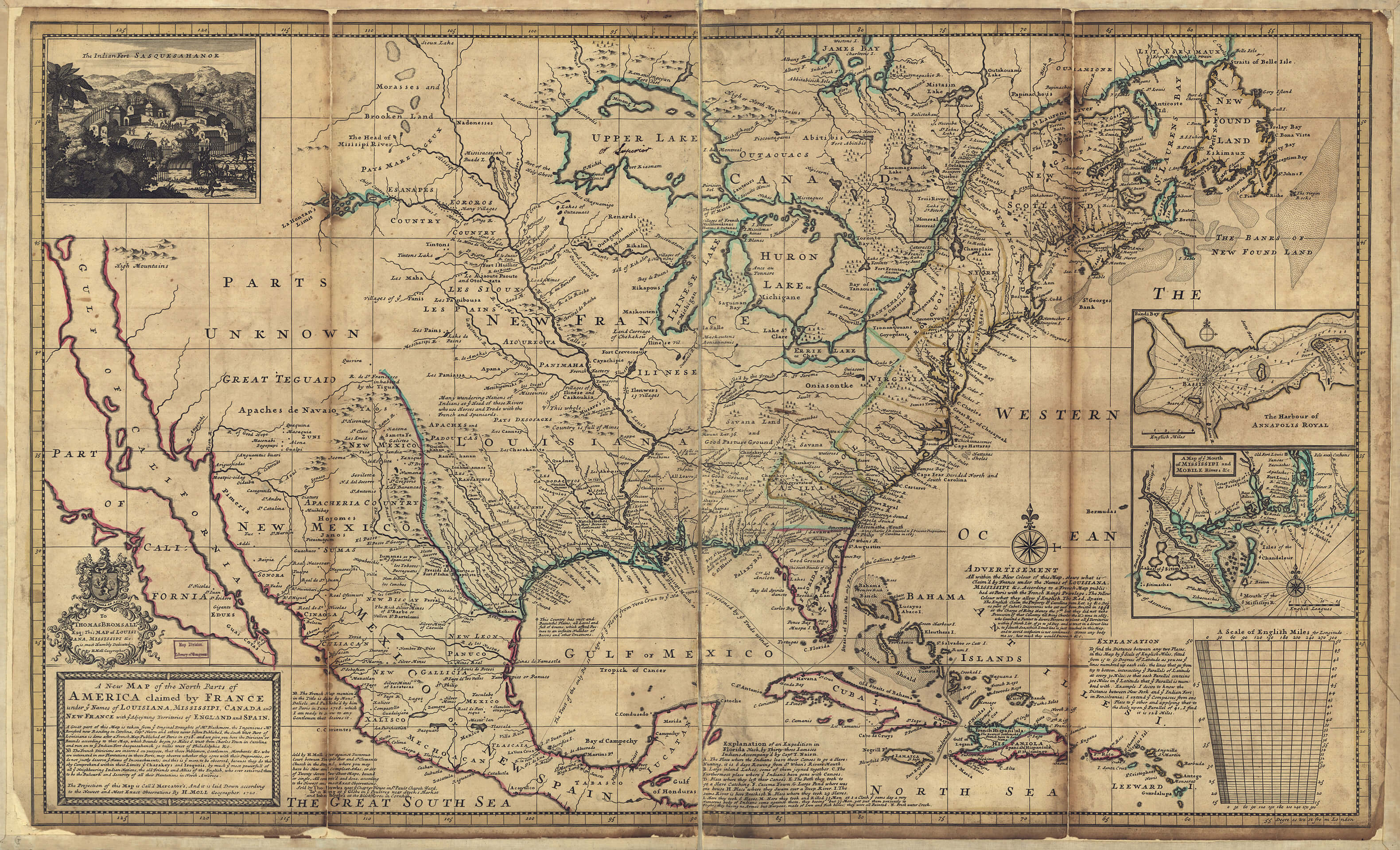
Moll-Map-of-1720-small
Moll’s map of 1720 has “Savannah Old Settlement” at the mouth of the Cumberland, showing that the term Savannah was sometimes applied to the Western as well as to the eastern band
These western Shawnee may possibly be the people mentioned in the Jesuit Relation of 1648, under the name of “Ouchaouanag,” in connection with the Mascoutens, who lived in northern Illinois. In the Relation of 1670 we find the “Chaouanon” mentioned as having visited the Illinois the preceding year, and they are described as living some distance to the south east of the latter. From this period until their removal to the north they are frequently mentioned by the French writers, sometimes under some form of the collective Iroquois name Toagenha, but generally under their Algonquian name Chaouanon. La Harpe, about 1715, called them Tongarois, another form of Toagenha. All these writers concur in the statement that they lived upon a large southern branch of the Ohio, at no great distance east of the Mississippi. This was the Cumberland River of Tennessee and Kentucky, which is called the River of the Shawnee on all the old maps down to about the year 1770.
 
When the French traders first came into the region the Shawnee had their principal village on that river near the present Nashville, Tennessee. They seem also to have ranged northeastward to Kentucky River and southward to the Tennessee. It will thus be seen that they were not isolated from the great body of the Algonquian tribes, as has frequently been represented to have been the case, but simply occupied an interior position, adjoining the kindred Illinois and Miami, with whom they kept up constant communication. As previously mentioned, the early maps plainly distinguish these Shawnee on the Cumberland from the other division of the tribe on Savannah River.

These western Shawnee are mentioned about the year 1672 as being harassed by the Iroquois, and also as allies and neighbors of the Andaste, or Conestoga, who were themselves at war with the Iroquois. As the Andaste were then incorrectly supposed to live on the upper waters of the Ohio River, the Shawnee would naturally be considered their neighbors. The two tribes were probably in alliance against the Iroquois, as we find that when the first body of Shawnee removed from South Carolina to Pennsylvania, about 1678, they settled adjoining the Conestoga, and when another part of the same tribe desired to remove to the Delaware in 1694 permission was granted on condition that they make peace with the Iroquois. Again, in 1684, the Iroquois justified their attacks on the Miami by asserting that the latter had invited the Satanas (Shawnee) into their country to make war upon the Iroquois. This is the first historic mention of the Shawnee evidently the western division in the country north of the Ohio River. As the Cumberland region was out of the usual course of exploration and settlement, but few notices of the western Shawnee are found until 1714, when the French trader Charleville established himself among them near the present Nashville. They were then gradually leaving the country in small bodies in consequence of a war with the Cherokee, their former allies, who were assisted by the Chickasaw. From the statement of Iberville in 1702 8 it seems that this was due to the latter’s efforts to bring them more closely under French influence. It is impossible now to learn the cause of the war between the Shawnee and the Cherokee. It probably did not begin until after 1707, the year of the final expulsion of the Shawnee from South Carolina by the Catawba, as there is no evidence to show that the Cherokee took part in that struggle.

From Shawnee tradition the quarrel with the Chickasaw would seem to be of older date. After the reunion of the Shawnee in the north they secured the alliance of the Delawares, and the two tribes turned against the Cherokee until the latter were compelled to ask peace, when the old friendship was renewed. Soon after the coming of Charleville, in 1714, the Shawnee finally abandoned the Cumberland valley, being pursued to the last moment by the Chickasaw. In a council held at Philadelphia in 1715 with the Shawnee and Delawares, the former, “who live at a great distance,” asked the friendship of the Pennsylvania government. These are evidently the same who about this time were driven from their home on Cumberland river.

To Be Continued Winter 2018
 
Piqua Shawnee Tribe
"Piqua Shawnee"


Wednesday, September 12, 2018

Smithsonian: Museum of The American Indian

Nation to Nation: Treaties Between the United States and American Indian Nations

Exhibit: September 21, 2014–2021
Washington, DC

Muscogee (Creek) bandolier bag, ca. 1814. Alabama. Wool fabric and tassels, silk fabric, dye, glass beads, cotton thread. Photo by Ernest Amoroso, NMAI. (24/4150)

From a young age, most Americans learn about the Founding Fathers, but are told very little about equally important and influential Native diplomats and leaders of Indian Nations. Treaties lie at the heart of the relationship between Indian Nations and the United States, and Nation to Nation: Treaties Between the United States and American Indian Nations is the story of that relationship, including the history and legacy of U.S.–American Indian diplomacy from the colonial period through the present.
Generous support for the exhibition is provided by:
Shakopee Mdewakanton Sioux Community - Bank of America - San Manuel Band of Mission Indians - Interface Media Group
http://www.nmai.si.edu/explore/exhibitions/item/?id=934
Piqua Shawnee
Piqua Shawnee Tribe

Friday, September 7, 2018

The War of 1812 in Alabama and the Creek War, 1813-1814


Causes:
The Federal Road divided the traditional Upper Creeks from more assimilated Lower Creeks.
  • Creek ownership of traditional lands was endangered as land-hungry whites moved across it or settled illegally on it.
  • The British sent Tecumseh, a Shawnee chief, from the Great Lakes to unite all Indians against white Americans and form an alliance with England and Spain.
  • England and Spain incited the Creeks against American settlers and supplied Creeks with guns and ammunition.
Battles raged on the frontier between Creek "Red Sticks" and American militia led by General Andrew Jackson. The last and most famous battle, the Battle of Horseshoe Bend (now a National Military Park) destroyed the strength of the Creek Nation. General Jackson forced the Creeks to sign the Treaty of Fort Jackson, ceding some forty thousand square miles of land to the United States.
Consequences:
  • Foreign influence among Indians was destroyed.
  • United States took Mobile from Spain, the only additional land acquired in War of 1812.
  • The Fort Jackson Treaty, acquiring Creek lands, began a series of forced land-cession treaties by the United States with other southern tribes until all were removed west.
  • General Andrew Jackson became a national hero for defeating the Creeks, a victory that helped pave his way to become President of the United States.

BIBLIOGRAPHY
Halbert, Henry S. and Timothy H. Ball. The Creek War of 1813-1814. 1895. Reprints, edited, with introductions and notes, by Frank L. Owsley Jr., Tuscaloosa: University of Alabama, 1969 and 1995.
In vivid detail, Halbert and Ball recount everything they could find about this conflict. The names of participants (their ancestors and children), locations of battles with full descriptions of gory scenes, and comments on accounts of informants and other writers make this a wonderful source. Students will find textbook accounts of the Fort Mims massacre pale compared to this one. The question of what caused the Creek conflict, whether it was a civil war brought on by factionalism between Lower Creeks and Upper Creeks, is debated.

Holland, James W. Andrew Jackson and the Creek: Victory at the Horseshoe. Tuscaloosa: University of Alabama Press, 1968. Reprint, 1990.
This fifty-page booklet, published to promote Horseshoe Bend National Military Park, offers a concise story of the events that brought an end to the Creek Nation in the South. Students will enjoy this well-illustrated, lively account.

Martin, Joel W. Sacred Revolt: The Muskogees' Struggle for a New World. Boston: Beacon Press, 1991.Martin approaches the history of the Muskogees (Creeks) from a religious point-of-view. According to his theory, their "culture of the sacred" determined how they interacted with and reacted to Europeans and, later, Americans. To support his theory, he discusses their spiritual, economic, and social background. He compares their revolt against the Americans in the Creek War with struggles of other native Americans to retain their traditions. It is an interesting theory that can provide an introduction to the religious beliefs of the Creeks.

Wright, J. Leitch Jr. Creeks and Seminoles: The Destruction and Regeneration of the Muscogulge People. Lincoln: University of Nebraska Press, 1986.

The names Creek and Seminole were attached to the Muscogulge people for the convenience of European and U.S. governments who wanted to address nations. The Muscogulge lived in Georgia, Alabama, and Florida—geographically close, but not unified under one leader. Although some had ancient common origins, many spoke different languages and often could not understand each other. Wright explains the background of the Muscogulges and describes their culture in language readily understood. He defines words that he believes might be unfamiliar to the general reader. He elaborates on familiar topics such as trade, relations with European powers and the U.S. government, the Creek Wars with Andrew Jackson and his pursuit of the survivors into Florida, and finally removal, dispersal, and survival. This book is an enlightening inside view of the Muscogulges' heroic struggle for survival; it is also an indictment of the U.S. Government.

Piqua Shawnee
Piqua Shawnee Tribe

http://www.archives.alabama.gov/results.html?q=shawnee

Wednesday, September 5, 2018

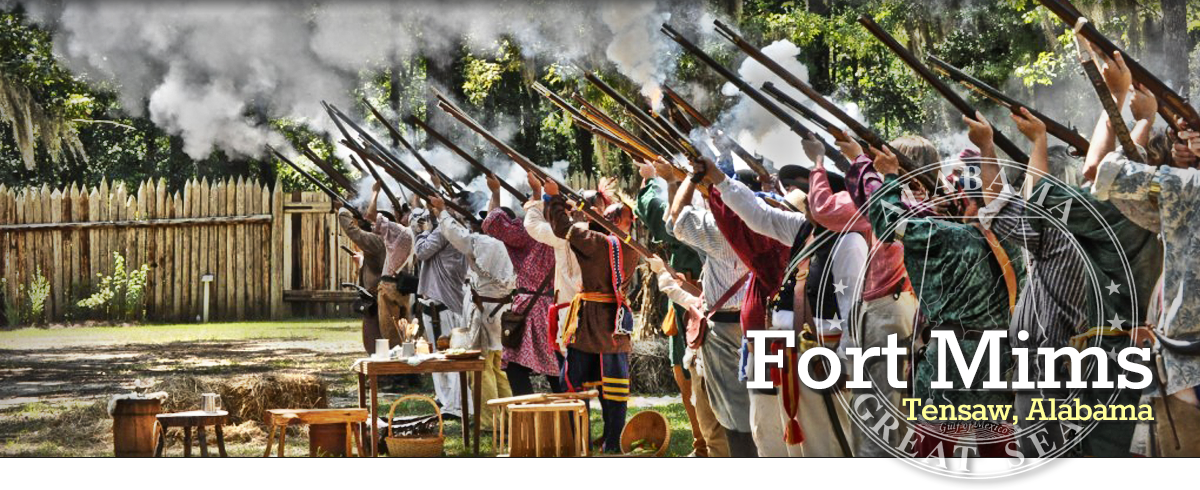
Fort Mims: Tensaw Alabama

Alabama Historical Commission
NATIONAL REGISTER OF HISTORIC PLACES
ahc-ftmims
The Fort Mims site commemorates the battle that led to the Creek War of 1813-14.
On August 30, 1813 over 700 Creek Indians destroyed Fort Mims. American settlers, U.S. allied Creeks, and enslaved African Americans had sought refuge in the stockade. The Creek warriors who carried out the attack were members of the Red Stick faction named for the red wooden war clubs they carried. Their assault on Fort Mims is considered one of the greatest successes of Indian warfare.
The Alabama Historical Commission owns this historic site. The Fort Mims Restoration Association is the support group in charge of operating the site.
Visit
https://ahc.alabama.gov/properties/ftmims/ftmims.aspx

Piqua Shawnee
Piqua Shawnee Tribe

ahc-header-logo2

Thursday, August 23, 2018

The Piqua Shawnee Tribe


Visit the State of Alabama Indian Affairs Commission website for more information

http://aiac.state.al.us/tribes_piquaShawnee.aspx

Early History
The state of Alabama has long been the home of many Shawnee people. In fact, some historians state that perhaps the Shawnee people have inhabited Alabama for a longer period of time than any other geographic region. Some archaeologists set the date of 1685 as the first evidence of Shawnee settlement in Alabama. However, oral tradition states that we have been here much longer than that. Ancient burial sites that use burial methods common to the Shawnee have been located in several sections of the state. Early accounts can be confusing since what is now called Alabama was once a part of Georgia territory. Several early maps show Shawnee settlements in what is now called Alabama.

Early French and English maps show several Shawnee towns in what would be considered Upper Creek territory in Alabama. Some of the most notable were near modern Alabama towns. One village was near present day Talladega and was known in English as Shawnee Town. Another town was near Sylacauga. In 1750 the French took a census mentioning the Shawnee at Sylacauga as well as enumerating another Shawnee town called Cayomulgi, (currently spelled Kyamulga town) that was located nearby. Kiamulgatown was also listed in an 1832 census. A 1761 English census names Tallapoosa Town. This town was also named in a 1792 census by Marbury. There are French military records that mention a Shawnee presence at Wetumpka near Fort Toulouse. In most cases the traders called Alabama Indians “Creeks” because they lived on the numerous creeks and waterways in the area. Many of these “Creeks” were not of the same tribe or nation. Rather they went by a large number of names. Each group maintained their own unique heritage while living side by side with their neighbors.

Piqua Shawnee

Piqua Shawnee Tribe